MRC Centre for Synaptic Plasticity, School of Physiology and Pharmacology, University of Bristol, University Walk, Bristol BS8 1TD, UK.
Neural Plast. 2011;2011:960389. doi: 10.1155/2011/960389. Epub 2011 Sep 27.
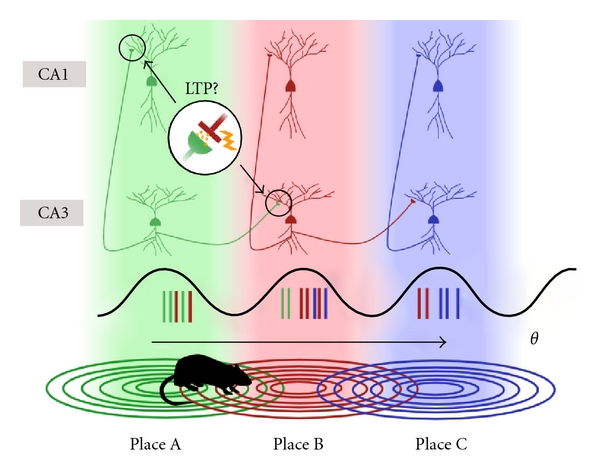
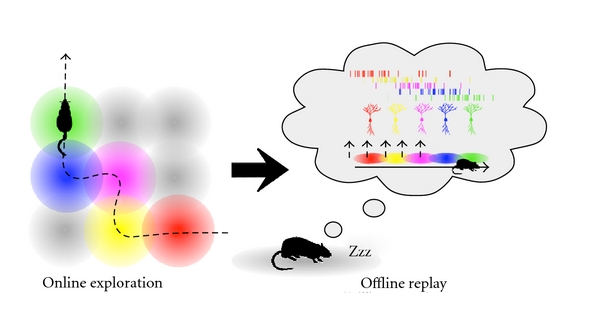
Establishing novel episodic memories and stable spatial representations depends on an exquisitely choreographed, multistage process involving the online encoding and offline consolidation of sensory information, a process that is largely dependent on the hippocampus. Each step is influenced by distinct neural network states that influence the pattern of activation across cellular assemblies. In recent years, the occurrence of hippocampal sharp wave ripple (SWR) oscillations has emerged as a potentially vital network phenomenon mediating the steps between encoding and consolidation, both at a cellular and network level by promoting the rapid replay and reactivation of recent activity patterns. Such events facilitate memory formation by optimising the conditions for synaptic plasticity to occur between contingent neural elements. In this paper, we explore the ways in which SWRs and other network events can bridge the gap between spatiomnemonic processing at cellular/synaptic and network levels in the hippocampus.
建立新的情景记忆和稳定的空间表示依赖于一个精心编排的、多阶段的过程,涉及在线编码和离线巩固感觉信息,这个过程在很大程度上依赖于海马体。每个步骤都受到不同的神经网络状态的影响,这些状态影响着细胞集合中激活模式的模式。近年来,海马体尖波涟漪(SWR)振荡的发生已经成为一种潜在的重要网络现象,通过促进最近活动模式的快速重演和再激活,在细胞和网络水平上调节编码和巩固之间的步骤。这种事件通过优化偶发神经元素之间突触可塑性发生的条件来促进记忆形成。在本文中,我们探讨了 SWR 和其他网络事件如何在海马体的细胞/突触和网络水平的空间记忆处理之间架起桥梁。