Brain and Behavior Laboratory, Nathan Kline Institute for Psychiatric Research, Orangeburg, NY 10962, USA.
Neuroimage. 2012 Feb 1;59(3):2316-21. doi: 10.1016/j.neuroimage.2011.09.037. Epub 2011 Sep 22.
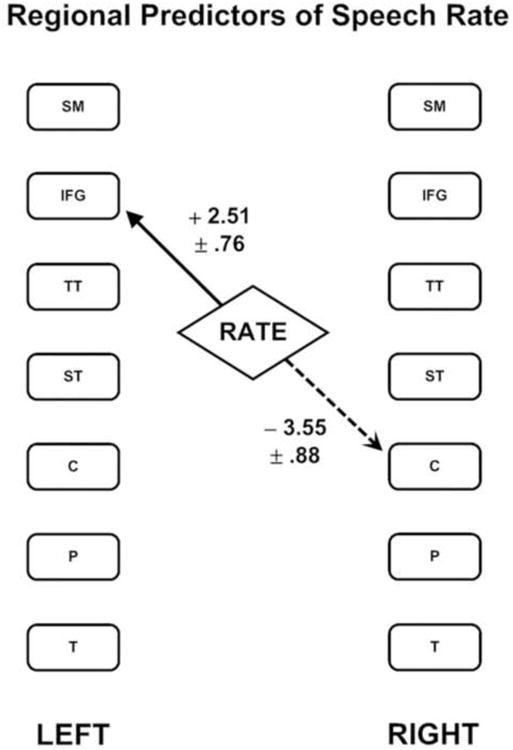
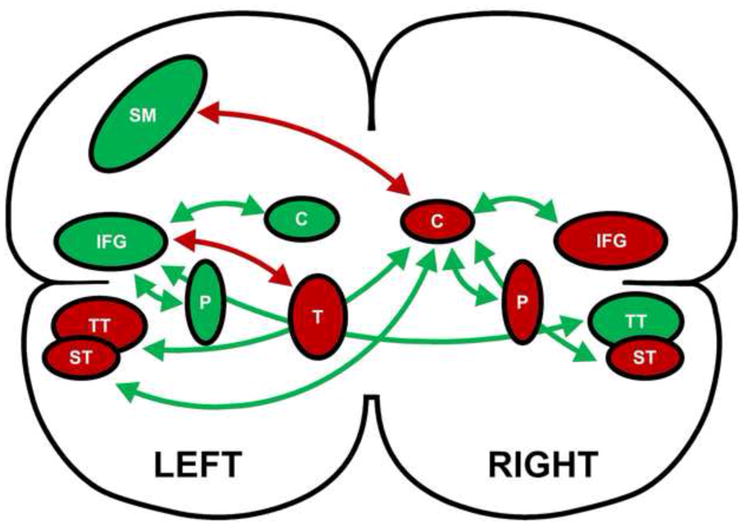
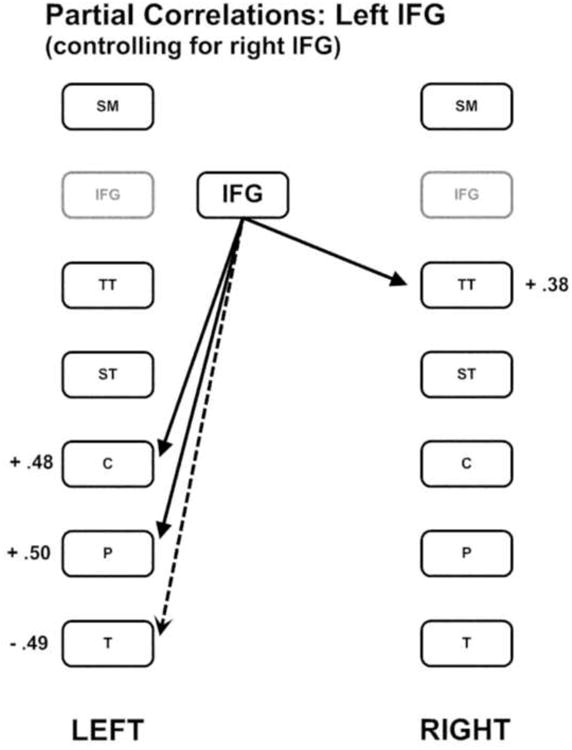
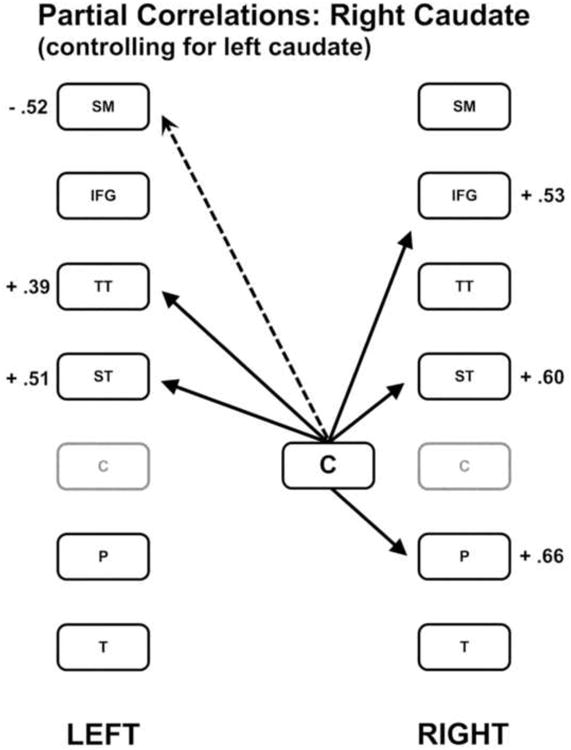
Connectivity analyses have become increasingly important in functional imaging. When used to describe the functional anatomy of a specific behavior, these analyses are generally applied to a subset of the data that demonstrate significant differences when experimental conditions are contrasted. Such data reduction is sub-optimal for a systems approach as it assumes that all data that survive the statistical contrast filter are related to the behavior and that none of the filtered data has a significant function. When such data filtering is applied to speech and language tasks, the resulting functional anatomy rarely reflects the brain lateralization established in over a century and a half of clinical studies. A two-step performance-based connectivity analysis is described in which the first step uses multiple linear regression to establish a direct relationship between regional brain activity and a measure of performance. The second step uses partial correlations to examine the functional relationships between the predictor regions and other brain regions. When applied to regional cerebral blood flow data obtained with positron emission tomography during a speech production task, the results demonstrate left lateralization of motor control areas, thalamic involvement in repetition rate, and auditory cortical suppression, all consistent with clinical observations. The integration of performance measures into the earliest stages of image analysis without reliance on data filtering based on decomposition may provide a path toward convergence with traditional descriptions of functional anatomy based on clinical studies.
连通性分析在功能成像中变得越来越重要。当用于描述特定行为的功能解剖结构时,这些分析通常应用于显示实验条件对比时存在显著差异的数据集的子集。这种数据减少对于系统方法来说是不理想的,因为它假设所有通过统计对比滤波器幸存的数据都与行为有关,并且没有任何过滤后的数据具有重要功能。当这种数据过滤应用于言语和语言任务时,得到的功能解剖结构很少反映出在超过一个半世纪的临床研究中建立的大脑侧化。描述了一种两步基于性能的连通性分析方法,其中第一步使用多元线性回归在区域脑活动和性能度量之间建立直接关系。第二步使用偏相关来检查预测区域与其他脑区域之间的功能关系。当应用于正电子发射断层扫描在言语产生任务期间获得的局部脑血流数据时,结果表明运动控制区域的左侧化、重复率的丘脑参与以及听觉皮质的抑制,所有这些都与临床观察一致。将性能度量集成到图像分析的最早阶段,而不依赖于基于分解的数据过滤,可以为与基于临床研究的传统功能解剖描述的融合提供一条途径。