Department of Radiology and Biomedical Research Imaging Center, University of North Carolina at Chapel Hill, Chapel Hill, North Carolina, United States of America.
PLoS One. 2011;6(9):e25278. doi: 10.1371/journal.pone.0025278. Epub 2011 Sep 23.
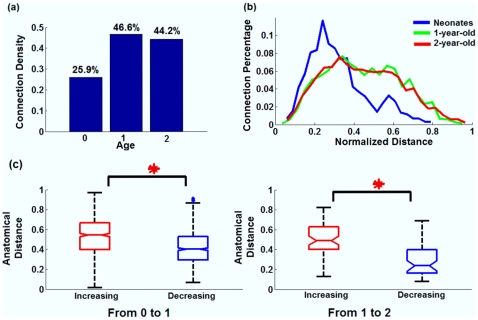
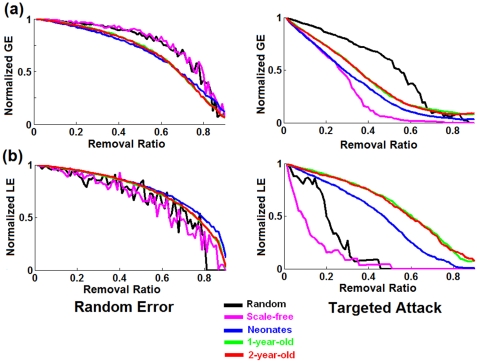
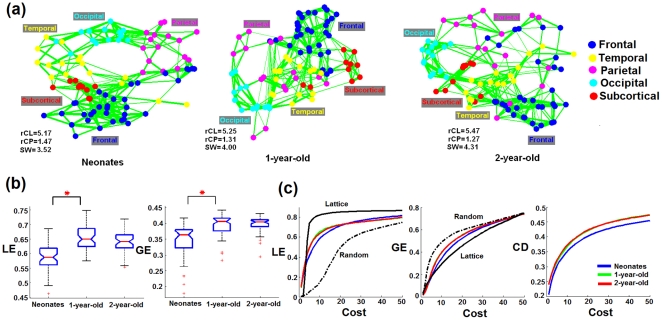
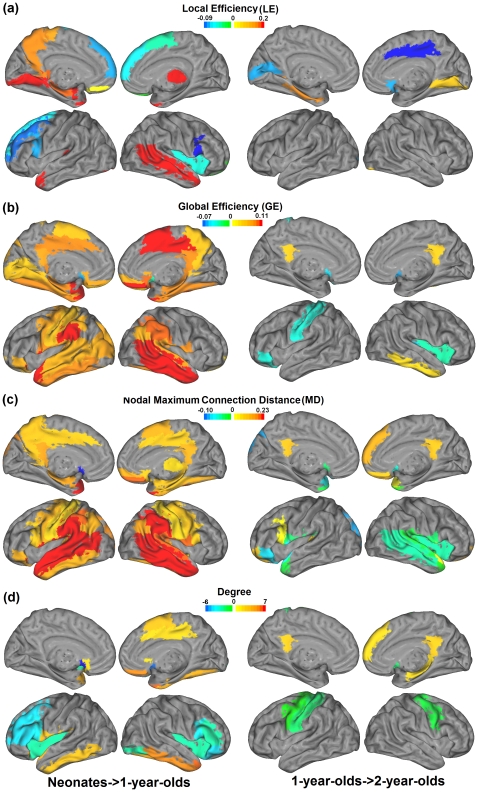
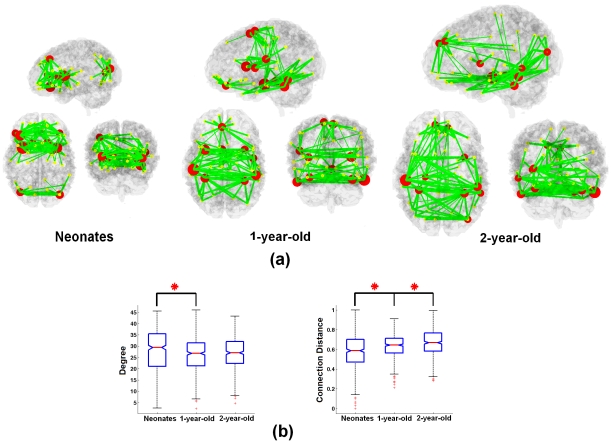
The mature brain features high wiring efficiency for information transfer. However, the emerging process of such an efficient topology remains elusive. With resting state functional MRI and a large cohort of normal pediatric subjects (n = 147) imaged during a critical time period of brain development, 3 wk- to 2 yr-old, the temporal and spatial evolution of brain network topology is revealed. The brain possesses the small world topology immediately after birth, followed by a remarkable improvement in whole brain wiring efficiency in 1 yr olds and becomes more stable in 2 yr olds. Regional developments of brain wiring efficiency and the evolution of functional hubs suggest differential development trend for primary and higher order cognitive functions during the first two years of life. Simulations of random errors and targeted attacks reveal an age-dependent improvement of resilience. The lower resilience to targeted attack observed in 3 wk old group is likely due to the fact that there are fewer well-established long-distance functional connections at this age whose elimination might have more profound implications in the overall efficiency of information transfer. Overall, our results offer new insights into the temporal and spatial evolution of brain topology during early brain development.
成熟大脑在信息传递方面具有很高的布线效率。然而,这种高效拓扑结构的新兴过程仍然难以捉摸。利用静息态功能磁共振成像和一大群正常儿科受试者(n=147)在大脑发育的关键时期进行成像(3 周到 2 岁),揭示了大脑网络拓扑结构的时间和空间演变。大脑在出生后立即具有小世界拓扑结构,随后在 1 岁时整个大脑布线效率显著提高,并在 2 岁时变得更加稳定。脑布线效率的区域发展和功能枢纽的演变表明,在生命的头两年,初级和高级认知功能的发展趋势存在差异。随机错误和有针对性攻击的模拟揭示了弹性的年龄依赖性提高。在 3 周大的组中观察到的针对攻击的弹性较低,可能是由于在这个年龄,已经建立的长距离功能连接较少,其消除可能对信息传递的整体效率产生更深远的影响。总的来说,我们的研究结果为早期大脑发育过程中大脑拓扑结构的时间和空间演变提供了新的见解。