School of Economics and Finance, Yeungnam University 280 Daehak-ro Kyungsan-si, Kyungbuk 712-749 Korea.
Int J Equity Health. 2011 Oct 3;10:41. doi: 10.1186/1475-9276-10-41.
In addition to economic inequalities, there has been growing concern over socioeconomic inequalities in health across income levels and/or regions. This study measures income-related health inequalities within and between regions and assesses the possibility of convergence of socioeconomic inequalities in health as regional incomes converge.
We considered a total of 45,233 subjects (≥ 19 years) drawn from the four waves of the Korean National Health and Nutrition Examination Survey (KNHANES). We considered true health as a latent variable following a lognormal distribution. We obtained ill-health scores by matching self-rated health (SRH) to its distribution and used the Gini Coefficient (GC) and an income-related ill-health Concentration Index (CI) to examine inequalities in income and health, respectively.
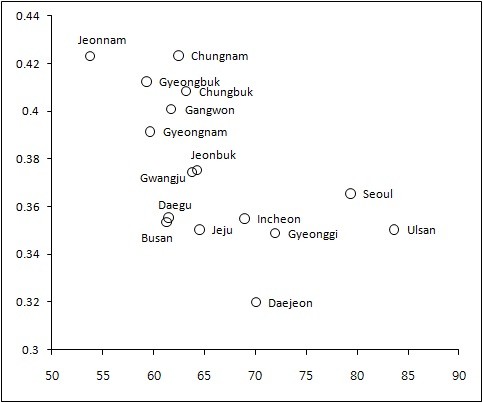
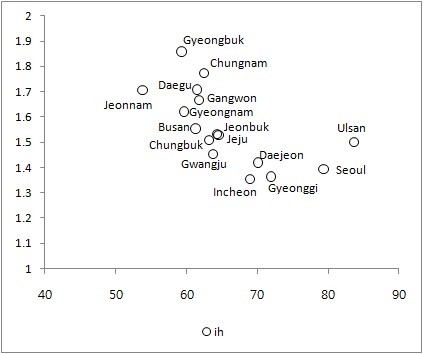
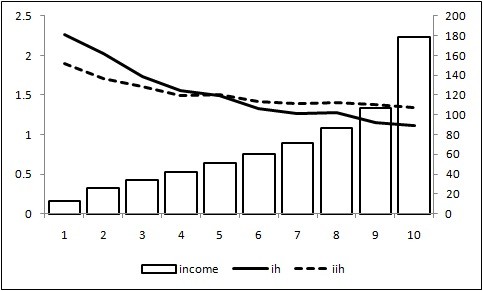
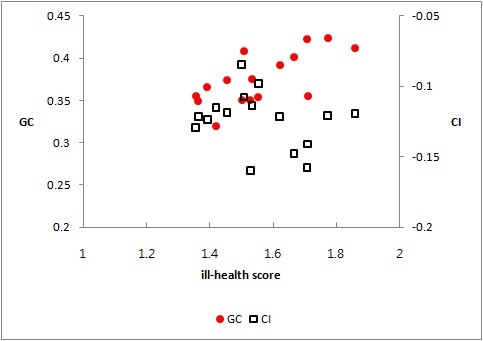
The GC estimates were 0.3763 and 0.0657 for overall and spatial inequalities, respectively. The overall CI was -0.1309, and the spatial CI was -0.0473. The spatial GC and CI estimates were smaller than their counterparts, indicating substantial inequalities in income (from 0.3199 in Daejeon to 0.4233 Chungnam) and income-related health inequalities (from -0.1596 in Jeju and -0.0844 in Ulsan) within regions.The results indicate a positive relationship between the GC and the average ill-health and a negative relationship between the CI and the average ill-health. Those regions with a low level of health tended to show an unequal distribution of income and health. In addition, there was a negative relationship between the GC and the CI, that is, the larger the income inequalities, the larger the health inequalities were. The GC was negatively related to the average regional income, indicating that an increase in a region's average income reduced income inequalities in the region. On the other hand, the CI showed a positive relationship, indicating that an increase in a region's average income reduced health inequalities in the region.
The results suggest that reducing health inequalities across regions require a more equitable distribution of income and a higher level of average income and that the higher the region's average income, the smaller its health inequalities are.
除了经济不平等之外,人们越来越关注收入水平和/或地区之间的健康的社会经济不平等。本研究衡量了区域内和区域之间与收入相关的健康不平等,并评估了随着区域收入趋同,健康的社会经济不平等趋同的可能性。
我们共考虑了来自韩国国家健康和营养检查调查(KNHANES)的四波调查中的 45233 名(≥19 岁)的受试者。我们将真实健康视为遵循对数正态分布的潜在变量。我们通过将自评健康(SRH)与分布相匹配来获得健康不良评分,并分别使用基尼系数(GC)和与收入相关的健康不良集中指数(CI)来检查收入和健康方面的不平等。
GC 估计值分别为整体不平等和空间不平等的 0.3763 和 0.0657。整体 CI 为-0.1309,空间 CI 为-0.0473。空间 GC 和 CI 估计值较小,表明区域内收入(从大田的 0.3199 到忠南的 0.4233)和与收入相关的健康不平等(从济州的-0.1596 到蔚山的-0.0844)存在巨大差异。结果表明,GC 与平均健康不良呈正相关,CI 与平均健康不良呈负相关。健康水平较低的地区往往表现出收入和健康的不平等分配。此外,GC 与 CI 之间存在负相关关系,即收入不平等越大,健康不平等越大。GC 与区域平均收入呈负相关,表明区域平均收入的增加降低了区域内的收入不平等。另一方面,CI 呈正相关,表明区域平均收入的增加降低了区域内的健康不平等。
研究结果表明,减少区域间的健康不平等需要更公平的收入分配和更高的平均收入,并且区域平均收入越高,其健康不平等程度就越小。