Réus Gislaine Z, Stringari Roberto B, Gonçalves Cinara L, Scaini Giselli, Carvalho-Silva Milena, Jeremias Gabriela C, Jeremias Isabela C, Ferreira Gabriela K, Streck Emílio L, Hallak Jaime E, Zuardi Antônio W, Crippa José A, Quevedo João
Laboratório de Neurociências and Instituto Nacional de Ciência e Tecnologia Translacional em Medicina (INCT-TM), Programa de Pós-Graduação em Ciências da Saúde, Unidade Acadêmica de Ciências da Saúde, Universidade do Extremo Sul Catarinense, 88806-000 Criciúma, SC, Brazil.
Depress Res Treat. 2012;2012:987397. doi: 10.1155/2012/987397. Epub 2011 Sep 29.
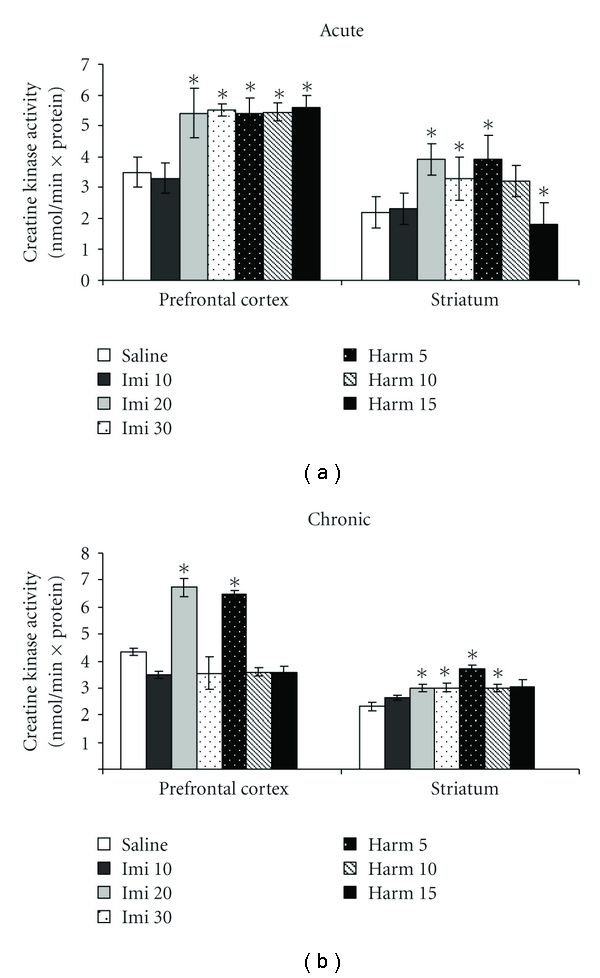
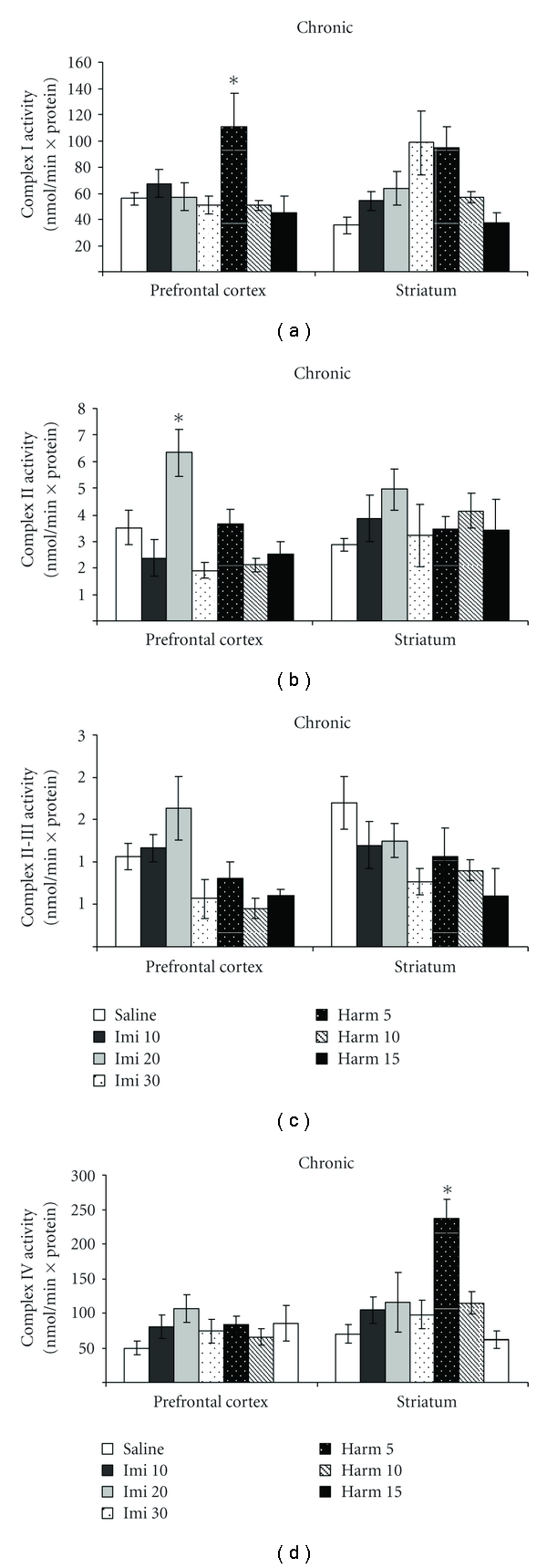
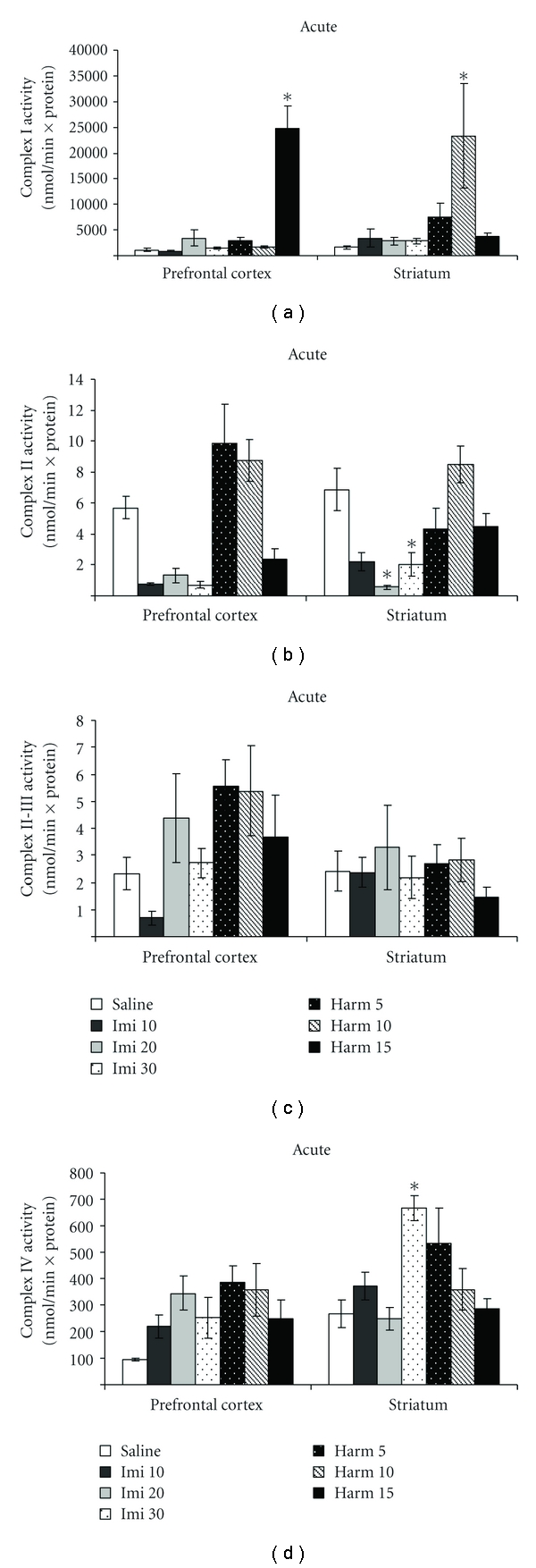
The present study evaluated mitochondrial respiratory chain and creatine kinase activities after administration of harmine (5, 10, and 15 mg/kg) and imipramine (10, 20, and 30 mg/kg) in rat brain. After acute treatment occurred an increase of creatine kinase in the prefrontal with imipramine (20 and 30 mg/kg) and harmine in all doses, in the striatum with imipramine (20 and 30 mg/kg) and harmine (5 and 10 mg/kg); harmine (15 mg/kg) decreased creatine kinase. In the chronic treatment occurred an increase of creatine kinase with imipramine (20 mg/kg), harmine (5 mg/kg) in the prefrontal with imipramine (20 and 30 mg/kg) and harmine (5 and 10 mg/kg) in the striatum. In the acute treatment, the complex I increased in the prefrontal with harmine (15 mg/kg) and in the striatum with harmine (10 mg/kg); the complex II decreased with imipramine (20 and 30 mg/kg) in the striatum; the complex IV increased with imipramine (30 mg/kg) in the striatum. In the chronic treatment, the complex I increased with harmine (5 mg/kg) in the prefrontal; the complex II increased with imipramine (20 mg/kg) in the prefrontal; the complex IV increased with harmine (5 mg/kg) in the striatum. Finally, these findings further support the hypothesis that harmine and imipramine could be involved in mitochondrial function.
本研究评估了在大鼠脑中给予 harmine(5、10 和 15mg/kg)和丙咪嗪(10、20 和 30mg/kg)后线粒体呼吸链和肌酸激酶的活性。急性治疗后,丙咪嗪(20 和 30mg/kg)和所有剂量的 harmine 使前额叶肌酸激酶增加,丙咪嗪(20 和 30mg/kg)和 harmine(5 和 10mg/kg)使纹状体肌酸激酶增加;harmine(15mg/kg)使肌酸激酶降低。慢性治疗时,丙咪嗪(20mg/kg)、harmine(5mg/kg)使前额叶肌酸激酶增加,丙咪嗪(20 和 30mg/kg)和 harmine(5 和 10mg/kg)使纹状体肌酸激酶增加。急性治疗中,harmine(15mg/kg)使前额叶复合体 I 增加,harmine(10mg/kg)使纹状体复合体 I 增加;丙咪嗪(20 和 30mg/kg)使纹状体复合体 II 降低;丙咪嗪(30mg/kg)使纹状体复合体 IV 增加。慢性治疗时,harmine(5mg/kg)使前额叶复合体 I 增加;丙咪嗪(20mg/kg)使前额叶复合体 II 增加;harmine(5mg/kg)使纹状体复合体 IV 增加。最后,这些发现进一步支持了 harmine 和丙咪嗪可能参与线粒体功能的假说。