Balasubramaniam Sudharsanam M, Krishnakumar J, Stephen Thattiparthi, Gaur Rashmi, Appavoo Nc
Department of Community Medicine, Sree Balaji Medical College and Hospital, Chromepet, Chennai, Tamil Nadu, India.
Indian J Community Med. 2011 Apr;36(2):124-7. doi: 10.4103/0970-0218.84131.
The outbreak of Chikungunya in India started during December 2005 with more than 11,00,000 cases. Many cases with symptoms suggestive of Chikungunya reported to our urban health-training centre. Hence this study was done to estimate the prevalence of Chikungunya, to study the common treatment-seeking behavior, control measures and the sequalae of Chikungunya by follow-up.
This cross-sectional study was done in Anagaputhur an urban field practice area of our college. The study was done on a sample selected by systematic random sampling. Any person with fever and joint pain, with an onset from 1 August 2006 to 31 August 2006, were enrolled as cases. The cases were followed up after three months.
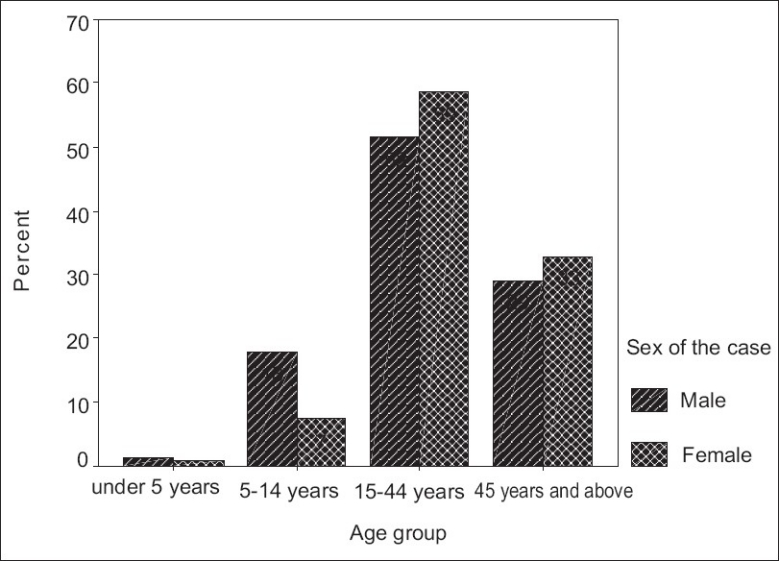
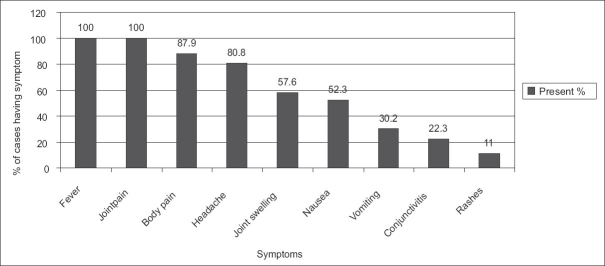
Chikungunya prevalence in the community was 22.3%; 52% of them were females and 56% of cases were in the 15-44 years age group. Median duration of acute phase was three days. Ninety-one percent of them had multiple joints' involvement. Seventy-eight percent sought treatment from the private sector. Sixty-seven percent reported artificial collections of water around their household and 44% complained of mosquito problems during the day. Eighty-eight percent used mosquito repellents for personal protection. On follow-up 95% of them had residual joint pain, 43% had residual joint swelling and 11% had disabilities with median duration of 30 days.
Prevalence of Chikungunya was 22.3%, predominantly affecting the age group of 15-44 years and females. The private sector was commonly sought for treatment. Entomological survey indicated Aedes breeding. Eleven percent had disabilities due to the sequelae.
2005年12月印度开始爆发基孔肯雅热,病例超过110万例。许多疑似基孔肯雅热症状的病例向我们城市健康培训中心报告。因此开展本研究以评估基孔肯雅热的患病率,研究常见的求医行为、控制措施以及通过随访了解基孔肯雅热的后遗症。
本横断面研究在我校城市野外实习区阿纳加普图尔进行。研究采用系统随机抽样选取样本。2006年8月1日至8月31日发病的发热伴关节疼痛者纳入病例组。对病例进行了三个月的随访。
社区中基孔肯雅热患病率为22.3%;其中52%为女性,56%的病例年龄在15 - 44岁组。急性期的中位持续时间为三天。91%的患者有多关节受累。78%的患者在私立部门寻求治疗。67%的患者报告其家庭周围有人造积水,44%的患者抱怨白天有蚊虫问题。88%的患者使用驱蚊剂进行个人防护。随访时,95%的患者有残留关节疼痛,43%的患者有残留关节肿胀,11%的患者有残疾,中位持续时间为30天。
基孔肯雅热患病率为22.3%,主要影响15 - 44岁年龄组和女性。患者通常在私立部门寻求治疗。昆虫学调查表明存在伊蚊繁殖。11%的患者因后遗症而残疾。