Department of Biophysics, School of Life Science and Technology, University of Electronic Science and Technology of China, Chengdu, Sichuan, People's Republic of China.
Int J Nanomedicine. 2011;6:2023-32. doi: 10.2147/IJN.S24792. Epub 2011 Sep 19.
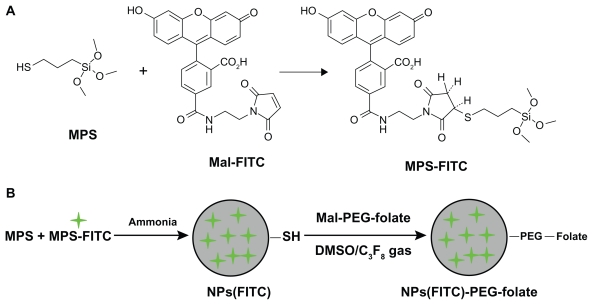
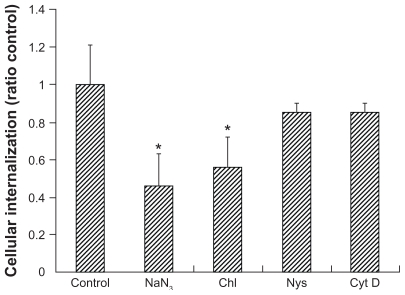
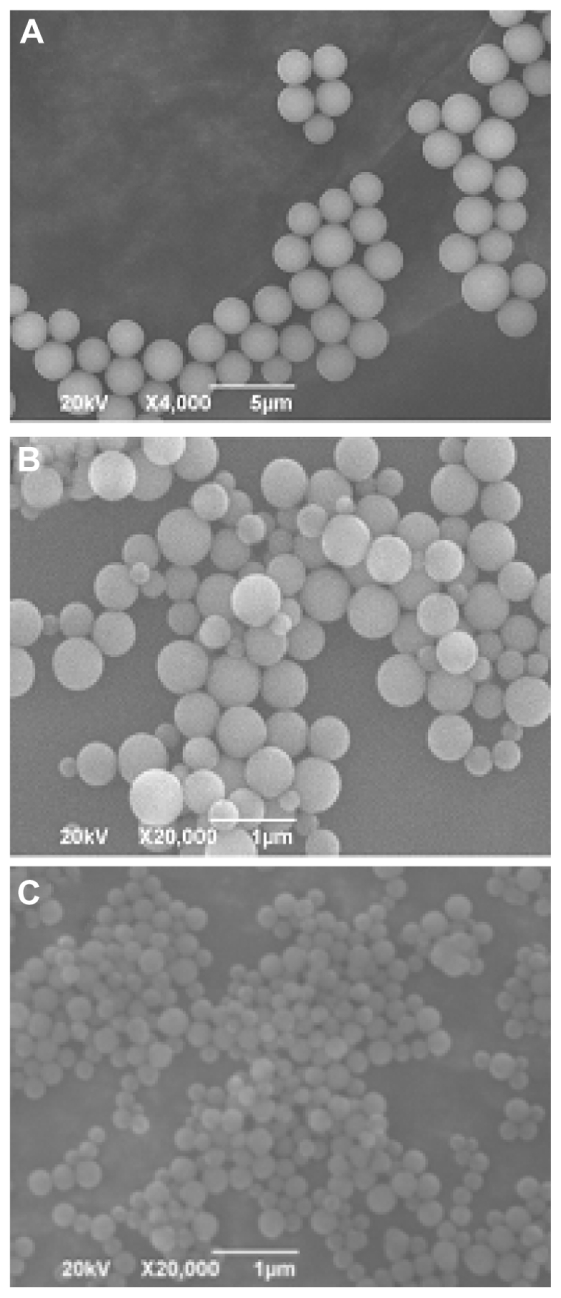
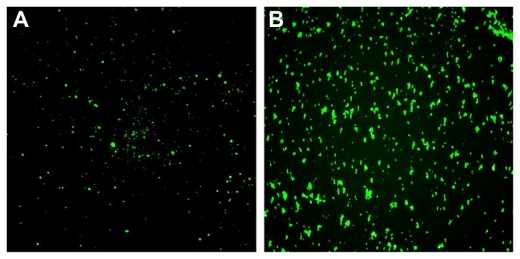
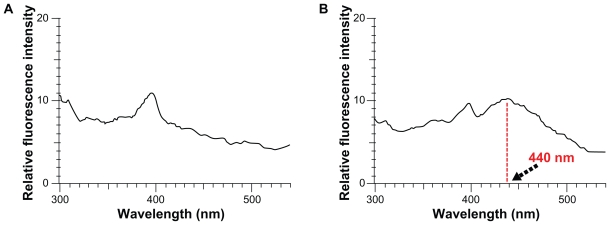
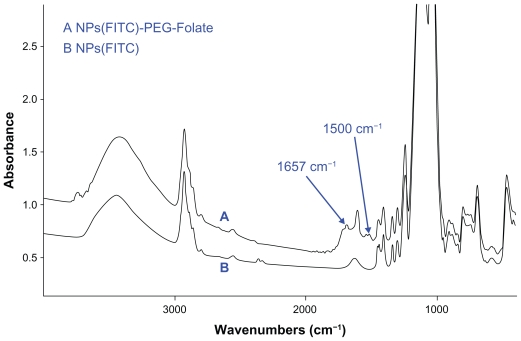
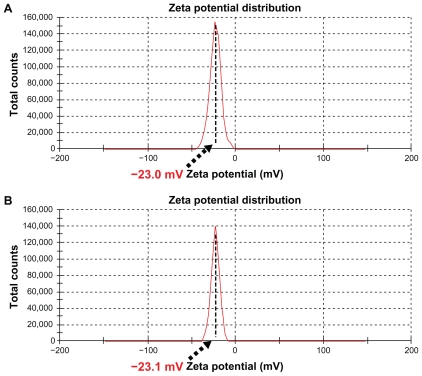
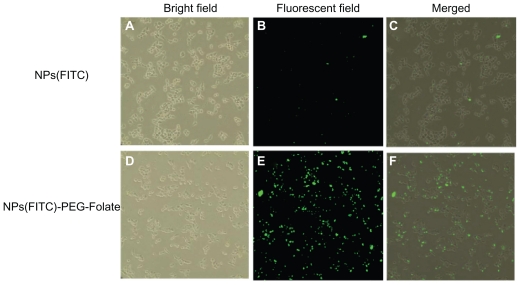
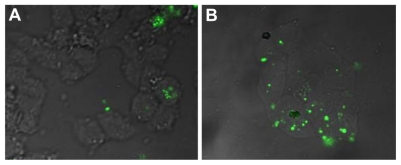
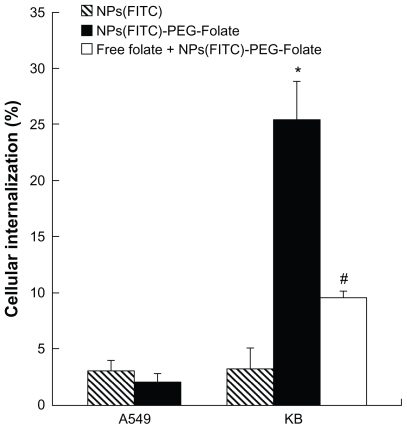
Multifunctionalized nanoparticles (NPs) are emerging as ideal tools for gene/drug delivery, bioimaging, labeling, or intracellular tracking in biomedical applications, and have attracted considerable attention owing to their unique advantages. In this study, fluorescent silica NPs were synthesized by a modified Stöber method using conjugates of 3-mercaptopropyltrimethoxysilane (MPS) and maleimide-fluorescein isothiocyanate (maleimide-FITC). Mean diameters of the NPs were controlled between 212-2111 nm by regulating MPS concentration in the reaction mixture. Maleimide-FITC molecules were doped into NPs or conjugated to the surface of NPs through the chemical reaction of maleimide and thiol groups. The data showed that the former NPs are better than the latter by comparing their fluorescence intensity. Furthermore, folate molecules were linked to the FITC-doped silica NPs by using polyethylene glycol (PEG) (NH2-PEG-maleimide) as a spacer, thus forming folate receptor targeting fluorescent NPs, referred to as NPs(FITC)-PEG-Folate. The quantitative analysis of cellular internalization into different cancer cells showed that the delivery efficiency of KB cells (folate receptor-positive cells) is more than six-fold higher than that of A549 cells (folate receptor-negative cells). The delivery efficiency of KB cells decreased significantly after free folate addition to the cell culture medium because the folate receptors were occupied by the free folate. The NPs endocytosis mechanism was also investigated. It was shown that clathrin, an inhibitor of cell phagocytosis, markedly decreased the NPs uptake into KB cells, suggesting that it plays an important role in NPs cellular internalization. These results demonstrated that the novel particles of NPs(FITC)-PEG-Folate are promising for fluorescent imaging or targeting delivery to folate receptor-positive tumors.
多功能化纳米粒子(NPs)作为基因/药物传递、生物成像、标记或细胞内追踪的理想工具,在生物医学应用中引起了相当大的关注,这是由于它们具有独特的优势。在本研究中,通过使用 3-巯基丙基三甲氧基硅烷(MPS)和马来酰亚胺-荧光素异硫氰酸酯(马来酰亚胺-FITC)的缀合物,采用改良的 Stöber 法合成了荧光硅纳米粒子。通过调节反应混合物中 MPS 的浓度,控制 NPs 的平均直径在 212-2111nm 之间。马来酰亚胺-FITC 分子通过马来酰亚胺和巯基之间的化学反应被掺杂到 NPs 中或被接枝到 NPs 的表面。通过比较荧光强度,数据表明前者比后者更好。此外,通过使用聚乙二醇(PEG)(NH2-PEG-马来酰亚胺)作为间隔物,将叶酸分子连接到 FITC 掺杂的硅纳米粒子上,从而形成叶酸受体靶向荧光 NPs,称为 NPs(FITC)-PEG-叶酸。不同癌细胞内吞作用的定量分析表明,KB 细胞(叶酸受体阳性细胞)的递送效率是 A549 细胞(叶酸受体阴性细胞)的六倍以上。当细胞培养液中添加游离叶酸时,KB 细胞的递送效率显著降低,因为游离叶酸占据了叶酸受体。还研究了 NPs 的内吞作用机制。结果表明,网格蛋白,一种细胞吞噬抑制剂,显著降低了 KB 细胞对 NPs 的摄取,表明其在 NPs 细胞内化中起着重要作用。这些结果表明,新型 NPs(FITC)-PEG-叶酸粒子有望用于荧光成像或靶向递送至叶酸受体阳性肿瘤。