Chomutare Taridzo, Fernandez-Luque Luis, Arsand Eirik, Hartvigsen Gunnar
Norwegian Centre for Integrated Care and Telemedicine, University Hospital of North Norway, Tromsø, Norway.
J Med Internet Res. 2011 Sep 22;13(3):e65. doi: 10.2196/jmir.1874.
Interest in mobile health (mHealth) applications for self-management of diabetes is growing. In July 2009, we found 60 diabetes applications on iTunes for iPhone; by February 2011 the number had increased by more than 400% to 260. Other mobile platforms reflect a similar trend. Despite the growth, research on both the design and the use of diabetes mHealth applications is scarce. Furthermore, the potential influence of social media on diabetes mHealth applications is largely unexplored.
Our objective was to study the salient features of mobile applications for diabetes care, in contrast to clinical guideline recommendations for diabetes self-management. These clinical guidelines are published by health authorities or associations such as the National Institute for Health and Clinical Excellence in the United Kingdom and the American Diabetes Association.
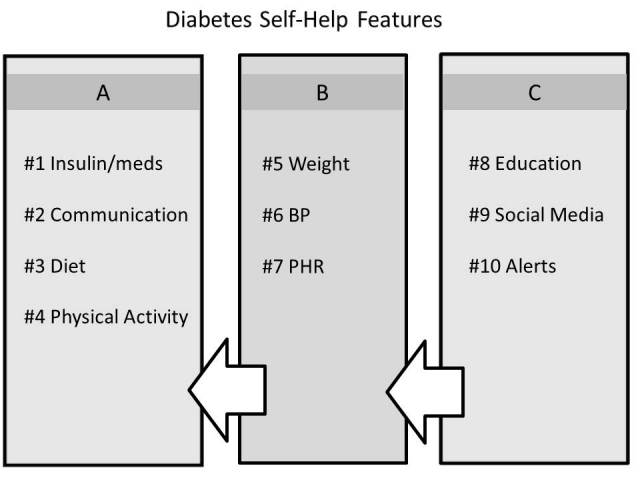
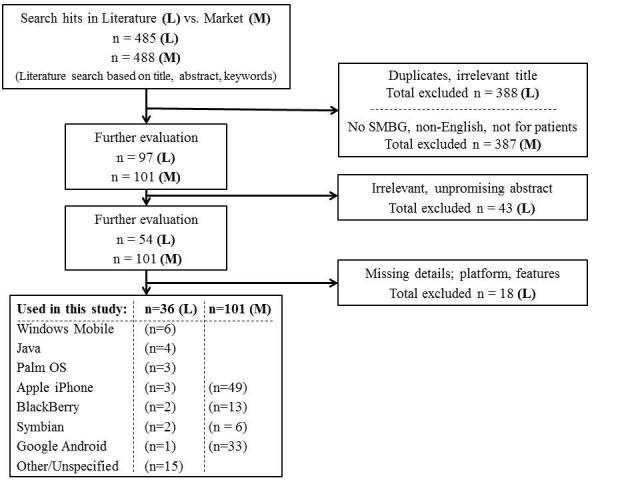
We searched online vendor markets (online stores for Apple iPhone, Google Android, BlackBerry, and Nokia Symbian), journal databases, and gray literature related to diabetes mobile applications. We included applications that featured a component for self-monitoring of blood glucose and excluded applications without English-language user interfaces, as well as those intended exclusively for health care professionals. We surveyed the following features: (1) self-monitoring: (1.1) blood glucose, (1.2) weight, (1.3) physical activity, (1.4) diet, (1.5) insulin and medication, and (1.6) blood pressure, (2) education, (3) disease-related alerts and reminders, (4) integration of social media functions, (5) disease-related data export and communication, and (6) synchronization with personal health record (PHR) systems or patient portals. We then contrasted the prevalence of these features with guideline recommendations.
The search resulted in 973 matches, of which 137 met the selection criteria. The four most prevalent features of the applications available on the online markets (n = 101) were (1) insulin and medication recording, 63 (62%), (2) data export and communication, 61 (60%), (3) diet recording, 47 (47%), and (4) weight management, 43 (43%). From the literature search (n = 26), the most prevalent features were (1) PHR or Web server synchronization, 18 (69%), (2) insulin and medication recording, 17 (65%), (3) diet recording, 17 (65%), and (4) data export and communication, 16 (62%). Interestingly, although clinical guidelines widely refer to the importance of education, this is missing from the top functionalities in both cases.
While a wide selection of mobile applications seems to be available for people with diabetes, this study shows there are obvious gaps between the evidence-based recommendations and the functionality used in study interventions or found in online markets. Current results confirm personalized education as an underrepresented feature in diabetes mobile applications. We found no studies evaluating social media concepts in diabetes self-management on mobile devices, and its potential remains largely unexplored.
用于糖尿病自我管理的移动健康(mHealth)应用程序越来越受到关注。2009年7月,我们在iTunes上为iPhone找到了60款糖尿病应用程序;到2011年2月,这一数字增长了400%以上,达到260款。其他移动平台也呈现出类似趋势。尽管数量有所增长,但关于糖尿病mHealth应用程序的设计和使用的研究却很少。此外,社交媒体对糖尿病mHealth应用程序的潜在影响在很大程度上尚未得到探索。
我们的目的是研究糖尿病护理移动应用程序的显著特征,并与糖尿病自我管理的临床指南建议进行对比。这些临床指南由英国国家卫生与临床优化研究所和美国糖尿病协会等卫生当局或协会发布。
我们搜索了在线供应商市场(苹果iPhone、谷歌安卓、黑莓和诺基亚塞班的在线商店)、期刊数据库以及与糖尿病移动应用程序相关的灰色文献。我们纳入了具有血糖自我监测组件的应用程序,排除了没有英文用户界面的应用程序,以及专为医疗保健专业人员设计的应用程序。我们调查了以下特征:(1)自我监测:(1.1)血糖,(1.2)体重,(1.3)身体活动,(1.4)饮食,(1.5)胰岛素和药物,以及(1.6)血压,(2)教育,(3)疾病相关警报和提醒,(4)社交媒体功能的整合,(5)疾病相关数据导出和通信,以及(6)与个人健康记录(PHR)系统或患者门户的同步。然后,我们将这些特征的普遍性与指南建议进行了对比。
搜索结果有973条匹配项,其中137条符合选择标准。在线市场上可用的应用程序(n = 101)的四个最普遍特征是:(1)胰岛素和药物记录,63个(62%),(2)数据导出和通信,61个(60%),(3)饮食记录,47个(47%),以及(4)体重管理,43个(43%)。从文献搜索(n = 26)中,最普遍的特征是:(1)PHR或网络服务器同步,18个(69%),(2)胰岛素和药物记录,17个(65%),(3)饮食记录,17个(65%),以及(4)数据导出和通信,16个(62%)。有趣的是,尽管临床指南广泛提及教育的重要性,但在这两种情况下,教育都未出现在顶级功能中。
虽然似乎有各种各样的移动应用程序可供糖尿病患者使用,但这项研究表明,循证建议与研究干预中使用的功能或在线市场中发现的功能之间存在明显差距。当前结果证实,个性化教育是糖尿病移动应用程序中一个代表性不足的特征。我们没有找到评估移动设备上糖尿病自我管理中社交媒体概念的研究,其潜力在很大程度上仍未得到探索。