Hematology Division, Department of Oncology, Transplants and New Advances in Medicine, University of Pisa, Pisa, Italy.
PLoS One. 2011;6(9):e25600. doi: 10.1371/journal.pone.0025600. Epub 2011 Sep 29.
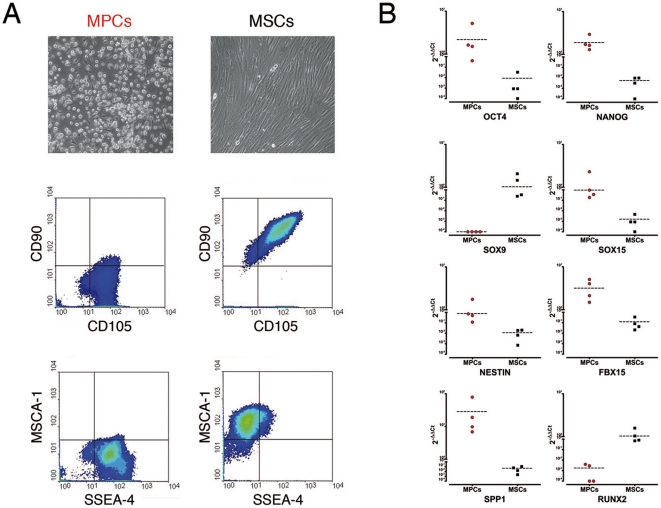
Mesenchymal Stromal Cells (MSCs) remain poorly characterized because of the absence of manifest physical, phenotypic, and functional properties in cultured cell populations. Despite considerable research on MSCs and their clinical application, the biology of these cells is not fully clarified and data on signalling activation during mesenchymal differentiation and proliferation are controversial. The role of Wnt pathways is still debated, partly due to culture heterogeneity and methodological inconsistencies. Recently, we described a new bone marrow cell population isolated from MSC cultures that we named Mesodermal Progenitor Cells (MPCs) for their mesenchymal and endothelial differentiation potential. An optimized culture method allowed the isolation from human adult bone marrow of a highly pure population of MPCs (more than 97%), that showed the distinctive SSEA-4+CD105+CD90(neg) phenotype and not expressing MSCA-1 antigen. Under these selective culture conditions the percentage of MSCs (SSEA-4(neg)CD105+CD90(bright) and MSCA-1+), in the primary cultures, resulted lower than 2%.
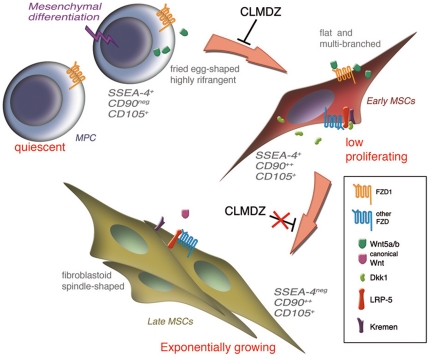
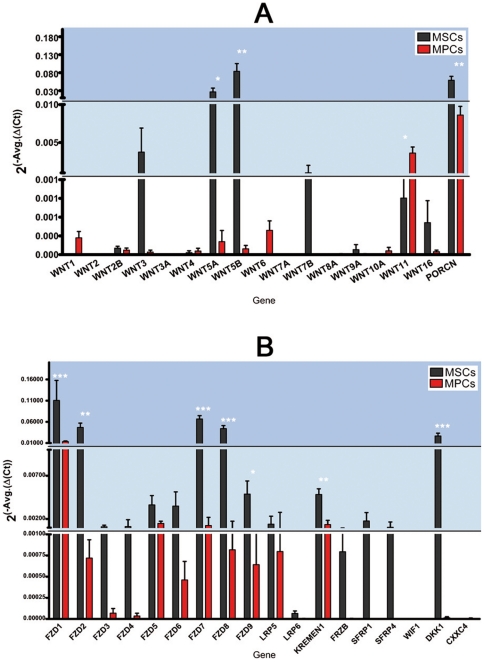
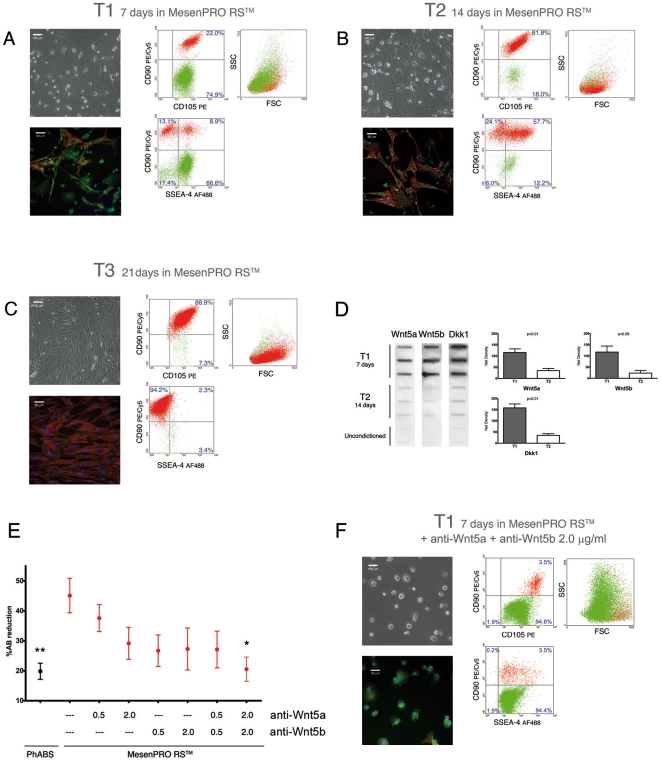
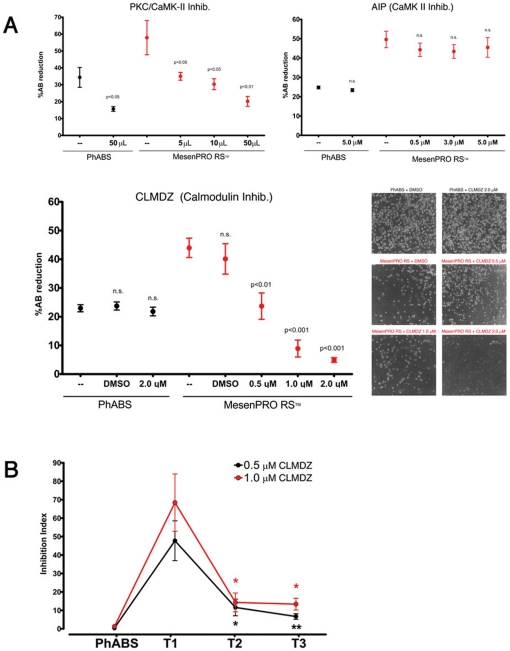
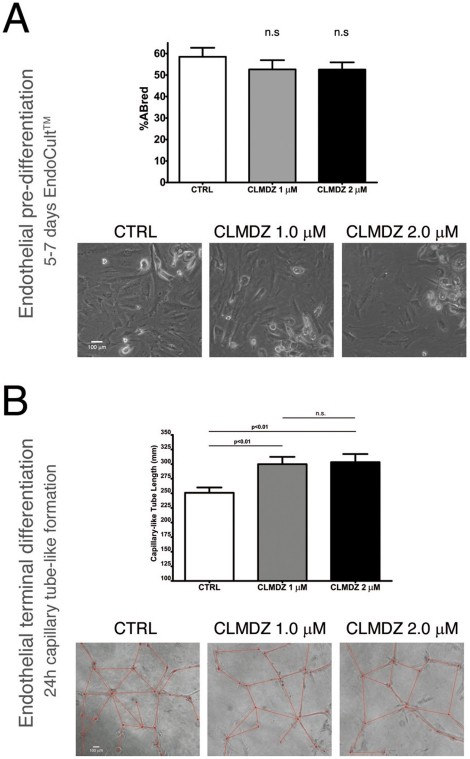
METHODOLOGY/PRINCIPAL FINDING: We demonstrate that MPCs differentiate to MSCs through an SSEA-4+CD105+CD90(bright) early intermediate precursor. Differentiation paralleled the activation of Wnt5/Calmodulin signalling by autocrine/paracrine intense secretion of Wnt5a and Wnt5b (p<0.05 vs uncondictioned media), which was later silenced in late MSCs (SSEA-4(neg)). We found the inhibition of this pathway by calmidazolium chloride specifically blocked mesenchymal induction (ID₅₀ = 0.5 µM, p<0.01), while endothelial differentiation was unaffected.
The present study describes two different putative progenitors (early and late MSCs) that, together with already described MPCs, could be co-isolated and expanded in different percentages depending on the culture conditions. These results suggest that some modifications to the widely accepted MSC nomenclature are required.
间充质基质细胞(MSCs)由于在培养细胞群体中缺乏明显的物理、表型和功能特性而仍未得到充分描述。尽管对 MSCs 及其临床应用进行了大量研究,但这些细胞的生物学特性尚未完全阐明,有关间充质分化和增殖过程中信号激活的数据存在争议。Wnt 途径的作用仍存在争议,部分原因是培养的异质性和方法学的不一致性。最近,我们描述了一种从 MSC 培养物中分离出来的新的骨髓细胞群体,我们将其命名为间充质祖细胞(MPCs),因为它们具有间充质和内皮分化的潜力。一种优化的培养方法允许从人成年骨髓中分离出高度纯的 MPC 群体(超过 97%),该群体表现出独特的 SSEA-4+CD105+CD90(neg)表型,不表达 MSCA-1 抗原。在这些选择性培养条件下,原代培养物中 MSC(SSEA-4(neg)CD105+CD90(bright)和 MSCA-1+)的比例低于 2%。
方法/主要发现:我们证明 MPCs 通过 SSEA-4+CD105+CD90(bright)早期中间前体分化为 MSCs。分化与 Wnt5/钙调蛋白信号的激活平行,这是通过自分泌/旁分泌强烈分泌 Wnt5a 和 Wnt5b 引起的(与无条件培养基相比,p<0.05),随后在晚期 MSCs(SSEA-4(neg)中沉默。我们发现,通过氯丙咪嗪特异性抑制该途径可特异性阻断间充质诱导(ID₅₀=0.5 μM,p<0.01),而内皮分化不受影响。
本研究描述了两种不同的假定祖细胞(早期和晚期 MSC),它们可以与已经描述的 MPC 一起在不同的比例中共同分离和扩增,这取决于培养条件。这些结果表明,需要对广泛接受的 MSC 命名法进行一些修改。