Biosciences Université d'Abidjan-Cocody, Abidjan, Côte d'Ivoire.
PLoS Negl Trop Dis. 2010 Jan 19;4(1):e574. doi: 10.1371/journal.pntd.0000574.
New efforts are being made to improve understanding of the epidemiology of the helminths and intensifying the control efforts against these parasites. In contrast, relatively few studies are being carried out in this direction for the intestinal protozoa. To contribute to a better comprehension of the epidemiology of the intestinal protozoa, prevalence, and spatial distribution of Entamoeba histolytica/dispar and Giardia lamblia, and their association with drinking water supplies, were determined in the Agboville department in southeast Côte d'Ivoire.
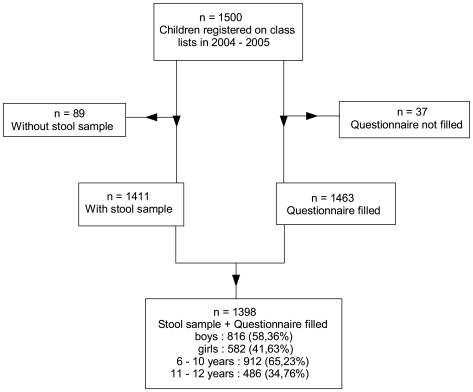
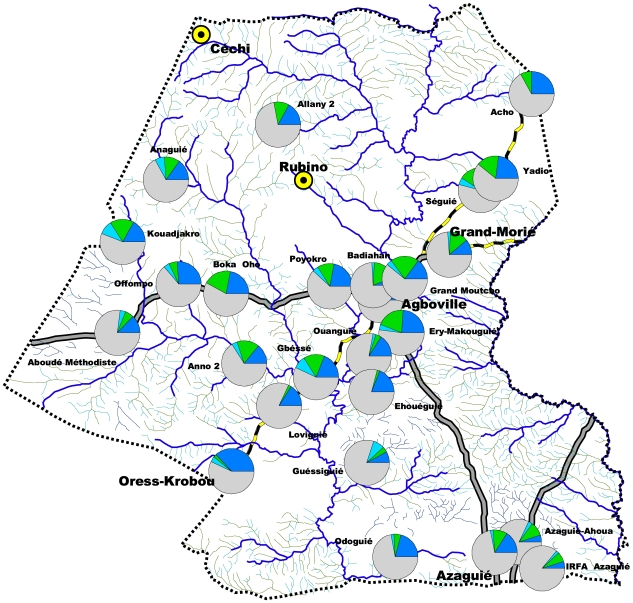
METHODS/FINDINGS: Stool samples were taken from more than 1,300 schoolchildren in the third year of primary education (CE1) from 30 primary schools and preserved in SAF (sodium acetate-acetic acid-formalin). The samples were analyzed by formalin-ether concentration. Then, a survey questionnaire addressed to schoolchildren and school directors was used to collect data on water supplies. Prevalence of E. histolytica/dispar and G. lamblia were, respectively, 18.8% and 13.9%. No particular focus zone was observed in the spatial distribution of the two species. Significant negative association was observed between use of tap water and high prevalence of E. histolytica/dispar infection (OR = 0.83, p = 0.01). High prevalence of G. lamblia infection was positively associated with use of ponds as the source of drinking water (OR = 1.28, p = 0.009).
These two species of pathogenic protozoa are present with substantial prevalence in this area of Côte d'Ivoire. Although their spatial distribution is not focused in any one place, determination of the population segments with the highest levels of infection will help to target the chemotherapeutic fight. To reinforce treatment with chemotherapeutic agents, tap water should be made available in all the localities of this area.
目前,人们正在努力提高对寄生虫病流行病学的认识,并加强对这些寄生虫的控制力度。相比之下,针对肠道原生动物的研究相对较少。为了更好地了解肠道原生动物的流行病学,在科特迪瓦东南部的阿博维尔省,确定了溶组织内阿米巴/迪斯帕和蓝氏贾第鞭毛虫的流行率和空间分布情况,及其与饮用水供应的关系。
方法/发现:从 30 所小学的 1300 多名小学三年级学生中采集粪便样本,并保存在 SAF(醋酸钠-乙酸-福尔马林)中。样本用福尔马林-乙醚浓缩法进行分析。然后,使用针对学童和校长的调查问卷收集有关水供应的数据。溶组织内阿米巴/迪斯帕和蓝氏贾第鞭毛虫的流行率分别为 18.8%和 13.9%。在这两种物种的空间分布中,没有观察到特定的重点区域。在使用自来水与溶组织内阿米巴/迪斯帕感染高流行率之间观察到显著的负相关(OR = 0.83,p = 0.01)。蓝氏贾第鞭毛虫感染的高流行率与使用池塘作为饮用水源呈正相关(OR = 1.28,p = 0.009)。
在科特迪瓦的这一地区,存在具有相当流行率的两种致病性原生动物。尽管它们的空间分布没有集中在任何一个地方,但确定感染程度最高的人群,有助于有针对性地开展化学治疗。为了加强化学治疗药物的治疗,应在该地区的所有地方提供自来水。