Department of Microbial Ecology, Netherlands Institute of Ecology (NIOO-KNAW), Wageningen, The Netherlands.
Oecologia. 2012 Mar;168(3):621-9. doi: 10.1007/s00442-011-2138-2. Epub 2011 Oct 5.
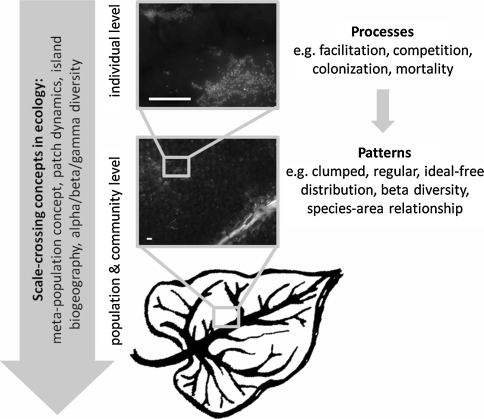
Many concepts and theories in ecology are highly debated, because it is often difficult to design decisive tests with sufficient replicates. Examples include biodiversity theories, succession concepts, invasion theories, coexistence theories, and concepts of life history strategies. Microbiological tests of ecological concepts are rapidly accumulating, but have yet to tap into their full potential to complement traditional macroecological theories. Taking the example of microbial communities on leaf surfaces (i.e. the phyllosphere), we show that most explorations of ecological concepts in this field of microbiology focus on autecology and population ecology, while community ecology remains understudied. Notable exceptions are first tests of the island biogeography theory and of biodiversity theories. Here, the phyllosphere provides the unique opportunity to set up replicated experiments, potentially moving fields such as biogeography, macroecology, and landscape ecology beyond theoretical and observational evidence. Future approaches should take advantage of the great range of spatial scales offered by the leaf surface by iteratively linking laboratory experiments with spatial simulation models.
生态学中有许多概念和理论备受争议,因为通常难以设计具有足够重复的决定性测试。这些例子包括生物多样性理论、演替概念、入侵理论、共存理论和生活史策略概念。对生态学概念的微生物学测试正在迅速积累,但尚未充分发挥其潜力来补充传统的宏观生态学理论。以叶片表面上的微生物群落(即叶面)为例,我们表明,该领域的微生物生态学中对大多数生态学概念的探索都集中在个体生态学和种群生态学上,而对群落生态学的研究还很不足。值得注意的例外是对岛屿生物地理学理论和生物多样性理论的首次检验。在这里,叶面为设置重复实验提供了独特的机会,有可能使生物地理学、宏观生态学和景观生态学等领域超越理论和观测证据。未来的方法应该利用叶面提供的广泛空间尺度,通过将实验室实验与空间模拟模型迭代链接来利用这一机会。