Brain Imaging Center, McLean Hospital, Belmont, Massachusetts, USA.
Diabetes. 2011 Dec;60(12):3256-64. doi: 10.2337/db11-0506. Epub 2011 Oct 7.
To investigate the effects of acute hypoglycemia on working memory and brain function in patients with type 1 diabetes.
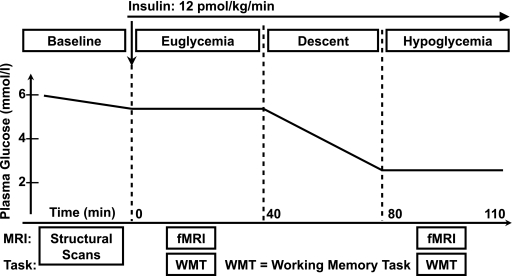
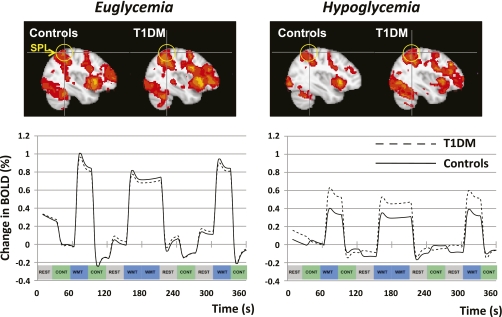
Using blood oxygen level-dependent (BOLD) functional magnetic resonance imaging during euglycemic (5.0 mmol/L) and hypoglycemic (2.8 mmol/L) hyperinsulinemic clamps, we compared brain activation response to a working-memory task (WMT) in type 1 diabetic subjects (n = 16) with that in age-matched nondiabetic control subjects (n = 16). Behavioral performance was assessed by percent correct responses.
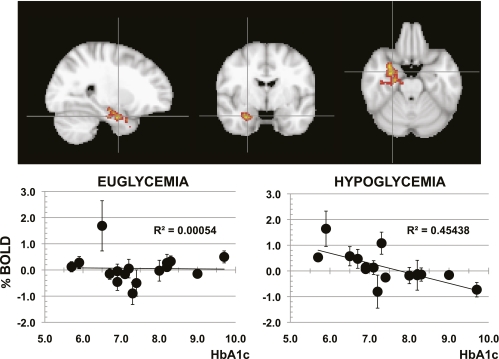
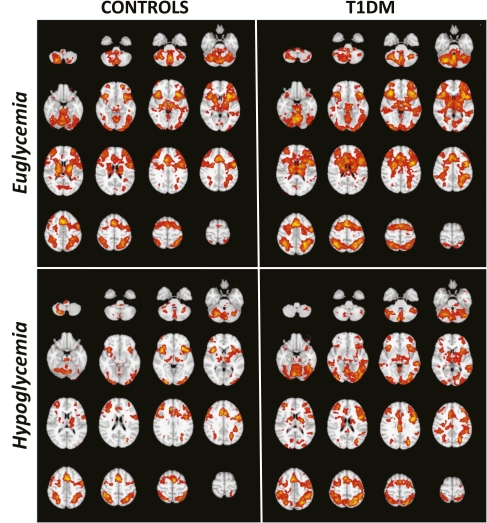
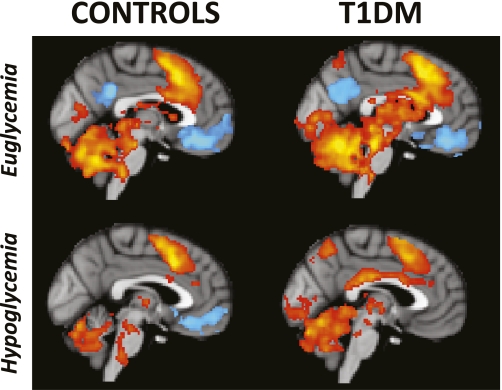
During euglycemia, the WMT activated the bilateral frontal and parietal cortices, insula, thalamus, and cerebellum in both groups. During hypoglycemia, activation decreased in both groups but remained 80% larger in type 1 diabetic versus control subjects (P < 0.05). In type 1 diabetic subjects, higher HbA(1c) was associated with lower activation in the right parahippocampal gyrus and amygdala (R(2) = 0.45, P < 0.002). Deactivation of the default-mode network (DMN) also was seen in both groups during euglycemia. However, during hypoglycemia, type 1 diabetic patients deactivated the DMN 70% less than control subjects (P < 0.05). Behavioral performance did not differ between glycemic conditions or groups.
BOLD activation was increased and deactivation was decreased in type 1 diabetic versus control subjects during hypoglycemia. This higher level of brain activation required by type 1 diabetic subjects to attain the same level of cognitive performance as control subjects suggests reduced cerebral efficiency in type 1 diabetes.
研究 1 型糖尿病患者急性低血糖对工作记忆和大脑功能的影响。
采用血氧水平依赖(BOLD)功能磁共振成像,在正常血糖(5.0mmol/L)和低血糖(2.8mmol/L)高胰岛素钳夹期间,我们比较了 1 型糖尿病患者(n=16)和年龄匹配的非糖尿病对照者(n=16)在进行工作记忆任务(WMT)时大脑激活的反应。行为表现通过正确反应的百分比来评估。
在正常血糖期间,WMT 激活了两组双侧额顶叶皮层、岛叶、丘脑和小脑。在低血糖期间,两组的激活均降低,但 1 型糖尿病患者的激活仍比对照组大 80%(P < 0.05)。在 1 型糖尿病患者中,HbA1c 越高,右侧海马旁回和杏仁核的激活越低(R²=0.45,P < 0.002)。两组在正常血糖期间也观察到默认模式网络(DMN)的去激活。然而,在低血糖期间,1 型糖尿病患者的 DMN 去激活程度比对照组低 70%(P < 0.05)。行为表现在血糖条件或组之间没有差异。
与对照组相比,1 型糖尿病患者在低血糖期间 BOLD 激活增加,去激活减少。1 型糖尿病患者需要更高水平的大脑激活才能达到与对照组相同的认知表现,这表明 1 型糖尿病患者的大脑效率降低。