Department of Internal Medicine (Rheumatology), University of Texas, Southwestern Medical Center, 5323 Harry Hines Boulevard, Dallas, TX 75235, USA.
Arthritis Res Ther. 2011;13(5):241. doi: 10.1186/ar3465. Epub 2011 Sep 30.
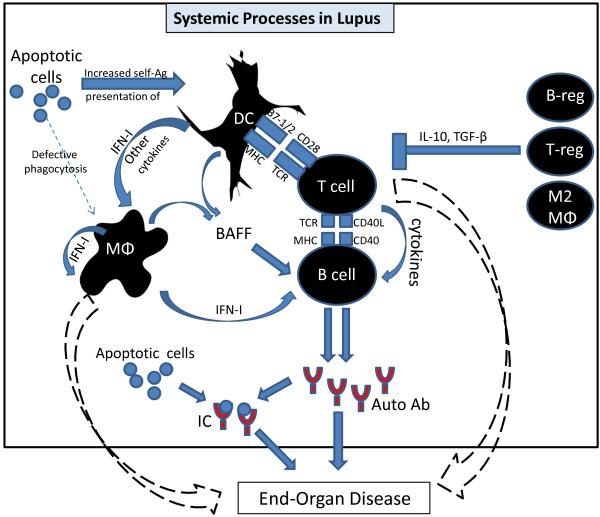
Systemic lupus erythematosus (SLE) is a complex disease characterized by the appearance of autoantibodies against nuclear antigens and the involvement of multiple organ systems, including the kidneys. The precise immunological events that trigger the onset of clinical manifestations of SLE are not yet well understood. However, research using various mouse strains of spontaneous and inducible lupus in the last two decades has provided insights into the role of the immune system in the pathogenesis of this disease. According to our present understanding, the immunological defects resulting in the development of SLE can be categorized into two phases: (a) systemic autoimmunity resulting in increased serum antinuclear and antiglomerular autoantibodies and (b) immunological events that occur within the target organ and result in end organ damage. Aberrations in the innate as well as adaptive arms of the immune system both play an important role in the genesis and progression of lupus. Here, we will review the present understanding--as garnered from studying mouse models--about the roles of various immune cells in lupus pathogenesis.
系统性红斑狼疮(SLE)是一种复杂的疾病,其特征是出现针对核抗原的自身抗体以及涉及多个器官系统,包括肾脏。触发 SLE 临床症状发作的确切免疫事件尚不完全清楚。然而,过去二十年中使用自发性和诱导性狼疮的各种小鼠品系进行的研究为了解免疫系统在该疾病发病机制中的作用提供了线索。根据我们目前的理解,导致 SLE 发展的免疫缺陷可分为两个阶段:(a)全身性自身免疫导致血清抗核和抗肾小球自身抗体增加,以及(b)发生在靶器官内并导致终末器官损伤的免疫事件。先天和适应性免疫系统的异常均在狼疮的发生和进展中起重要作用。在这里,我们将回顾从研究小鼠模型中获得的关于各种免疫细胞在狼疮发病机制中的作用的现有认识。