Medtronic International Trading Sàrl Tolochenaz, Switzerland.
Front Integr Neurosci. 2011 Sep 27;5:46. doi: 10.3389/fnint.2011.00046. eCollection 2011.
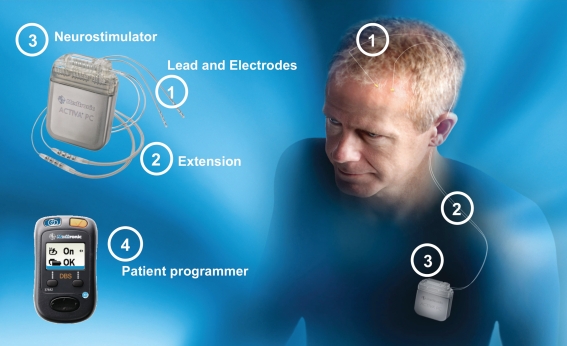
Deep brain stimulation (DBS) emerged in the late 1960s as a possible therapeutic alternative to lesioning in patients with severe, chronic, intractable pain. DBS devices in the era were based on cardiac pacing technology but were greatly modified in implementation due to the unique needs of DBS. Clinical studies in the 1970s and early 1980s have revealed a technique with modest results which did not lead to regulatory approval for the treatment of pain. In the 1980s a new application for DBS emerged in the treatment of movement disorders. Clinical trials confirmed the robustness of the therapy leading to approvals by regulatory authorities in the US and Europe for the treatment of tremor and the symptoms of Parkinson's disease. Technology based on that used for earlier clinical research in pain was improved by leveraging advances in cardiac pacing technology resulting in the sophisticated and reliable systems available today. In the 1990s scientific exploration began in the treatment of psychiatric disorders which is ongoing today. Simultaneously, studies into the treatment of epilepsy were begun which resulted in regulatory approval in Europe. Suggestions have been made to expand these scientific explorations to other central nervous system dysfunctions. Opportunity remains to improve the technology including individualized and symptom specific stimulation patterns, more physician and patient friendly programming, and possibly closed-loop systems for more situation dependent and effective therapy.
脑深部刺激(DBS)于 20 世纪 60 年代末期出现,成为严重、慢性、顽固性疼痛患者除损伤以外的一种可能的治疗选择。当时的 DBS 设备基于心脏起搏技术,但由于 DBS 的独特需求,在实施方面进行了重大修改。20 世纪 70 年代和 80 年代的临床研究揭示了一种技术,其结果并不显著,也没有导致监管机构批准用于治疗疼痛。20 世纪 80 年代,DBS 在治疗运动障碍方面出现了新的应用。临床试验证实了该疗法的稳健性,导致美国和欧洲监管机构批准其用于治疗震颤和帕金森病的症状。基于早期疼痛临床研究中使用的技术,通过利用心脏起搏技术的进步进行了改进,从而得到了当今先进可靠的系统。20 世纪 90 年代,开始了针对精神疾病治疗的科学探索,这一探索仍在继续。同时,也开始了针对癫痫治疗的研究,并在欧洲获得了监管批准。有人建议将这些科学探索扩展到其他中枢神经系统功能障碍。仍有机会改进该技术,包括个体化和特定症状的刺激模式、更便于医生和患者使用的编程,以及可能的闭环系统,以实现更依赖于情境和更有效的治疗。