Institut National de la Recherche Agronomique, UMR 1301 Interactions Biotiques et Santé Végétale, Centre National de la Recherche Scientifique, UMR 6243, Université de Nice Sophia Antipolis, Sophia-Antipolis, France.
PLoS One. 2011;6(10):e25708. doi: 10.1371/journal.pone.0025708. Epub 2011 Oct 3.
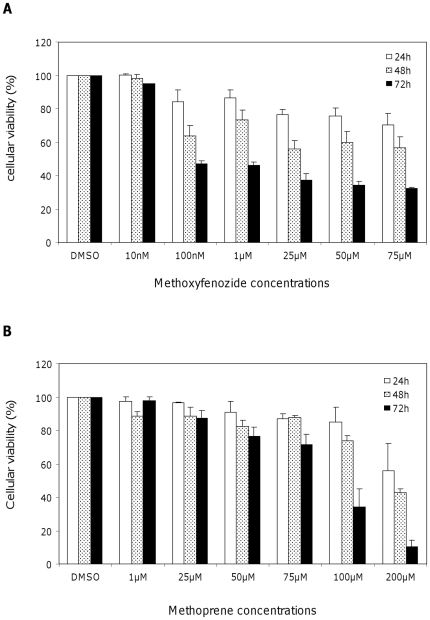
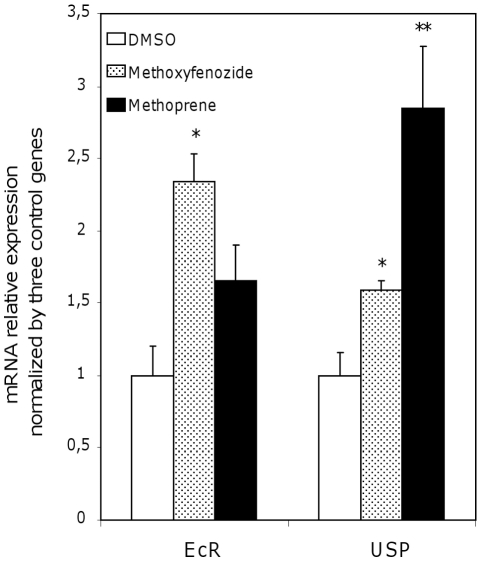
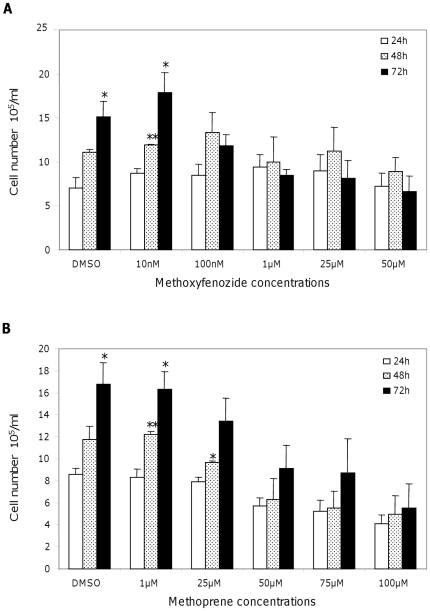
Methoxyfenozide and methoprene are two insecticides that mimic the action of the main hormones involved in the control of insect growth and development, 20-hydroxyecdysone and juvenile hormone. We investigated their effect on the Spodoptera frugiperda Sf9 cell line. Methoxyfenozide was more toxic than methoprene in cell viability tests and more potent in the inhibition of cellular proliferation. Cell growth arrest occurred in the G2/M phase after a methoprene treatment and more modestly in G1 after methoxyfenozide treatment. Microarray experiments and real-time quantitative PCR to follow the expression of nuclear receptors ultraspiracle and ecdysone receptor were performed to understand the molecular action of these hormone agonists. Twenty-six genes were differentially expressed after methoxyfenozide treatment and 55 genes after methoprene treatment with no gene in common between the two treatments. Our results suggest two different signalling pathways in Sf9 cells.
甲氧虫酰肼和保幼激素类似物是两种杀虫剂,它们模拟了 20-羟基蜕皮酮和保幼激素这两种主要激素在昆虫生长发育调控中的作用。我们研究了它们对 Sf9 细胞系的影响。在细胞活力测试中,甲氧虫酰肼比保幼激素更具毒性,对细胞增殖的抑制作用更强。保幼激素处理后细胞生长停滞发生在 G2/M 期,而甲氧虫酰肼处理后则更适度地发生在 G1 期。为了了解这些激素激动剂的分子作用,我们进行了微阵列实验和实时定量 PCR 来跟踪核受体 ultraspiracle 和蜕皮激素受体的表达。甲氧虫酰肼处理后有 26 个基因表达差异,保幼激素处理后有 55 个基因表达差异,两种处理之间没有共同的基因。我们的结果表明 Sf9 细胞中存在两种不同的信号通路。