Laboratory of Molecular Virology and Biotechnology, Institute of Biotechnology, National Cheng Kung University, Tainan, Taiwan, Republic of China.
PLoS One. 2011;6(10):e25853. doi: 10.1371/journal.pone.0025853. Epub 2011 Oct 3.
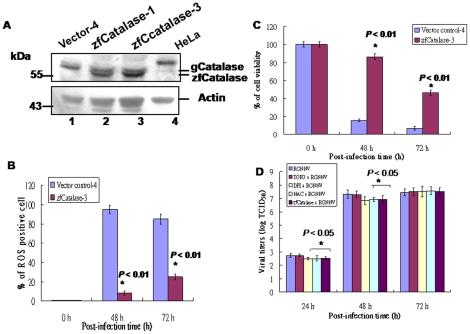
The role of oxidative stress in the pathogenesis of RNA nervous necrosis virus infection is still unknown. Red-spotted grouper nervous necrosis virus (RGNNV) induced free radical species (ROS) production at 12-24 h post-infection (pi; early replication stage) in fish GF-1 cells, and then at middle replication stage (24-48 h pi), this ROS signal may upregulate some expressions of the anti-oxidant enzymes Cu/Zn SOD and catalase, and eventually expression of the transcription factor Nrf2. Furthermore, both antioxidants diphenyliodonium and N-acetylcysteine or overexpression of zebrafish catalase in GF-1 cells also reduced ROS production and protected cells for enhancing host survival rate due to RGNNV infection. Furthermore, localization of ROS production using esterase activity and Mitotracker staining assays found that the ROS generated can affect mitochondrial morphology changes and causes ΔΨ loss, both of which can be reversed by antioxidant treatment. Taken together, our data suggest that RGNNV induced oxidative stress response for playing dual role that can initiate the host oxidative stress defense system to upregulate expression of antioxidant enzymes and induces cell death via disrupting the mitochondrial morphology and inducing ΔΨ loss, which can be reversed by anti-oxidants and zfcatalase, which provide new insight into betanodavirus-induced ROS-mediated pathogenesis.
氧化应激在 RNA 神经坏死病毒感染发病机制中的作用尚不清楚。红鳍东方鲀神经坏死病毒(RGNNV)在感染后 12-24 小时(早期复制阶段)诱导鱼类 GF-1 细胞中产生自由基(ROS),然后在中期复制阶段(24-48 小时),这种 ROS 信号可能上调一些抗氧化酶 Cu/Zn SOD 和过氧化氢酶的表达,最终上调转录因子 Nrf2 的表达。此外,GF-1 细胞中的抗氧化剂二苯基碘鎓和 N-乙酰半胱氨酸或斑马鱼过氧化氢酶的过表达也减少了 ROS 的产生,并保护细胞提高了宿主因 RGNNV 感染而导致的存活率。此外,使用酯酶活性和 Mitotracker 染色测定 ROS 产生的定位发现,产生的 ROS 可以影响线粒体形态变化并导致ΔΨ 丧失,抗氧化剂处理可以逆转这两种变化。总之,我们的数据表明,RGNNV 诱导的氧化应激反应具有双重作用,可以启动宿主的氧化应激防御系统,上调抗氧化酶的表达,并通过破坏线粒体形态和诱导ΔΨ 丧失来诱导细胞死亡,抗氧化剂和 zfcatalase 可以逆转这两种变化,这为 betanodavirus 诱导的 ROS 介导的发病机制提供了新的见解。