Communication Science, Wageningen University, Hollandseweg 1, 6706 KN, Wageningen, The Netherlands.
BMC Public Health. 2011 Oct 13;11:798. doi: 10.1186/1471-2458-11-798.
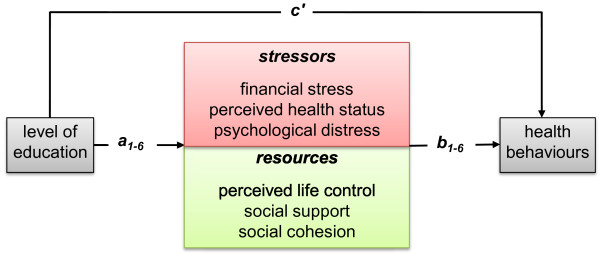
Variability in health behaviours is an important cause of socioeconomic health disparities. Socioeconomic differences in health behaviours are poorly understood. Previous studies have examined whether (single) stressors or psychosocial resources mediate the relationship between socioeconomic position and health or mortality. This study examined: 1) whether the presence of stressors and the absence of resources can be represented by a single underlying factor, and co-occur among those with lower education, 2) whether stressors and resources mediated the relation between education and health behaviours, and 3) addressed the question whether an aggregate measure of stressors and resources has an added effect over the use of individual measures.
Questionnaire data on sociodemographic variables, stressors, resources, and health behaviours were collected cross-sectionally among inhabitants (n = 3050) of a medium-sized Dutch city (Utrecht). Descriptive statistics and bootstrap analyses for multiple-mediator effects were used to examine the role of stressors and resources in mediating educational associations with health behaviours.
Higher levels of stressors and lower levels of resources could be represented by a single underlying factor, and co-occurred among those with lower educational levels. Stressors and resources partially mediated the relationship between education and four health- behaviours (exercise, breakfast frequency, vegetable consumption and smoking). Financial stress and poor perceived health status were mediating stressors, and social support a strong mediating resource. An aggregate measure of the stressors and resources showed similar associations with health behaviours compared to the summed individual measures.
Lower educated groups are simultaneously affected by the presence of various stressors and absence of multiple resources, which partially explain socioeconomic differences in health behaviours. Compared to the direct associations of stressors and resources with health behaviours, the association with socioeconomic status was modest. Therefore, besides addressing structural inequalities, interventions promoting financial management, coping with chronic disease, and social skills training have the potential to benefit large parts of the population, most notably the lower educated. Further research is needed to clarify how stressors and resources impact health behaviours, why this differs between behaviours and how these disparities could be alleviated.
健康行为的变异性是造成社会经济健康差异的一个重要原因。社会经济行为差异的研究还很缺乏。以前的研究检验了压力源和心理社会资源是否可以用一个单一的潜在因素来表示,以及它们是否在受教育程度较低的人群中同时存在。本研究考察了:1)压力源和资源的缺失是否可以用一个单一的潜在因素来表示,以及它们是否在受教育程度较低的人群中同时存在;2)压力源和资源是否在教育与健康行为之间的关系中起中介作用;3)解决了一个综合的压力源和资源指标是否比使用单个指标具有额外效果的问题。
在荷兰一个中等城市(乌得勒支),对居民(n=3050)进行了横断面调查,收集了社会人口变量、压力源、资源和健康行为的问卷数据。使用bootstrap 分析进行多重中介效应的描述性统计,以检验压力源和资源在中介教育与健康行为关系中的作用。
较高水平的压力源和较低水平的资源可以用一个单一的潜在因素来表示,并且在受教育程度较低的人群中同时存在。压力源和资源部分中介了教育与四种健康行为(锻炼、早餐频率、蔬菜摄入和吸烟)之间的关系。经济压力和较差的健康感知是压力源的中介,社会支持是强有力的资源中介。与单独使用个体测量相比,压力源和资源的综合测量与健康行为有类似的关联。
受教育程度较低的群体同时受到多种压力源的影响和缺乏多种资源,这部分解释了健康行为的社会经济差异。与压力源和资源与健康行为的直接关联相比,与社会经济地位的关联较为温和。因此,除了解决结构性不平等问题外,促进财务管理、应对慢性疾病和社会技能培训的干预措施有可能使大部分人群受益,特别是受教育程度较低的人群。需要进一步研究来阐明压力源和资源如何影响健康行为,为什么这些差异在行为之间存在差异,以及如何减轻这些差异。