Université de Toulouse; INSA, UPS, INP; LISBP, 135 Avenue de Rangueil, F-31077 Toulouse, France.
Microb Cell Fact. 2011 Aug 30;10 Suppl 1(Suppl 1):S18. doi: 10.1186/1475-2859-10-S1-S18.
Amino acid assimilation is crucial for bacteria and this is particularly true for Lactic Acid Bacteria (LAB) that are generally auxotroph for amino acids. The global response of the LAB model Lactococcus lactis ssp. lactis was characterized during progressive isoleucine starvation in batch culture using a chemically defined medium in which isoleucine concentration was fixed so as to become the sole limiting nutriment. Dynamic analyses were performed using transcriptomic and proteomic approaches and the results were analysed conjointly with fermentation kinetic data.
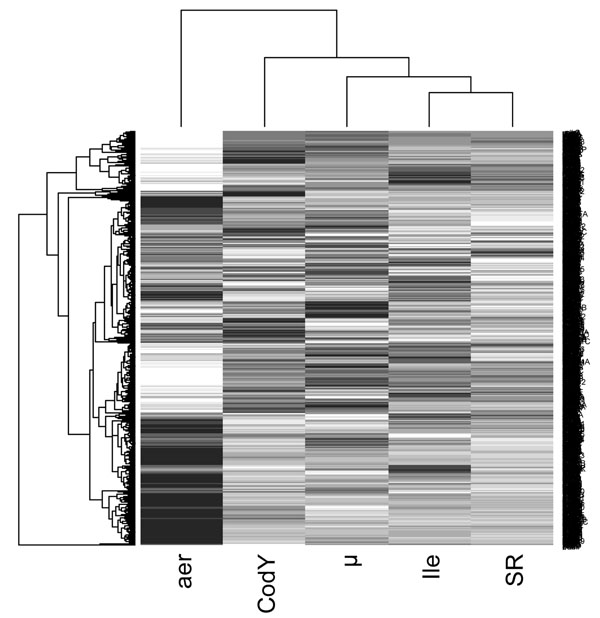
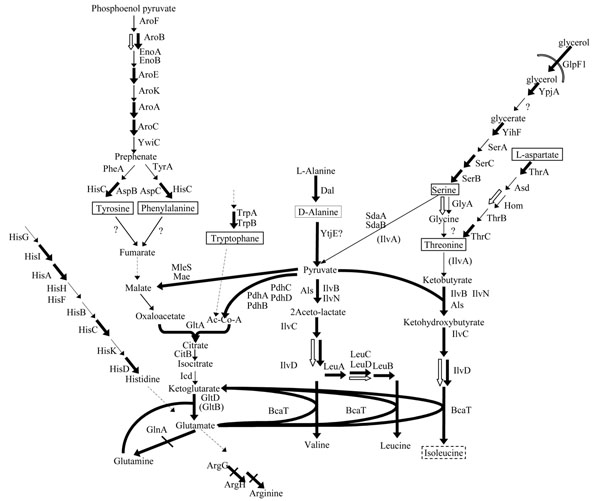
The response was first deduced from transcriptomic analysis and corroborated by proteomic results. It occurred progressively and could be divided into three major mechanisms: (i) a global down-regulation of processes linked to bacterial growth and catabolism (transcription, translation, carbon metabolism and transport, pyrimidine and fatty acid metabolism), (ii) a specific positive response related to the limiting nutrient (activation of pathways of carbon or nitrogen metabolism and leading to isoleucine supply) and (iii) an unexpected oxidative stress response (positive regulation of aerobic metabolism, electron transport, thioredoxin metabolism and pyruvate dehydrogenase). The involvement of various regulatory mechanisms during this adaptation was analysed on the basis of transcriptomic data comparisons. The global regulator CodY seemed specifically dedicated to the regulation of isoleucine supply. Other regulations were massively related to growth rate and stringent response.
This integrative biology approach provided an overview of the metabolic pathways involved during isoleucine starvation and their regulations. It has extended significantly the physiological understanding of the metabolism of L. lactis ssp. lactis. The approach can be generalised to other conditions and will contribute significantly to the identification of the biological processes involved in complex regulatory networks of micro-organisms.
氨基酸的同化作用对细菌至关重要,这对于通常为氨基酸营养缺陷型的乳酸菌(LAB)来说尤其如此。使用化学定义的培养基在分批培养中对乳酸菌模型乳球菌乳亚种的全球反应进行了特征描述,其中异亮氨酸浓度固定为唯一限制营养物质。使用转录组学和蛋白质组学方法进行动态分析,并将结果与发酵动力学数据进行联合分析。
该反应首先从转录组分析中推断出来,并通过蛋白质组学结果得到证实。它是渐进发生的,可以分为三个主要机制:(i)与细菌生长和分解代谢(转录、翻译、碳代谢和运输、嘧啶和脂肪酸代谢)相关的过程的全局下调,(ii)与限制营养物相关的特定正响应(碳或氮代谢途径的激活并导致异亮氨酸供应)和(iii)出乎意料的氧化应激反应(有氧代谢、电子传递、硫氧还蛋白代谢和丙酮酸脱氢酶的正调节)。根据转录组数据比较分析了这种适应过程中各种调节机制的参与。全局调节剂 CodY 似乎专门用于调节异亮氨酸的供应。其他调节与生长速率和严格响应密切相关。
这种综合生物学方法提供了在异亮氨酸饥饿期间涉及的代谢途径及其调节的概述。它大大扩展了对乳球菌乳亚种代谢的生理理解。该方法可以推广到其他条件,并将有助于确定参与微生物复杂调控网络的生物学过程。