Service of Endocrinology, Diabetes and Metabolism, Centre Hospitalier Universitaire Vaudois, University of Lausanne, Rue du Bugnon 46, 1011 Lausanne, Switzerland.
BMJ. 2011 Oct 13;343:d6195. doi: 10.1136/bmj.d6195.
To test the effect of a multidimensional lifestyle intervention on aerobic fitness and adiposity in predominantly migrant preschool children.
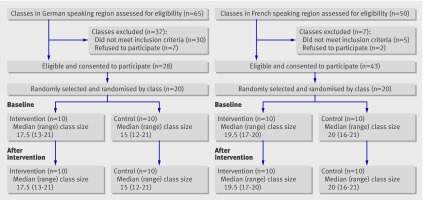
Cluster randomised controlled single blinded trial (Ballabeina study) over one school year; randomisation was performed after stratification for linguistic region.
40 preschool classes in areas with a high migrant population in the German and French speaking regions of Switzerland.
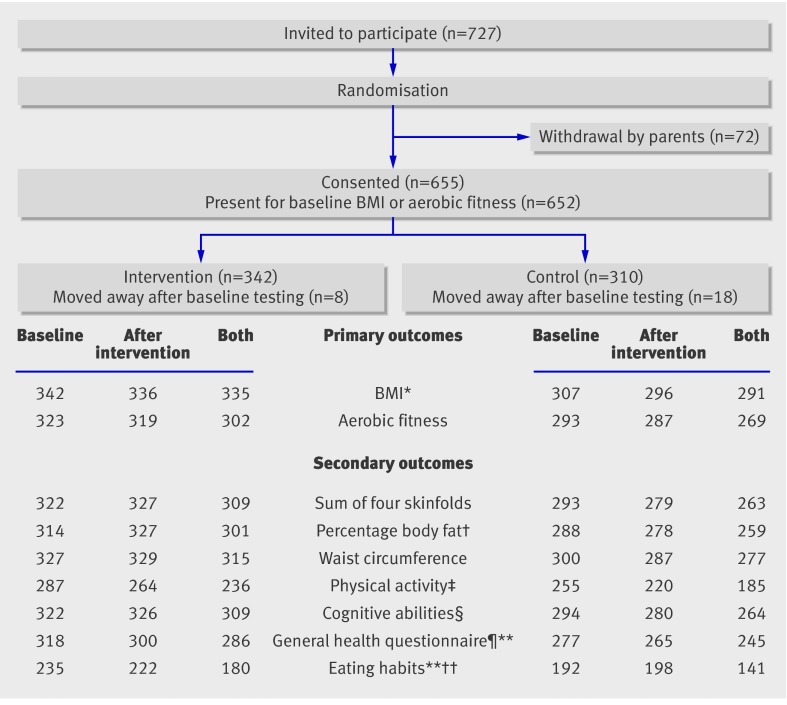
652 of the 727 preschool children had informed consent and were present for baseline measures (mean age 5.1 years (SD 0.7), 72% migrants of multicultural origins). No children withdrew, but 26 moved away.
The multidimensional culturally tailored lifestyle intervention included a physical activity programme, lessons on nutrition, media use (use of television and computers), and sleep and adaptation of the built environment of the preschool class. It lasted from August 2008 to June 2009.
Primary outcomes were aerobic fitness (20 m shuttle run test) and body mass index (BMI). Secondary outcomes included motor agility, balance, percentage body fat, waist circumference, physical activity, eating habits, media use, sleep, psychological health, and cognitive abilities.
Compared with controls, children in the intervention group had an increase in aerobic fitness at the end of the intervention (adjusted mean difference: 0.32 stages (95% confidence interval 0.07 to 0.57; P=0.01) but no difference in BMI (-0.07 kg/m(2), -0.19 to 0.06; P=0.31). Relative to controls, children in the intervention group had beneficial effects in motor agility (-0.54 s, -0.90 to -0.17; P=0.004), percentage body fat (-1.1%, -2.0 to -0.2; P=0.02), and waist circumference (-1.0 cm, -1.6 to -0.4; P=0.001). There were also significant benefits in the intervention group in reported physical activity, media use, and eating habits, but not in the remaining secondary outcomes.
A multidimensional intervention increased aerobic fitness and reduced body fat but not BMI in predominantly migrant preschool children. Trial registration Clinical Trials NCT00674544.
检验多维生活方式干预对以移民为主的学龄前儿童有氧适能和肥胖的影响。
一学年的集群随机对照单盲试验(Ballabeina 研究);按语言区进行分层后进行随机分组。
瑞士德语区和法语区高移民人口地区的 40 个学前班。
652 名 727 名学龄前儿童中有知情同意书并参加了基线测量(平均年龄 5.1 岁(0.7 标准差),72%为多元文化背景的移民)。没有儿童退出,但有 26 人搬家了。
多维文化定制生活方式干预包括体育活动方案、营养课程、媒体使用(电视和电脑使用)以及睡眠和学前班环境的调整。它从 2008 年 8 月持续到 2009 年 6 月。
主要结局指标为有氧适能(20 米穿梭跑测试)和体重指数(BMI)。次要结局指标包括运动敏捷性、平衡、体脂百分比、腰围、体力活动、饮食习惯、媒体使用、睡眠、心理健康和认知能力。
与对照组相比,干预组儿童在干预结束时有氧适能增加(调整后的平均差异:0.32 阶段(95%置信区间 0.07 至 0.57;P=0.01),但 BMI 无差异(-0.07kg/m2,-0.19 至 0.06;P=0.31)。与对照组相比,干预组儿童在运动敏捷性(-0.54 秒,-0.90 至 -0.17;P=0.004)、体脂百分比(-1.1%,-2.0 至 -0.2;P=0.02)和腰围(-1.0cm,-1.6 至 -0.4;P=0.001)方面均有显著改善。干预组在体力活动、媒体使用和饮食习惯方面也有显著改善,但其余次要结局无改善。
多维干预增加了以移民为主的学龄前儿童的有氧适能,减少了体脂,但 BMI 没有变化。
ClinicalTrials.gov NCT00674544。