Department of Physical Medicine and Rehabilitation, Northwestern University and Rehabilitation Institute of Chicago, Chicago, Illinois, United States of America.
PLoS Comput Biol. 2011 Oct;7(10):e1002210. doi: 10.1371/journal.pcbi.1002210. Epub 2011 Oct 6.
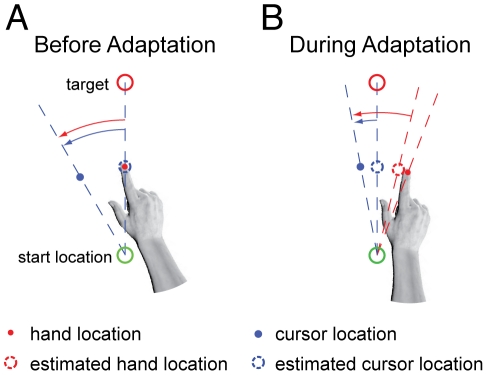
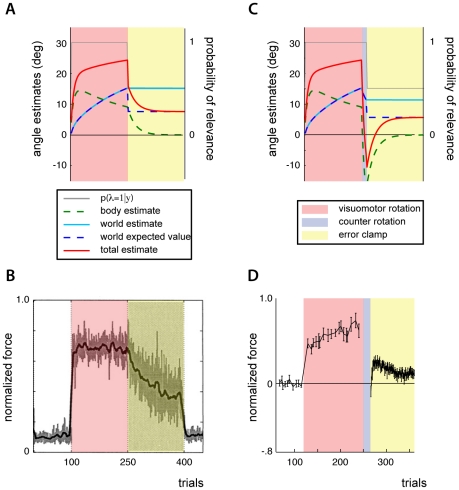
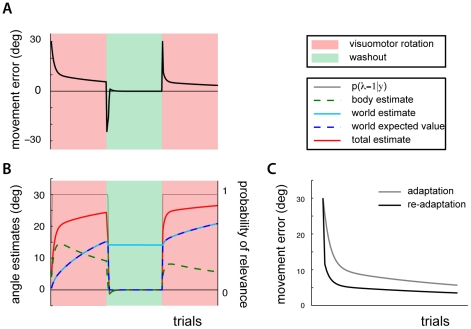
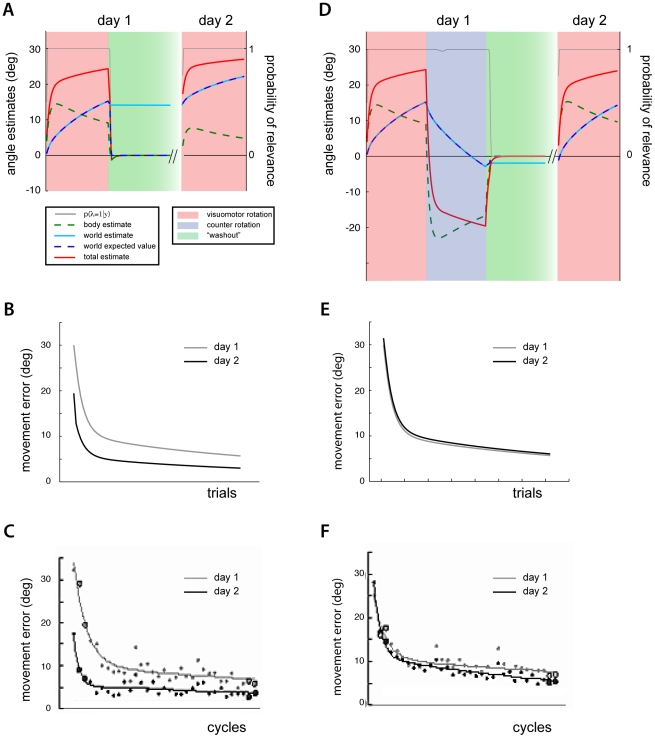
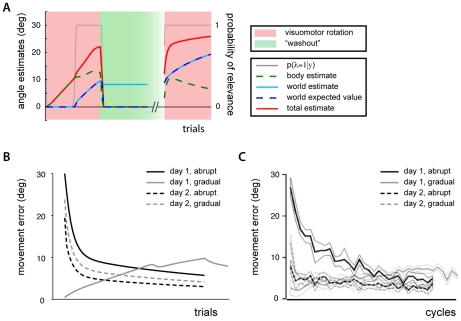
Recent studies suggest that motor adaptation is the result of multiple, perhaps linear processes each with distinct time scales. While these models are consistent with some motor phenomena, they can neither explain the relatively fast re-adaptation after a long washout period, nor savings on a subsequent day. Here we examined if these effects can be explained if we assume that the CNS stores and retrieves movement parameters based on their possible relevance. We formalize this idea with a model that infers not only the sources of potential motor errors, but also their relevance to the current motor circumstances. In our model adaptation is the process of re-estimating parameters that represent the body and the world. The likelihood of a world parameter being relevant is then based on the mismatch between an observed movement and that predicted when not compensating for the estimated world disturbance. As such, adapting to large motor errors in a laboratory setting should alert subjects that disturbances are being imposed on them, even after motor performance has returned to baseline. Estimates of this external disturbance should be relevant both now and in future laboratory settings. Estimated properties of our bodies on the other hand should always be relevant. Our model demonstrates savings, interference, spontaneous rebound and differences between adaptation to sudden and gradual disturbances. We suggest that many issues concerning savings and interference can be understood when adaptation is conditioned on the relevance of parameters.
最近的研究表明,运动适应是多个(或许是线性的)过程的结果,每个过程都有不同的时间尺度。虽然这些模型与一些运动现象一致,但它们既不能解释在长时间的洗脱期后相对较快的重新适应,也不能解释第二天的节省现象。在这里,我们假设中枢神经系统(CNS)根据运动参数的可能相关性来存储和检索运动参数,以此来检验这些效应是否可以得到解释。我们用一个模型来形式化这个想法,该模型不仅可以推断潜在运动误差的来源,还可以推断它们与当前运动环境的相关性。在我们的模型中,适应是重新估计代表身体和世界的参数的过程。然后,世界参数的相关性是基于观察到的运动与未补偿估计的世界干扰时的预测运动之间的不匹配。因此,在实验室环境中适应较大的运动误差应该提醒受试者,即使运动表现已经恢复到基线,也会对他们施加干扰。对这种外部干扰的估计在现在和未来的实验室环境中都应该是相关的。另一方面,对我们身体的估计属性应该始终是相关的。我们的模型演示了节省、干扰、自发反弹以及对突然和逐渐干扰的适应之间的差异。我们认为,当适应条件与参数的相关性相适应时,许多关于节省和干扰的问题都可以得到理解。