Brai2n, TRI & Department of Neurosurgery, Antwerp University Hospital, Antwerp, Belgium.
PLoS One. 2011;6(10):e24273. doi: 10.1371/journal.pone.0024273. Epub 2011 Oct 6.
Tinnitus, the perception of a sound without an external sound source, can lead to variable amounts of distress.
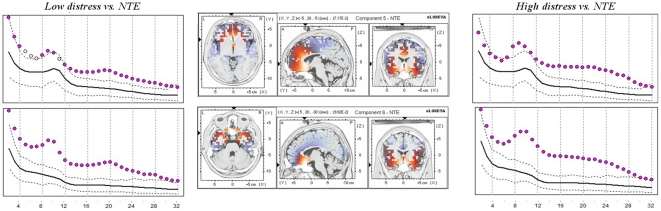
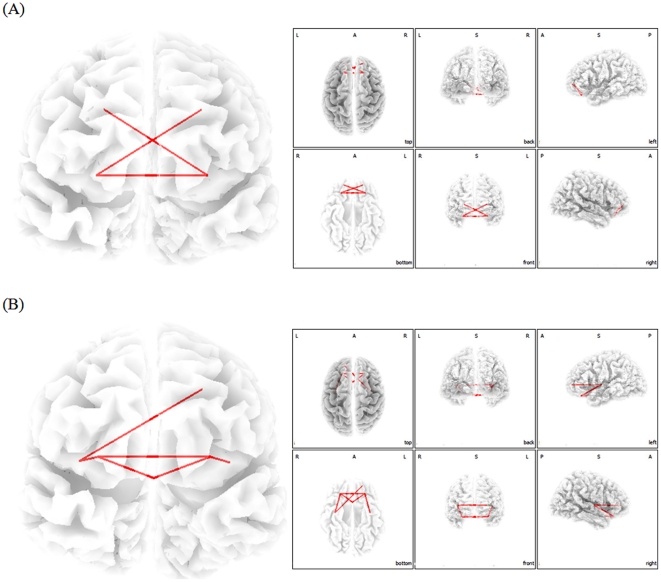
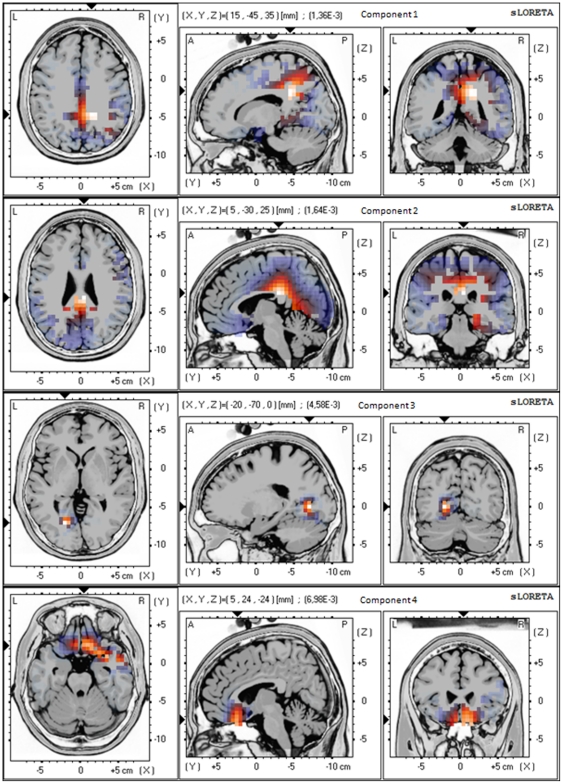
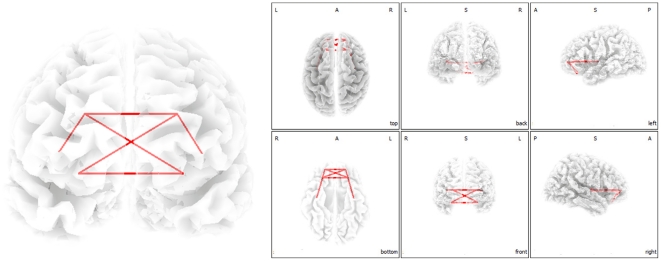
In a group of tinnitus patients with variable amounts of tinnitus related distress, as measured by the Tinnitus Questionnaire (TQ), an electroencephalography (EEG) is performed, evaluating the patients' resting state electrical brain activity. This resting state electrical activity is compared with a control group and between patients with low (N = 30) and high distress (N = 25). The groups are homogeneous for tinnitus type, tinnitus duration or tinnitus laterality. A group blind source separation (BSS) analysis is performed using a large normative sample (N = 84), generating seven normative components to which high and low tinnitus patients are compared. A correlation analysis of the obtained normative components' relative power and distress is performed. Furthermore, the functional connectivity as reflected by lagged phase synchronization is analyzed between the brain areas defined by the components. Finally, a group BSS analysis on the Tinnitus group as a whole is performed.
Tinnitus can be characterized by at least four BSS components, two of which are posterior cingulate based, one based on the subgenual anterior cingulate and one based on the parahippocampus. Only the subgenual component correlates with distress. When performed on a normative sample, group BSS reveals that distress is characterized by two anterior cingulate based components. Spectral analysis of these components demonstrates that distress in tinnitus is related to alpha and beta changes in a network consisting of the subgenual anterior cingulate cortex extending to the pregenual and dorsal anterior cingulate cortex as well as the ventromedial prefrontal cortex/orbitofrontal cortex, insula, and parahippocampus. This network overlaps partially with brain areas implicated in distress in patients suffering from pain, functional somatic syndromes and posttraumatic stress disorder, and might therefore represent a specific distress network.
耳鸣是一种没有外部声源的声音感知,可能导致不同程度的痛苦。
在一组耳鸣患者中,根据耳鸣问卷(TQ)测量,存在不同程度的耳鸣相关痛苦,对其进行脑电图(EEG)检查,评估患者的静息状态大脑电活动。将静息状态的电活动与对照组进行比较,并在低(N=30)和高痛苦(N=25)的患者之间进行比较。这些组在耳鸣类型、耳鸣持续时间或耳鸣侧别方面是同质的。对一个大的规范样本(N=84)进行群组盲源分离(BSS)分析,生成七个规范分量,将高和低耳鸣患者与之进行比较。对获得的规范分量的相对功率和痛苦进行相关分析。此外,还分析了由组件定义的大脑区域之间滞后相位同步反映的功能连接。最后,对整个耳鸣组进行群组 BSS 分析。
耳鸣至少可以用四个 BSS 分量来描述,其中两个分量基于后扣带,一个基于前扣带亚区,一个基于海马旁回。只有亚区分量与痛苦相关。当在规范样本上进行时,组 BSS 表明痛苦的特征是两个基于前扣带的分量。对这些分量的频谱分析表明,耳鸣中的痛苦与一个由扣带前回亚区延伸到扣带前回和背侧扣带前回以及腹内侧前额叶皮层/眶额皮层、岛叶和海马旁回的网络中的 alpha 和 beta 变化有关。这个网络与疼痛、功能性躯体综合征和创伤后应激障碍患者中涉及痛苦的大脑区域部分重叠,因此可能代表一个特定的痛苦网络。