
中低收入国家艾滋病治疗投资的经济回报。
Economic returns to investment in AIDS treatment in low and middle income countries.
机构信息
Harvard School of Public Health, Center for Health Decision Science, Boston, Massachusetts, United States of America.
出版信息
PLoS One. 2011;6(10):e25310. doi: 10.1371/journal.pone.0025310. Epub 2011 Oct 5.
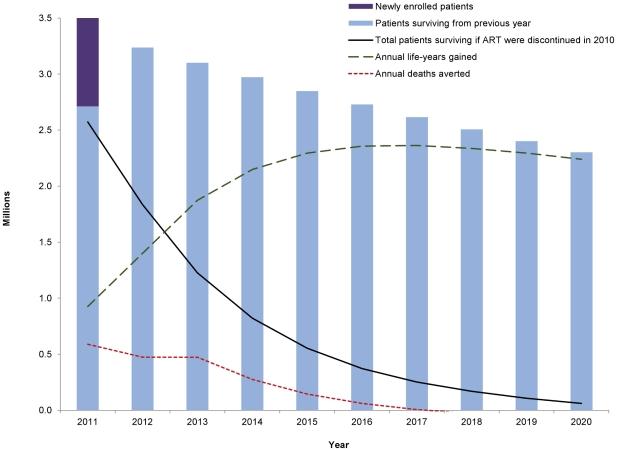
Since the early 2000s, aid organizations and developing country governments have invested heavily in AIDS treatment. By 2010, more than five million people began receiving antiretroviral therapy (ART)--yet each year, 2.7 million people are becoming newly infected and another two million are dying without ever having received treatment. As the need for treatment grows without commensurate increase in the amount of available resources, it is critical to assess the health and economic gains being realized from increasingly large investments in ART. This study estimates total program costs and compares them with selected economic benefits of ART, for the current cohort of patients whose treatment is cofinanced by the Global Fund to Fight AIDS, Tuberculosis and Malaria. At end 2011, 3.5 million patients in low and middle income countries will be receiving ART through treatment programs cofinanced by the Global Fund. Using 2009 ART prices and program costs, we estimate that the discounted resource needs required for maintaining this cohort are $14.2 billion for the period 2011-2020. This investment is expected to save 18.5 million life-years and return $12 to $34 billion through increased labor productivity, averted orphan care, and deferred medical treatment for opportunistic infections and end-of-life care. Under alternative assumptions regarding the labor productivity effects of HIV infection, AIDS disease, and ART, the monetary benefits range from 81 percent to 287 percent of program costs over the same period. These results suggest that, in addition to the large health gains generated, the economic benefits of treatment will substantially offset, and likely exceed, program costs within 10 years of investment.
自 21 世纪初以来,援助组织和发展中国家政府在艾滋病治疗方面投入了大量资金。到 2010 年,已有超过 500 万人开始接受抗逆转录病毒疗法(ART)——然而,每年仍有 270 万人新感染艾滋病,另有 200 万人在未经治疗的情况下死亡。由于治疗需求的增长与可用资源的相应增加不成比例,因此评估从越来越大的抗逆转录病毒疗法投资中获得的健康和经济效益至关重要。本研究估计了项目总成本,并将其与当前全球抗击艾滋病、结核病和疟疾基金共同资助的患者队列的部分经济效益进行了比较。到 2011 年底,低收入和中等收入国家将有 350 万名患者通过全球基金共同资助的治疗方案接受抗逆转录病毒治疗。利用 2009 年的抗逆转录病毒疗法价格和项目成本,我们估计,为维持这一患者队列,2011 年至 2020 年期间所需的资源需求预计为 142 亿美元。预计这项投资将挽救 1850 万人的生命,并通过提高劳动生产力、避免孤儿抚养、推迟治疗机会性感染和临终关怀,带来 120 亿至 340 亿美元的回报。在关于 HIV 感染、艾滋病和抗逆转录病毒疗法对劳动生产力影响的替代假设下,在同一时期,货币效益在项目成本的 81%至 287%之间。这些结果表明,除了产生的巨大健康收益外,治疗的经济效益将在投资 10 年内大大抵消,而且很可能超过项目成本。

 Zotero 插件