Departamento de Parasitología, Facultad de Farmacia, Universidad de Valencia, Avenida Vicente Andrés Estellés s/n, Burjassot, Valencia, Spain.
Parasit Vectors. 2011 Oct 14;4:200. doi: 10.1186/1756-3305-4-200.
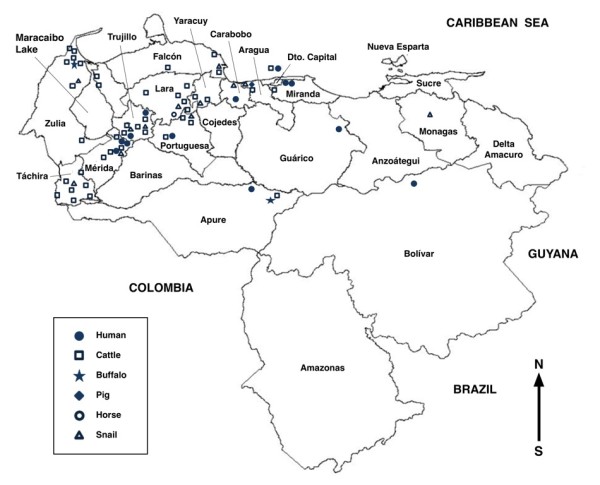
Human and animal fascioliasis poses serious public health problems in South America. In Venezuela, livestock infection represents an important veterinary problem whereas there appear to be few human cases reported, most of which are passively detected in health centres. However, results of recent surveys suggest that the situation may be underestimated in particular areas. To obtain a baseline for future fascioliasis assessment, studies were undertaken by means of rDNA ITS-2 and ITS-1 and mtDNA cox1 sequencing to clarify the specific status of Venezuelan lymnaeids, their geographical distribution and fascioliasis transmission capacity, by comparison with other American countries and other continents.
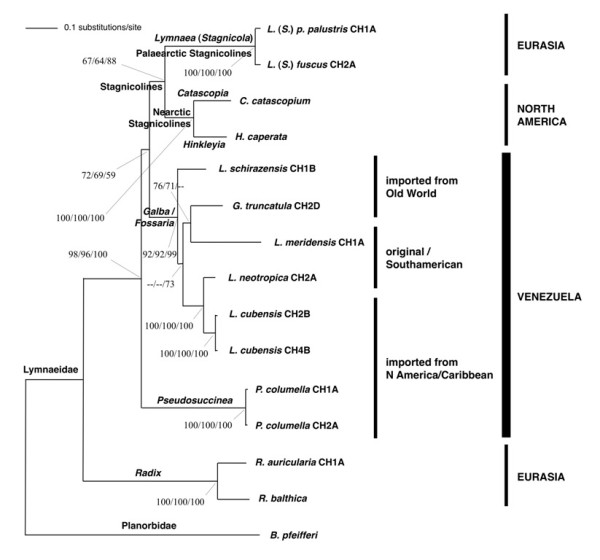
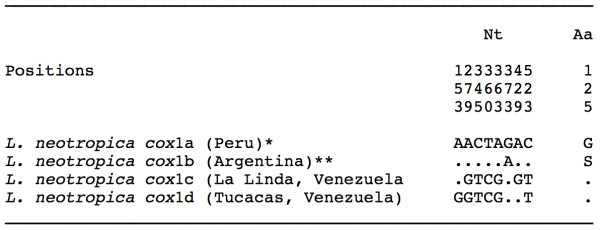
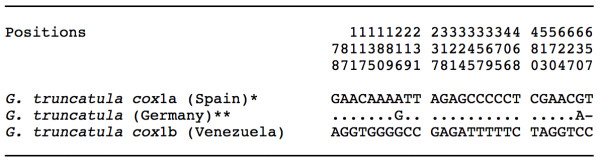
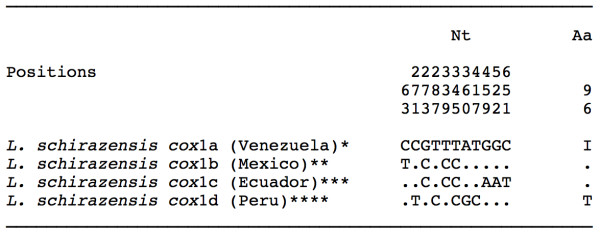
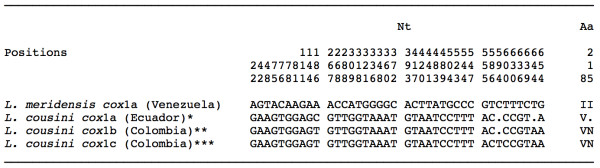
Results obtained completely change the lymnaeid scenario known so far. The relatively rich lymnaeid fauna of Venezuela has been proven to include (i) Lymnaea meridensis and L. neotropica as the only native members, (ii) L. cubensis and Pseudosuccinea columella introduced from the Caribbean area, and (iii) Galba truncatula and L. schirazensis introduced from the Old World. The absence of representatives of the stagnicoline and Radix groups is remarkable. Four species are fascioliasis vectors: G. truncatula, L. cubensis and L. neotropica, which have the capacity to give rise to human endemic areas, and P. columella, which is a source of animal infection and is responsible for the spread of disease. Vector capacity in the apparently highland endemic L. meridensis is to be confimed, although may be expected given its phylogenetic relationships. Similarly as elsewhere, the non-transmitting L. schirazensis has been confused with L. cubensis, also with G. truncatula and possibly with L. neotropica.
The new scenario leads to the re-opening of many disease aspects. In Venezuela, altitude appears to be the main factor influencing fascioliasis distribution. Human infection shows an altitude pattern similar to other Andean countries, although a differing highland/lowland impact on animal infection does not appear evident. The overlap of G. truncatula, L. cubensis and probably also L. neotropica in temperate and cold zones suggests a higher risk for human infection in mid and high altitude areas. A lymnaeid species mapping by means of DNA markers becomes a priority to determine human and animal fascioliasis distribution in Venezuela, owing to the importance of lymnaeid vectors in defining transmission and epidemiological patterns.
在南美洲,人类和动物的片形吸虫病对公共卫生构成严重威胁。在委内瑞拉,家畜感染是一个重要的兽医问题,而报告的人类病例似乎很少,大多数是在卫生中心被动发现的。然而,最近的调查结果表明,在某些地区情况可能被低估了。为了为未来的片形吸虫病评估提供基线,通过 rDNA ITS-2 和 ITS-1 以及 mtDNA cox1 测序进行了研究,以阐明委内瑞拉石鳖的具体状况、它们的地理分布和传播片形吸虫病的能力,与其他美洲国家和其他大陆进行了比较。
所获得的结果完全改变了迄今为止已知的石鳖情况。委内瑞拉相对丰富的石鳖动物群已被证明包括(i)meridensis 和 neotropica 作为唯一的本地成员,(ii)从加勒比地区引入的 cubensis 和 Pseudosuccinea columella,以及(iii)从旧世界引入的 truncatula 和 schirazensis。值得注意的是,没有 stagnicoline 和 Radix 组的代表。有四种石鳖是片形吸虫病的传播媒介:G. truncatula、L. cubensis 和 L. neotropica,它们有能力导致人类地方性地区的出现,以及 P. columella,它是动物感染的来源,负责疾病的传播。在看似高海拔的地方性 L. meridensis 中,传播能力有待确认,尽管考虑到其系统发育关系,这可能是预期的。与其他地方一样,非传播的 schirazensis 与 cubensis 混淆,也可能与 truncatula 和 neotropica 混淆。
新的情况导致了许多疾病方面的重新开放。在委内瑞拉,海拔似乎是影响片形吸虫病分布的主要因素。人类感染呈现出与其他安第斯国家相似的海拔模式,尽管在动物感染方面,高海拔/低海拔的影响似乎并不明显。G. truncatula、L. cubensis 和可能还有 L. neotropica 在温带和寒冷地区的重叠表明,在中高海拔地区人类感染的风险更高。通过 DNA 标记对石鳖进行物种绘图成为确定委内瑞拉人类和动物片形吸虫病分布的优先事项,因为石鳖媒介在确定传播和流行病学模式方面非常重要。