Departamento de Parasitología, Facultad de Farmacia, Universidad de Valencia, Av Vicente Andrés Estellés s/n, 46100 Burjassot-Valencia, Spain.
Parasit Vectors. 2012 Aug 15;5:174. doi: 10.1186/1756-3305-5-174.
Human and animal fascioliasis is emerging in many world regions, among which Andean countries constitute the largest regional hot spot and Peru the country presenting more human endemic areas. A survey was undertaken on the lymnaeid snails inhabiting the hyperendemic area of Cajamarca, where human prevalences are the highest known among the areas presenting a "valley transmission pattern", to establish which species are present, genetically characterise their populations by comparison with other human endemic areas, and discuss which ones have transmission capacity and their potential implications with human and animal infection.
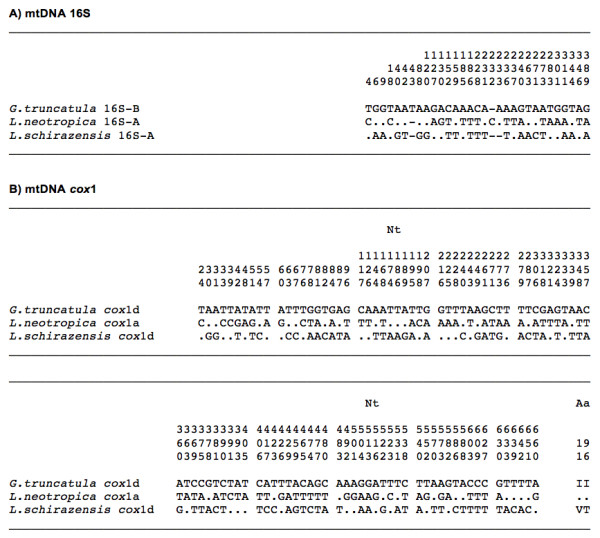
Therefore, ribosomal DNA ITS-2 and ITS-1, and mitochondrial DNA 16S and cox1 were sequenced by the dideoxy chain-termination method.
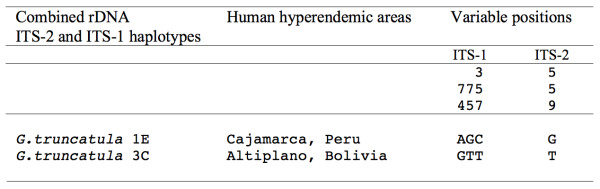
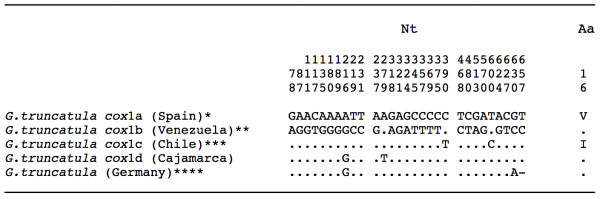
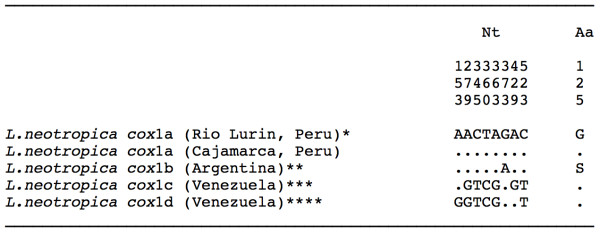
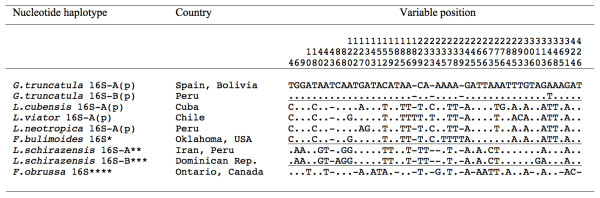
Results indicate the presence of three, morphologically similar, small lymnaeid species belonging to the Galba/Fossaria group: Galba truncatula, Lymnaea neotropica and L. schirazensis. Only one combined haplotype for each species was found. The ITS-1, 16S and cox1 haplotypes of G. truncatula are new. No new haplotypes were found in the other two species. This scenario changes previous knowledge, in which only L. viator (= L. viatrix) was mentioned. Galba truncatula appears to be the most abundant, with high population densities and evident anthropophyly including usual presence in human neighbourhood. Infection by Fasciola hepatica larval stages were molecularly confirmed in two populations of this species. The nearness between G. truncatula populations presenting liver fluke infection and both human settings and schools for children, together with the absence of populations of other lymnaeid species in the locality, suggest a direct relationship with human infection.
The geographical overlap of three lymnaeid species poses problems for epidemiological studies and control action. First, a problem in classifying lymnaeid specimens in both field and laboratory activities, given their transmission capacity differences: G. truncatula mainly involved in transmission to humans, L neotropica typically responsible for livestock infection, and L. schirazensis unable for transmission. Although several phenotypic characteristics may be helpful for a preliminary specimen classification, a definitive classification can only be obtained by marker sequencing. Aditionally, L. schirazensis increases the confusion, owing to its ability to mix with other Galba/Fossaria species and distort fascioliasis data such as transmission capacity and infection susceptibility. Second, a problem for epidemiological analysis, surveillance and control by methods as mathematical modelling and Remote Sensing--Geographical Information Systems. In Cajamarca, low resolution mapping may be insufficient, as already verified in Andean areas where different lymnaeid species overlap.
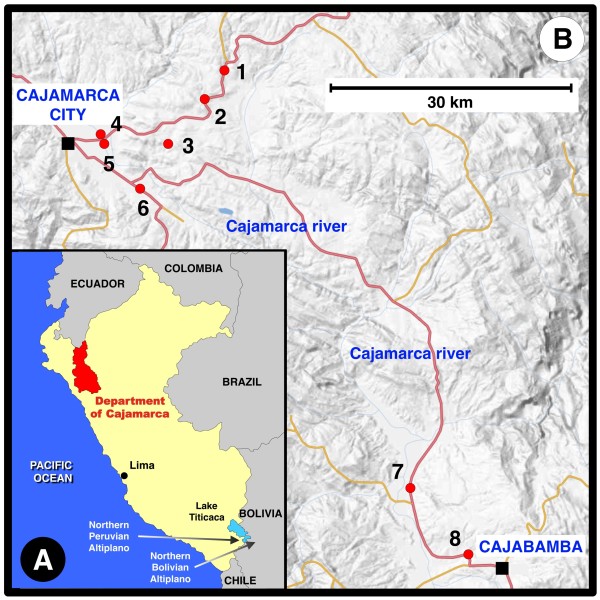
在许多世界区域,人类和动物片形吸虫病正在出现,其中安第斯国家构成了最大的区域热点,秘鲁是出现人类地方性流行区最多的国家。在卡哈马卡的高度地方性流行地区,对栖息的圆口螺进行了调查,该地区的人类流行率是已知的“山谷传播模式”中最高的,以确定存在哪些物种,通过与其他人类地方性流行地区的比较,对其种群进行遗传特征描述,并讨论哪些具有传播能力及其对人类和动物感染的潜在影响。
因此,通过双脱氧链终止法对核糖体 DNA ITS-2 和 ITS-1 以及线粒体 DNA 16S 和 cox1 进行了测序。
结果表明,存在三种形态相似的小型圆口螺,属于 Galba/Fossaria 组:Galba truncatula、Lymnaea neotropica 和 L. schirazensis。每种物种仅发现一个组合单倍型。G. truncatula 的 ITS-1、16S 和 cox1 单倍型是新的。在其他两种物种中没有发现新的单倍型。这种情况改变了以前的知识,其中只提到了 L. viator(=L. viatrix)。G. truncatula 似乎是最丰富的,具有高密度的种群和明显的人亲源性,包括通常存在于人类社区中。在该物种的两个种群中,通过分子方法证实了肝片吸虫幼虫阶段的感染。在存在肝片吸虫感染的 G. truncatula 种群与人类环境和儿童学校之间的接近程度,以及该地点缺乏其他圆口螺种群,表明与人类感染之间存在直接关系。
三种圆口螺的地理重叠给流行病学研究和控制行动带来了问题。首先,在现场和实验室活动中对圆口螺标本进行分类存在问题,因为它们的传播能力不同:G. truncatula 主要参与人类传播,L. neotropica 通常负责牲畜感染,而 L. schirazensis 则无法传播。尽管一些表型特征可能有助于初步标本分类,但只有通过标记测序才能获得确定的分类。此外,由于其能够与其他 Galba/Fossaria 物种混合并扭曲肝片吸虫病的数据(如传播能力和感染易感性),L. schirazensis 增加了混淆。其次,由于数学模型和遥感-地理信息系统等方法的流行病学分析、监测和控制存在问题。在卡哈马卡,低分辨率测绘可能不足,正如在安第斯地区已经验证的那样,那里存在不同的圆口螺物种重叠。