Department of Sociology and Office of Population Research, Princeton University, Princeton, NJ 08544, USA.
Am J Epidemiol. 2011 Nov 15;174(10):1190-6. doi: 10.1093/aje/kwr246. Epub 2011 Oct 14.
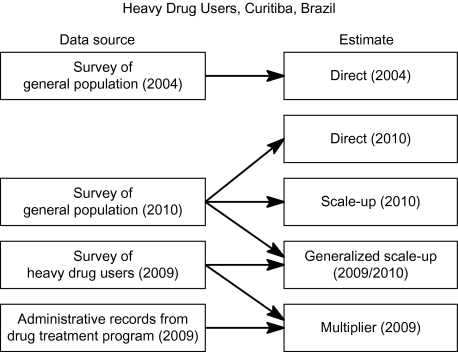
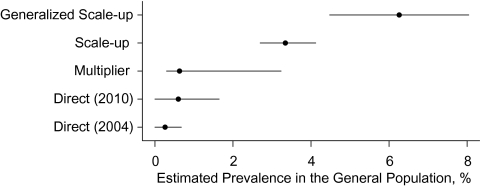
One of the many challenges hindering the global response to the human immunodeficiency virus (HIV)/acquired immunodeficiency syndrome (AIDS) epidemic is the difficulty of collecting reliable information about the populations most at risk for the disease. Thus, the authors empirically assessed a promising new method for estimating the sizes of most at-risk populations: the network scale-up method. Using 4 different data sources, 2 of which were from other researchers, the authors produced 5 estimates of the number of heavy drug users in Curitiba, Brazil. The authors found that the network scale-up and generalized network scale-up estimators produced estimates 5-10 times higher than estimates made using standard methods (the multiplier method and the direct estimation method using data from 2004 and 2010). Given that equally plausible methods produced such a wide range of results, the authors recommend that additional studies be undertaken to compare estimates based on the scale-up method with those made using other methods. If scale-up-based methods routinely produce higher estimates, this would suggest that scale-up-based methods are inappropriate for populations most at risk of HIV/AIDS or that standard methods may tend to underestimate the sizes of these populations.
阻碍全球应对人类免疫缺陷病毒 (HIV)/获得性免疫缺陷综合征 (AIDS) 流行的众多挑战之一是难以收集有关最易感染该疾病人群的可靠信息。因此,作者对一种估计高危人群规模的有前途的新方法进行了实证评估:网络扩展方法。作者使用了 4 个不同的数据源,其中 2 个来自其他研究人员,对巴西库里蒂巴的重度吸毒者人数进行了 5 次估计。作者发现,网络扩展和广义网络扩展估计器产生的估计值比使用标准方法(乘数法和使用 2004 年和 2010 年数据的直接估计法)的估计值高 5-10 倍。鉴于同样合理的方法产生了如此广泛的结果,作者建议进行更多的研究,以比较基于扩展方法的估计值与使用其他方法得出的估计值。如果基于扩展的方法通常产生更高的估计值,则表明基于扩展的方法不适合 HIV/AIDS 高危人群,或者标准方法可能倾向于低估这些人群的规模。