Department of Chemical Engineering, Columbia University, New York, New York, United States of America.
PLoS One. 2011;6(10):e24948. doi: 10.1371/journal.pone.0024948. Epub 2011 Oct 7.
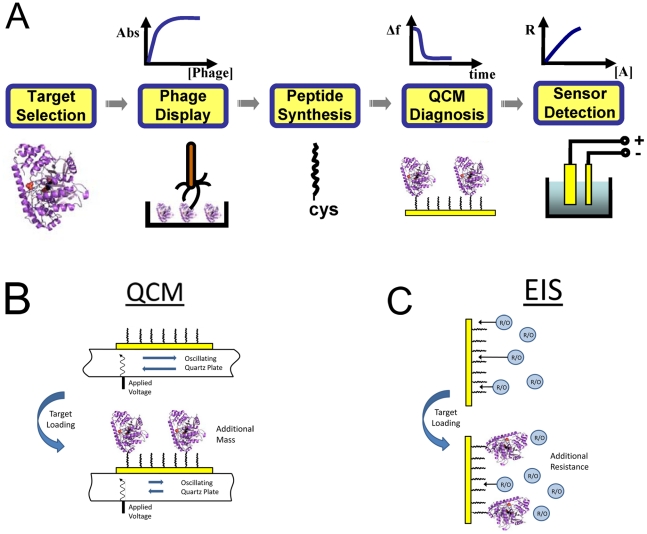
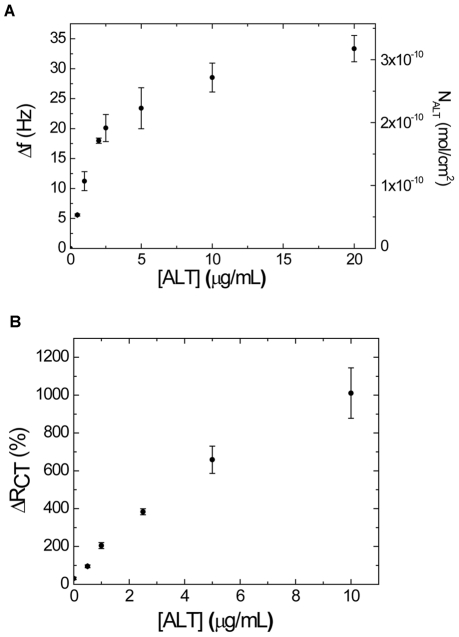
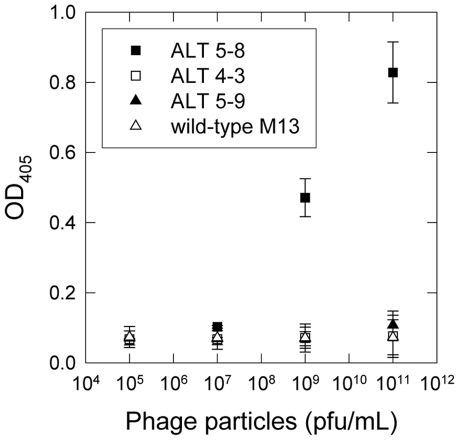
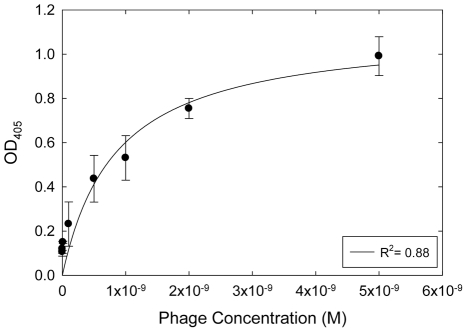
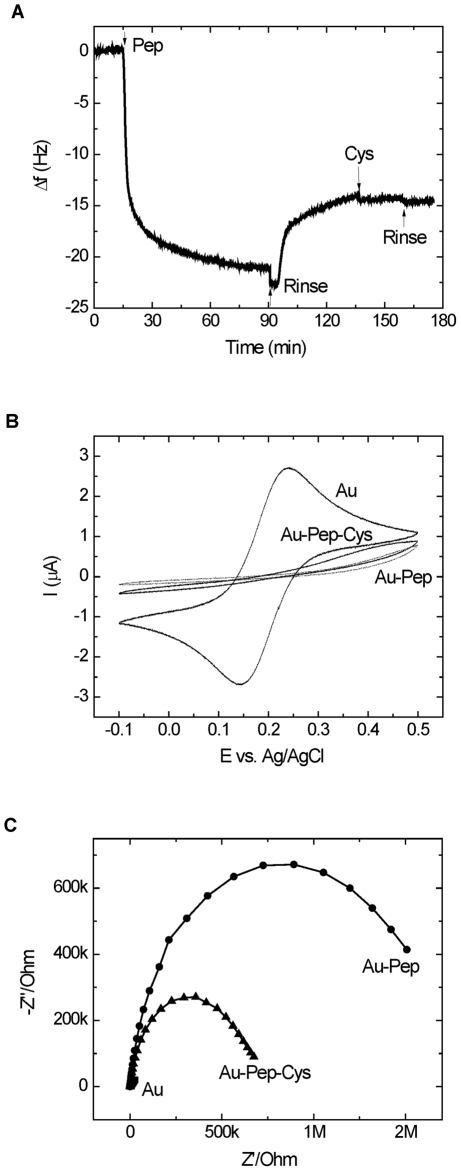
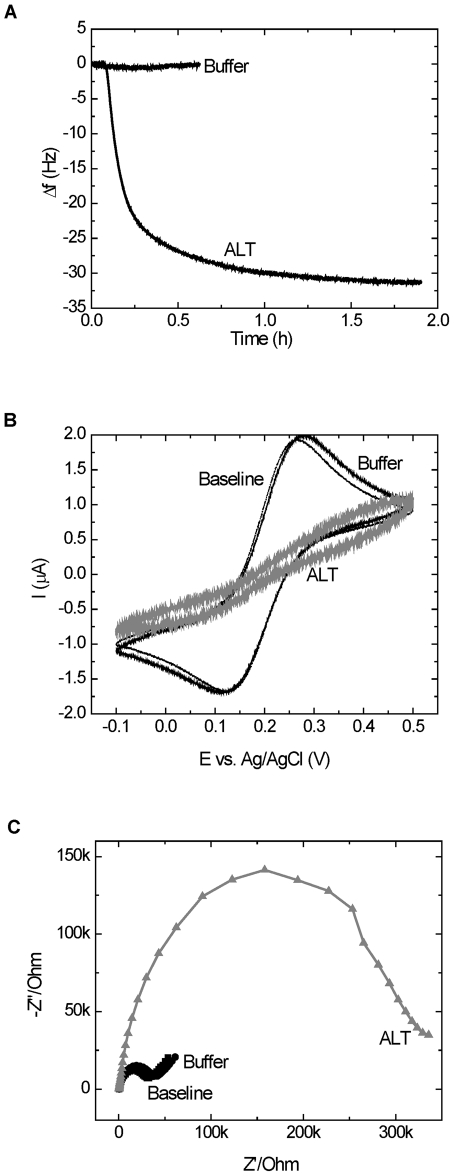
There is a consistent demand for new biosensors for the detection of protein targets, and a systematic method for the rapid development of new sensors is needed. Here we present a platform where short unstructured peptides that bind to a desired target are selected using M13 phage display. The selected peptides are then chemically synthesized and immobilized on gold, allowing for detection of the target using electrochemical techniques such as electrochemical impedance spectroscopy (EIS). A quartz crystal microbalance (QCM) is also used as a diagnostic tool during biosensor development. We demonstrate the utility of this approach by creating a novel peptide-based electrochemical biosensor for the enzyme alanine aminotransferase (ALT), a well-known biomarker of hepatotoxicity. Biopanning of the M13 phage display library over immobilized ALT, led to the rapid identification of a new peptide (ALT5-8) with an amino acid sequence of WHWRNPDFWYLK. Phage particles expressing this peptide exhibited nanomolar affinity for immobilized ALT (K(d,app) = 85±20 nM). The newly identified ALT5-8 peptide was then chemically synthesized with a C-terminal cysteine for gold immobilization. The performance of the gold-immobilized peptides was studied with cyclic voltammetry (CV), QCM, and EIS. Using QCM, the sensitivity for ALT detection was 8.9±0.9 Hz/(µg/mL) and the limit of detection (LOD) was 60 ng/mL. Using EIS measurements, the sensitivity was 142±12 impedance percentage change %/(µg/mL) and the LOD was 92 ng/mL. In both cases, the LOD was below the typical concentration of ALT in human blood. Although both QCM and EIS produced similar LODs, EIS is preferable due to a larger linear dynamic range. Using QCM, the immobilized peptide exhibited a nanomolar dissociation constant for ALT (K(d) = 20.1±0.6 nM). These results demonstrate a simple and rapid platform for developing and assessing the performance of sensitive, peptide-based biosensors for new protein targets.
人们一直需要新的生物传感器来检测蛋白质靶标,因此需要一种系统的方法来快速开发新的传感器。在这里,我们提出了一个平台,使用 M13 噬菌体展示技术选择与所需靶标结合的短非结构化肽。然后,选择的肽被化学合成并固定在金上,允许使用电化学技术(如电化学阻抗谱(EIS))检测目标。石英晶体微天平(QCM)也可作为生物传感器开发过程中的诊断工具。我们通过创建一种新颖的基于肽的电化学生物传感器来检测酶丙氨酸氨基转移酶(ALT),证明了这种方法的实用性,ALT 是肝毒性的一种众所周知的生物标志物。在固定化 ALT 上对 M13 噬菌体展示文库进行生物淘选,快速鉴定出一种新的肽(ALT5-8),其氨基酸序列为 WHWRNPDFWYLK。表达该肽的噬菌体颗粒对固定化 ALT 表现出纳摩尔亲和力(K(d,app)=85±20 nM)。然后,新鉴定的 ALT5-8 肽被化学合成,在 C 端带有半胱氨酸用于金固定。使用循环伏安法(CV)、QCM 和 EIS 研究了金固定肽的性能。使用 QCM,ALT 检测的灵敏度为 8.9±0.9 Hz/(µg/mL),检测限(LOD)为 60 ng/mL。使用 EIS 测量,灵敏度为 142±12 阻抗百分比变化%/(µg/mL),LOD 为 92 ng/mL。在这两种情况下,LOD 均低于人血液中 ALT 的典型浓度。虽然 QCM 和 EIS 产生的 LOD 相似,但 EIS 更可取,因为它具有更大的线性动态范围。使用 QCM,固定化肽对 ALT 的解离常数为纳摩尔级(K(d)=20.1±0.6 nM)。这些结果表明,这是一种用于开发和评估新型蛋白质靶标敏感肽基生物传感器性能的简单快速平台。