Department of Chemistry & Biochemistry, Kennesaw State University, Kennesaw, GA 30144, USA.
FEBS J. 2011 Dec;278(24):4943-54. doi: 10.1111/j.1742-4658.2011.08395.x. Epub 2011 Nov 11.
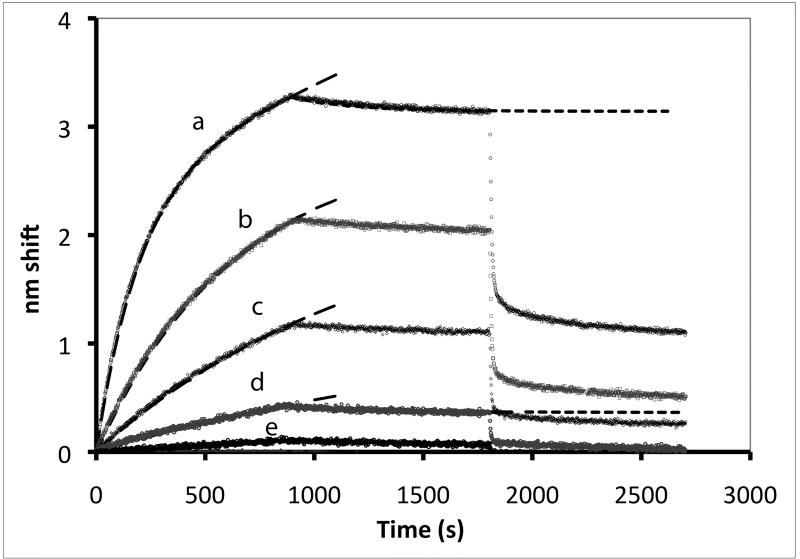
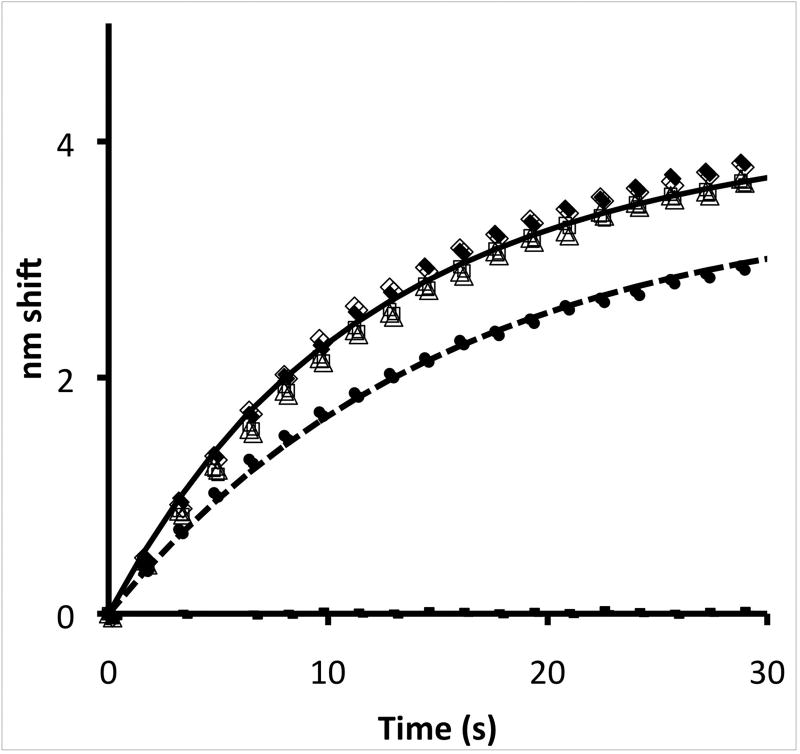
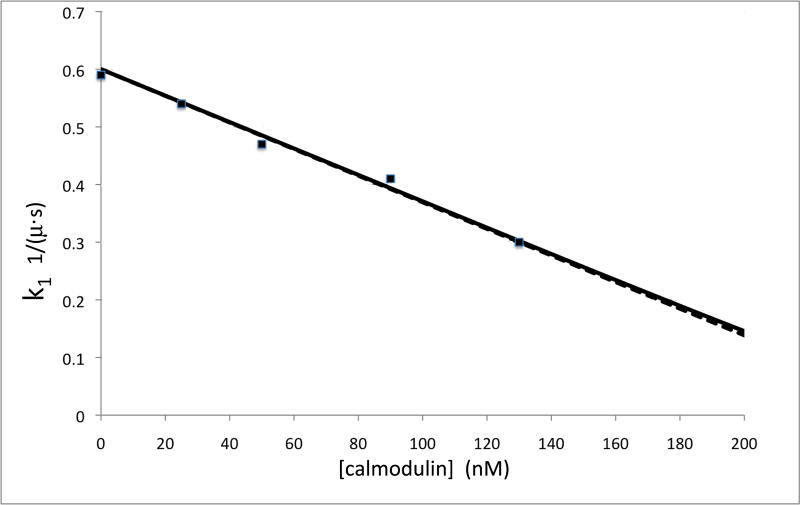
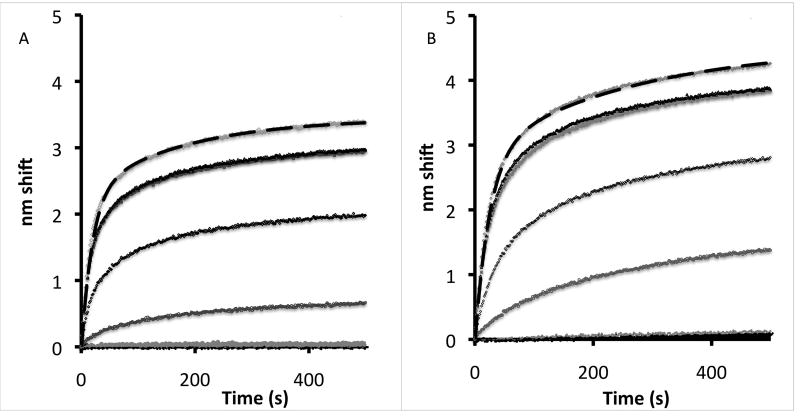
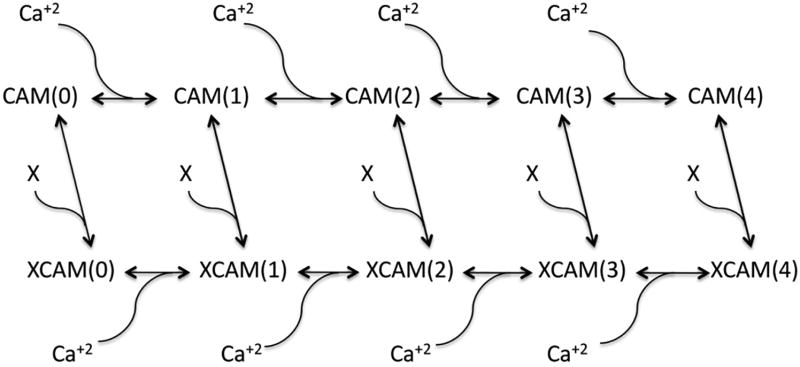
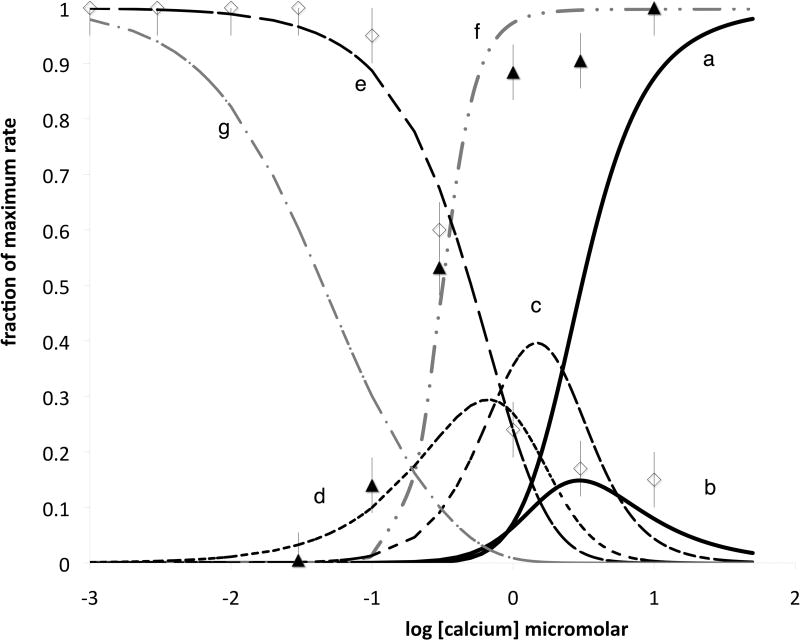
Using interferometry-based biosensors the binding and release of endothelial and neuronal nitric oxide synthase (eNOS and nNOS) from calmodulin (CaM) was measured. In both isoforms, binding to CaM is diffusion limited and within approximately three orders of magnitude of the Smoluchowski limit imposed by orientation-independent collisions. This suggests that the orientation of CaM is facilitated by the charge arrays on the CaM-binding site and the complementary surface on CaM. Protein kinase C phosphorylation of eNOS T495, adjacent to the CaM-binding site, abolishes or greatly slows CaM binding. Kinases which increase the activity of eNOS did not stimulate the binding of CaM, which is already diffusion limited. The coupling of Ca(2+) binding and CaM/NOS binding equilibria links the affinity of CaM for NOS to the Ca(2+) dependence of CaM binding. Hence, changes in the Ca(2+) sensitivity of CaM binding always imply changes in the NOS-CaM affinity. It is possible, however, that in some regimes binding and activation are not synonymous, so that Ca(2+) sensitivity need not be tightly linked to CaM sensitivity of activation. This study is being extended using mutants to probe the roles of individual structural elements in binding and release.
使用基于干涉测量的生物传感器,测量了内皮型和神经元型一氧化氮合酶(eNOS 和 nNOS)与钙调蛋白(CaM)的结合和释放。在这两种同工酶中,与 CaM 的结合是扩散限制的,并且大约在由无取向碰撞引起的 Smoluchowski 限制的三个数量级范围内。这表明 CaM 的取向是由 CaM 结合位点上的电荷阵列和 CaM 上的互补表面促进的。邻近 CaM 结合位点的 eNOS T495 的蛋白激酶 C 磷酸化会使 CaM 结合完全或大大减慢。增加 eNOS 活性的激酶不会刺激 CaM 的结合,因为 CaM 的结合已经是扩散限制的。Ca2+结合和 CaM/NOS 结合平衡的偶联将 CaM 与 NOS 的亲和力与 CaM 结合的 Ca2+依赖性联系起来。因此,CaM 结合的 Ca2+敏感性的变化总是意味着 NOS-CaM 亲和力的变化。然而,在某些情况下,结合和激活并非同义词,因此 Ca2+敏感性不一定与 CaM 激活的敏感性紧密相关。这项研究正在使用突变体进行扩展,以探究单个结构元素在结合和释放中的作用。