Department of Medical Parasitology, School of Basic Medical Science, Wuhan University, Wuhan 430071, People's Republic of China.
Parasit Vectors. 2011 Oct 17;4:201. doi: 10.1186/1756-3305-4-201.
Praziquantel has been used as first-line drug for chemotherapy of schistosomiasis since 1984. Besides praziquantel, artemether and artesunate have also been used for the control of this infectious disease since late 1990s. In this article, we conducted a systematic review and meta-analysis to evaluate the antischistosomal efficacy of different medication strategies including monotherapy or combination therapies of these drugs.
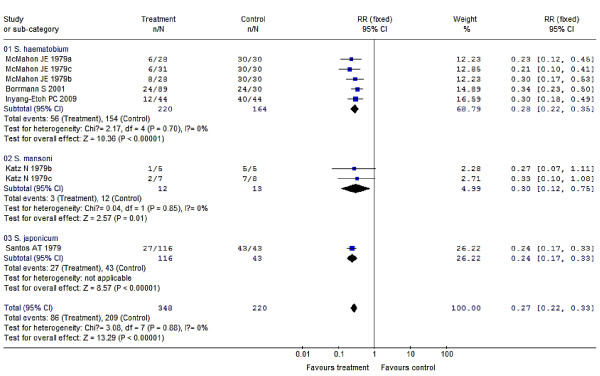
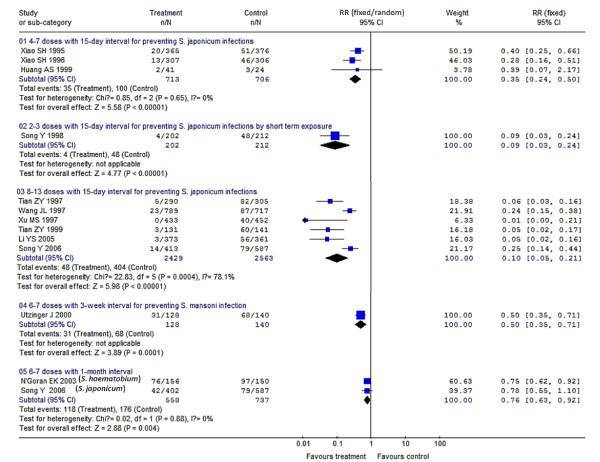
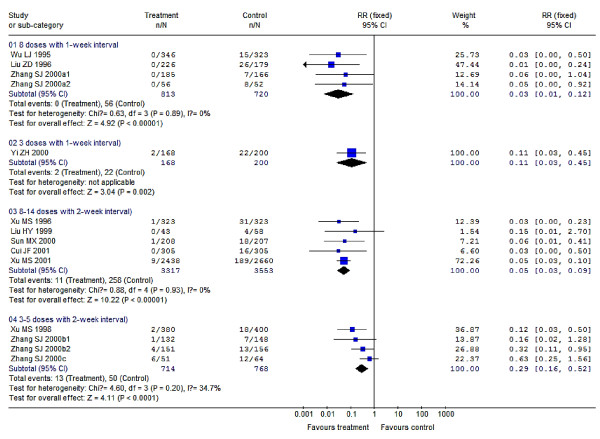
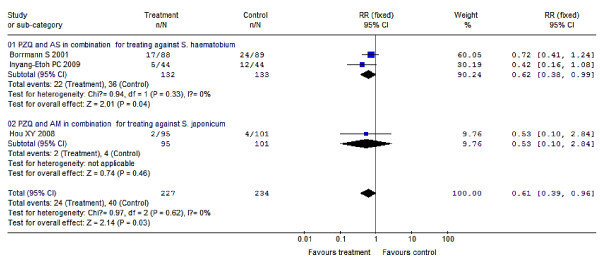
A number of 52 trials from 38 articles published in peer-reviewed journals before July 2011 were selected for analysis after searching the following literature databases: the Cochrane Library, PubMed/Medline, ISI Web of Science, Chinese Biomedicine Literature Database, and China National Knowledge Infrastructure. Our meta-analyses showed that a dosage of 30-60 mg/kg praziquantel compared with placebo produced a protection rate of about 76% (95% CI: 67%-83%) for treating human schistosomiasis, which varied from 70% to 76% with no significant differences among the subspecies S. haematobium, S. japonicum or S. mansoni. Protection rates were higher when praziquantel doses were elevated, as concluded from the nRCTs results: the protection rate of praziquantel at 40 mg/kg was 52% (95% CI: 49%-55%), and it increased to 91% (95% CI: 88%-92%) when the dosages were elevated to 60/80/100 mg/kg divided two or more doses. Multiple doses of artemether or artesunate over 1- or 2-week intervals resulted in protection rates of 65% to 97% for preventing schistosomiasis, and increased doses and shorter medication intervals improved their efficacies. Praziquantel and artemisinin derivatives (artemether or artesunate) in combination resulted in a higher protection rate of 84% (95% CI: 64%-91%) than praziquantel monotherapy for treatment. praziquantel and artesunate in combination had a great protection rate of 96% (95% CI: 78%-99%) for preventing schistosomes infection.
According to the results, praziquantel remains effective in schistosomiasis treatment, and multiple doses would improve its efficacy; meanwhile, praziquantel is also a good drug for preventing acute schistosomiasis morbidity. It's better to use multiple doses of artemether or artesunate with 1- or 2-week intervals for prevention against schistosome infection. Praziquantel and artemether or artesunate in combination perform better in treatment than praziquantel monotherapy, and they are especially suitable for treating the patients with repeated exposure to infected water.
自 1984 年以来,吡喹酮一直被用作治疗血吸虫病的一线化疗药物。除了吡喹酮,青蒿素及其衍生物(青蒿琥酯和蒿甲醚)自 20 世纪 90 年代末以来也被用于控制这种传染病。在本文中,我们进行了一项系统评价和荟萃分析,以评估这些药物的单药或联合治疗方案的抗血吸虫病疗效。
通过检索以下文献数据库,共筛选出 52 项研究,这些研究均来自于 2011 年 7 月前发表在同行评审期刊上的 38 篇文章:Cochrane 图书馆、PubMed/Medline、ISI Web of Science、中国生物医学文献数据库和中国国家知识基础设施。我们的荟萃分析显示,剂量为 30-60mg/kg 的吡喹酮与安慰剂相比,治疗人类血吸虫病的保护率约为 76%(95%CI:67%-83%),亚种 S. haematobium、S. japonicum 或 S. mansoni 之间无显著差异。从 nRCTs 结果可以看出,当吡喹酮剂量增加时,保护率更高:剂量为 40mg/kg 时保护率为 52%(95%CI:49%-55%),当剂量增加到 60/80/100mg/kg 并分为两剂或更多剂时,保护率增加到 91%(95%CI:88%-92%)。青蒿琥酯或蒿甲醚多剂量(1 或 2 周间隔)可预防血吸虫病,保护率为 65%-97%,增加剂量和缩短用药间隔可提高疗效。吡喹酮和青蒿素衍生物(青蒿琥酯或蒿甲醚)联合使用的保护率为 84%(95%CI:64%-91%),高于吡喹酮单药治疗。吡喹酮和青蒿琥酯联合使用对预防血吸虫感染的保护率高达 96%(95%CI:78%-99%)。
根据这些结果,吡喹酮在治疗血吸虫病方面仍然有效,多剂量可提高其疗效;同时,吡喹酮也是预防急性血吸虫病发病的一种良好药物。预防血吸虫感染,1 或 2 周间隔使用多剂量青蒿琥酯或蒿甲醚更好。吡喹酮和青蒿素衍生物(青蒿琥酯或蒿甲醚)联合使用在治疗方面优于吡喹酮单药治疗,特别适用于治疗反复接触感染水的患者。