Godar Dianne E
Center for Devices and Radiological Health, Food and Drug Administration, 10903 New Hampshire Avenue, WO64-4024, Silver Spring, MD 20993, USA.
J Skin Cancer. 2011;2011:858425. doi: 10.1155/2011/858425. Epub 2011 Oct 10.
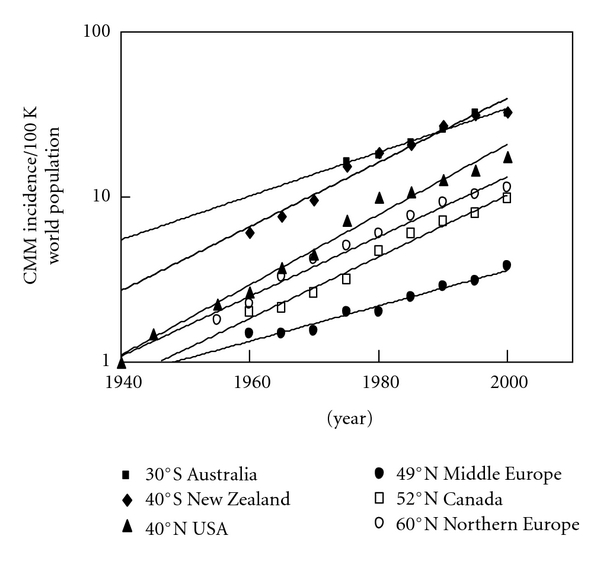
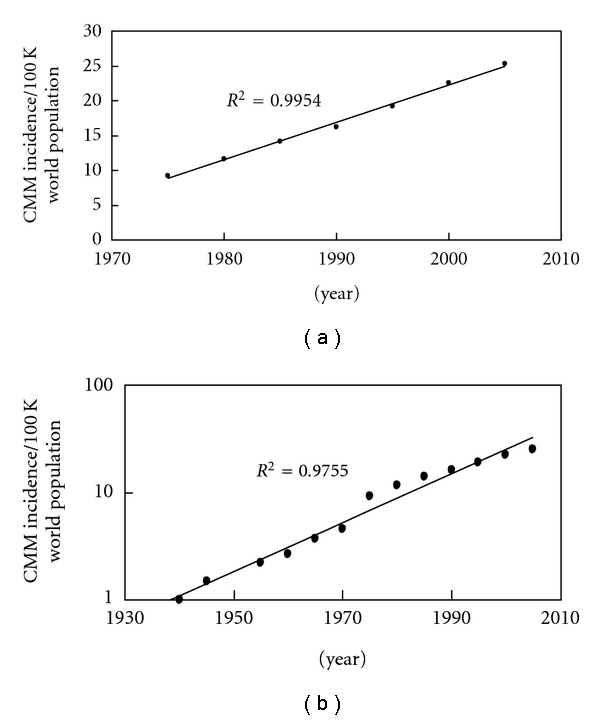
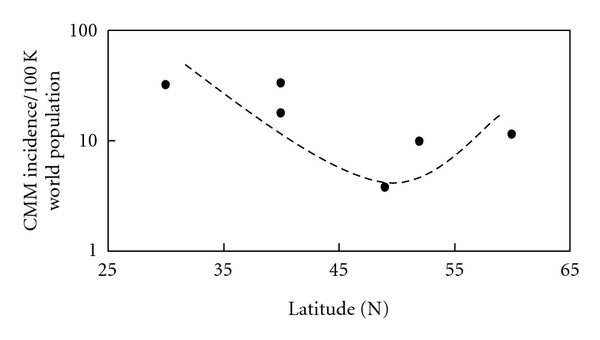
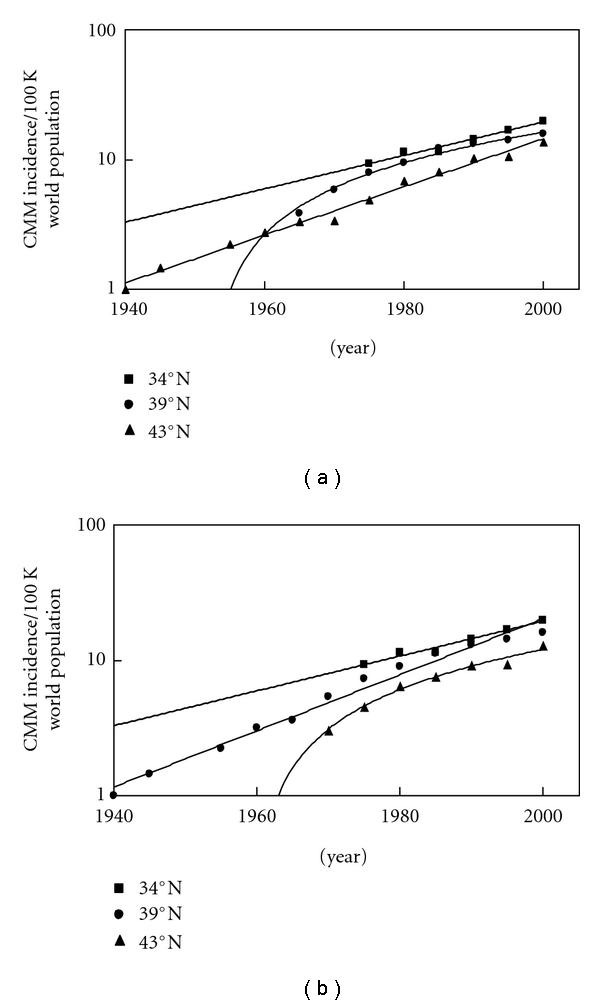
The incidence of cutaneous malignant melanoma (CMM) has been increasing at a steady rate in fair-skinned populations around the world for decades. Scientists are not certain why CMM has been steadily increasing, but strong, intermittent UVB (290-320 nm) exposures, especially sunburn episodes, probably initiate, CMM, while UVA (321-400 nm) passing through glass windows in offices and cars probably promotes it. The CMM incidence may be increasing at an exponential rate around the world, but it definitely decreases with increasing latitude up to ~50°N where it reverses and increases with the increasing latitude. The inversion in the incidence of CMM may occur because there is more UVA relative to UVB for most of the year at higher latitudes. If windows, allowing UVA to enter our indoor-working environment and cars, are at least partly responsible for the increasing incidence of CMM, then UV filters can be applied to reduce the rate of increase worldwide.
几十年来,在世界各地皮肤白皙的人群中,皮肤恶性黑色素瘤(CMM)的发病率一直在稳步上升。科学家们不确定CMM为何一直在稳步上升,但强烈的、间歇性的中波紫外线(UVB,290 - 320纳米)照射,尤其是晒伤,可能引发CMM,而透过办公室和汽车窗户的长波紫外线(UVA,321 - 400纳米)可能会促使其发展。全球范围内,CMM的发病率可能呈指数级增长,但随着纬度升高至约北纬50°,其发病率肯定会下降,在该纬度以上又会随着纬度升高而上升。CMM发病率的这种反转可能是因为在高纬度地区,一年中的大部分时间里UVA相对于UVB更多。如果允许UVA进入我们室内工作环境和汽车的窗户至少部分导致了CMM发病率的上升,那么可以应用紫外线过滤器来降低全球发病率的上升速度。