Grigalavicius Mantas, Juzeniene Asta, Baturaite Zivile, Dahlback Arne, Moan Johan
Department of Radiation Biology; Institute for Cancer Research; the Norwegian Radium Hospital; Oslo University Hospital; Oslo, Norway.
Institute of Physics; University of Oslo; Oslo, Norway.
Dermatoendocrinol. 2013 Jan 1;5(1):150-8. doi: 10.4161/derm.22941.
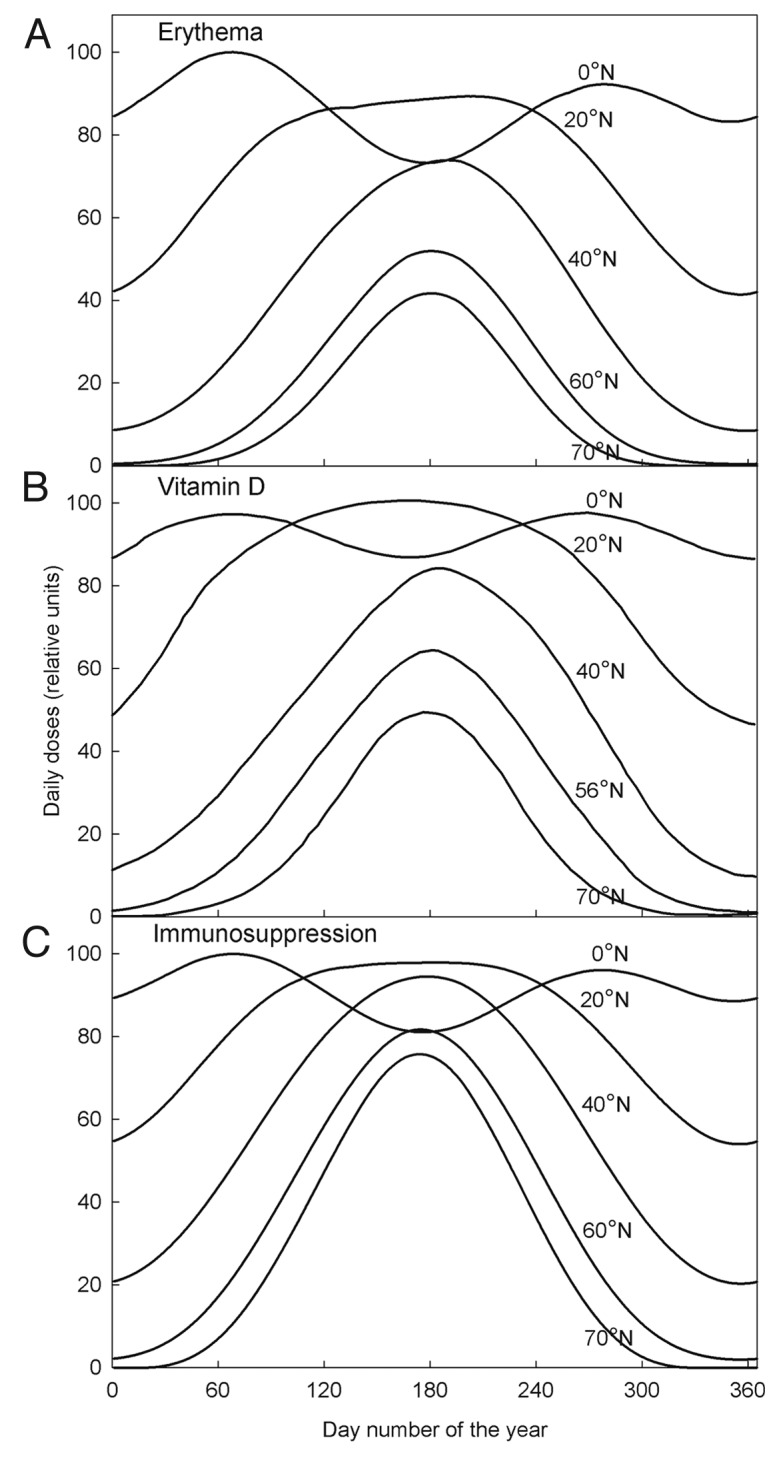
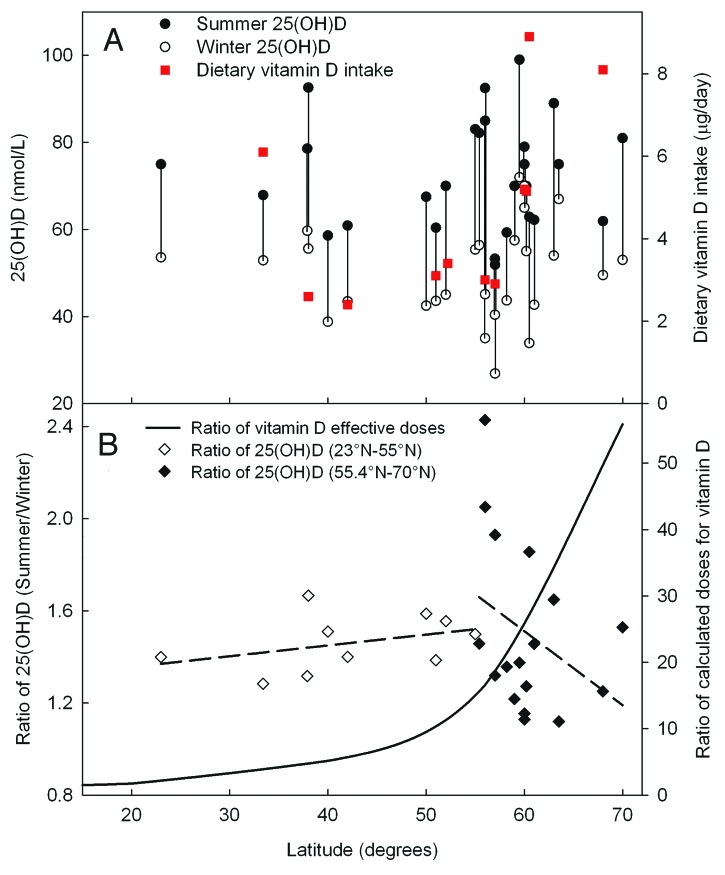
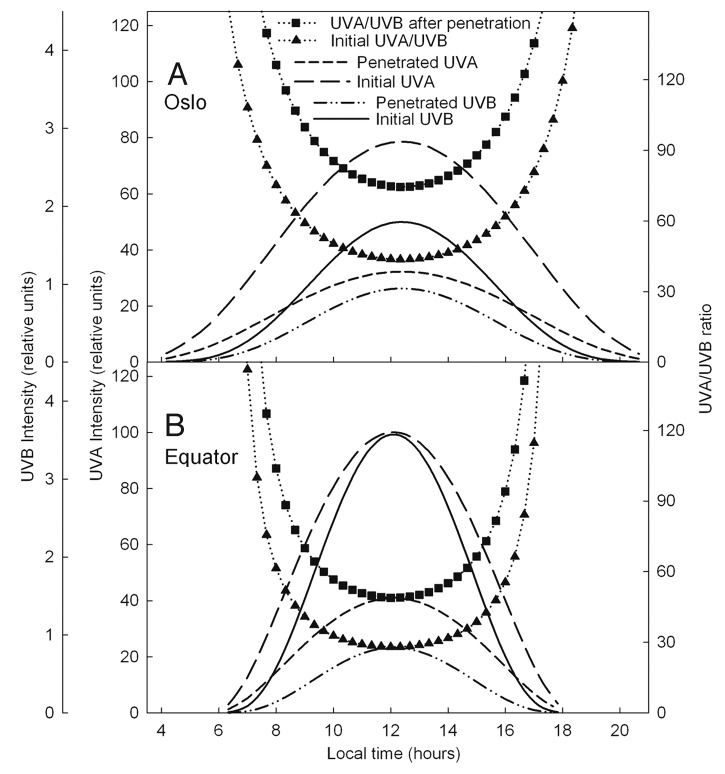
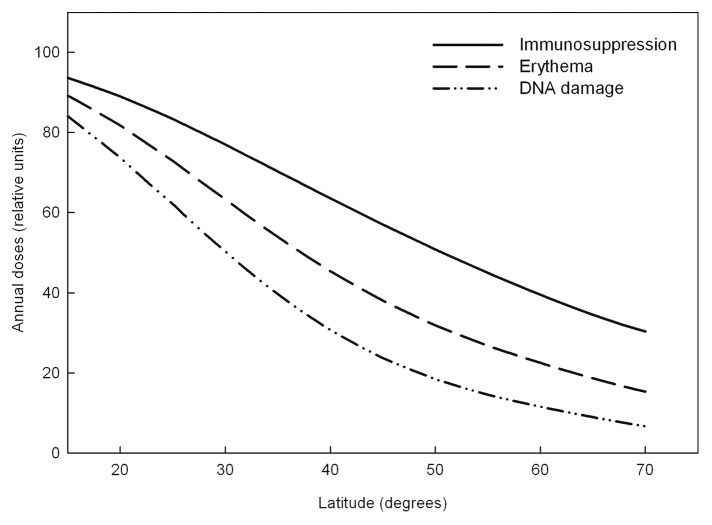
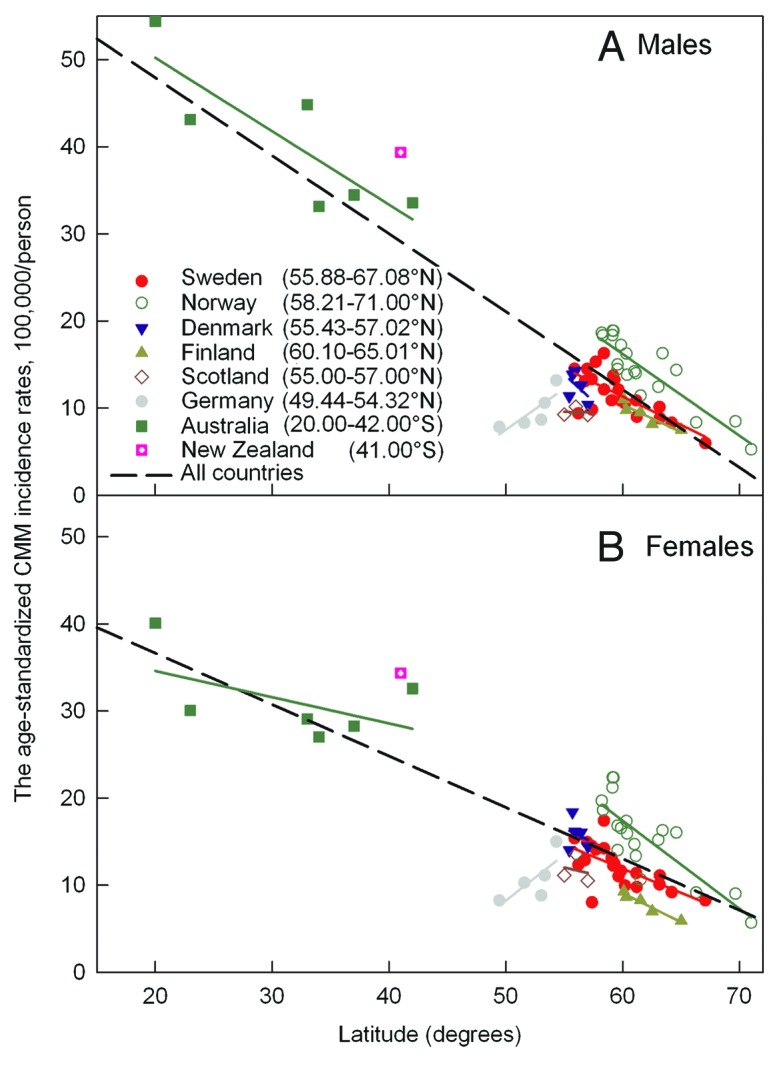
Solar ultraviolet (UV) radiation is the main source of vitamin D production and is also the most important environmental risk factor for cutaneous malignant melanoma (CMM) development. In the present study the relationships between daily or seasonal UV radiation doses and vitamin D status, dietary vitamin D intake and CMM incidence rates at different geographical latitudes were investigated. North-South gradients of 25-hydroxyvitamin D (25(OH)D) generation and CMM induction were calculated, based on known action spectra, and compared with measured vitamin D levels and incidence rates of CMM. The relative roles of UVA and UVB in CMM induction are discussed. Latitudinal dependencies of serum 25(OH)D levels and CMM incidence rates can only partly be explained by ambient UV doses. The UV sensitivity is different among populations with different skin color. This is well known for CMM, but seems also to be true for vitamin D status. The fact that UV-induced vitamin D may reduce the risk of CMM complicates the discussion. To some extent high dietary vitamin D intake seems to compensate low UV doses.
太阳紫外线辐射是维生素D产生的主要来源,也是皮肤恶性黑色素瘤(CMM)发生的最重要环境风险因素。在本研究中,调查了不同地理纬度每日或季节性紫外线辐射剂量与维生素D状态、膳食维生素D摄入量以及CMM发病率之间的关系。基于已知的作用光谱计算了25-羟基维生素D(25(OH)D)生成和CMM诱导的南北梯度,并与测量的维生素D水平和CMM发病率进行了比较。讨论了UVA和UVB在CMM诱导中的相对作用。血清25(OH)D水平和CMM发病率的纬度依赖性只能部分地由环境紫外线剂量来解释。不同肤色人群对紫外线的敏感性不同。这在CMM中是众所周知的,但对于维生素D状态似乎也是如此。紫外线诱导产生的维生素D可能会降低CMM风险这一事实使讨论变得复杂。在某种程度上,高膳食维生素D摄入量似乎可以补偿低紫外线剂量。