Cleary Margot P, Grossmann Michael E
University of Minnesota Hormel Institute, 801 16th Ave. NE Austin, MN 55912-3679, USA.
J Carcinog. 2011;10:21. doi: 10.4103/1477-3163.85181. Epub 2011 Sep 21.
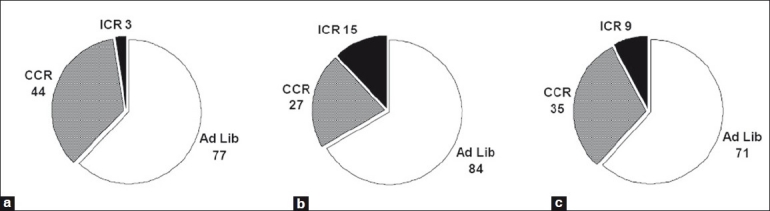
Although treatments for breast cancer have improved and long-term survival after diagnosis is now common, prevention of the disease is the ultimate goal. Weight loss or weight maintenance is one approach that has been recommended to reduce the risk of breast cancer, particularly for peri/postmenopausal women. This approach is supported by decades of data indicating that calorie restriction prevents spontaneous and chemically induced mammary tumor development in rodents. In most cases, calorie restriction was implemented by a consistent daily reduction of calories, i.e. chronic calorie restriction (CCR). There have also been several studies where periods of reduced caloric intake were followed by periods of refeeding, i.e. intermittent calorie restriction (ICR), resulting in the prevention of spontaneous mammary tumorigenesis. In most of the early studies, there were no direct comparisons of CCR to ICR. One study using moderate calorie restriction in a chemically induced breast cancer rat model found a slight increase in mammary tumor incidence compared with ad libitum fed and CCR rats. However, recently, it has been demonstrated in several transgenic mouse models of breast cancer that ICR consistently provided a greater degree of protection than CCR. This review will provide a detailed comparison of ICR and CCR for breast cancer prevention. It will also examine potential mechanisms of action that may include periods of reduced IGF-I and leptin as well as an increase in the adiponectin:leptin ratio. Application of this approach to at-risk women may provide an approach to lower the risk of breast cancer in overweight/obese women.
尽管乳腺癌的治疗方法有所改进,且诊断后的长期生存如今已很常见,但预防该疾病才是最终目标。减肥或维持体重是一种被推荐用于降低乳腺癌风险的方法,尤其适用于围绝经期/绝经后女性。这一方法得到了数十年数据的支持,这些数据表明热量限制可预防啮齿动物自发性和化学诱导性乳腺肿瘤的发生。在大多数情况下,热量限制是通过每天持续减少热量摄入来实现的,即慢性热量限制(CCR)。也有几项研究,在减少热量摄入期后接着是重新进食期,即间歇性热量限制(ICR),从而预防了自发性乳腺肿瘤的发生。在大多数早期研究中,没有对CCR和ICR进行直接比较。一项在化学诱导的乳腺癌大鼠模型中使用适度热量限制的研究发现,与自由进食和CCR大鼠相比,乳腺肿瘤发病率略有增加。然而,最近在几种乳腺癌转基因小鼠模型中已证明,ICR始终比CCR提供更大程度的保护。本综述将对ICR和CCR在预防乳腺癌方面进行详细比较。还将研究潜在的作用机制,这些机制可能包括IGF-I和瘦素水平降低的时期以及脂联素与瘦素比值的增加。将这种方法应用于高危女性可能为降低超重/肥胖女性患乳腺癌的风险提供一种途径。