Chen Yalan, Ling Lifeng, Su Guanglei, Han Ming, Fan Xikang, Xun Pengcheng, Xu Guangfei
Department of Nutrition and Food Science, School of Public Health, Nantong University, Nantong, Jiangsu, China.
Department of Medical Informatics, School of Medicine, Nantong University, Nantong, Jiangsu, China.
Sci Rep. 2016 Sep 22;6:33739. doi: 10.1038/srep33739.
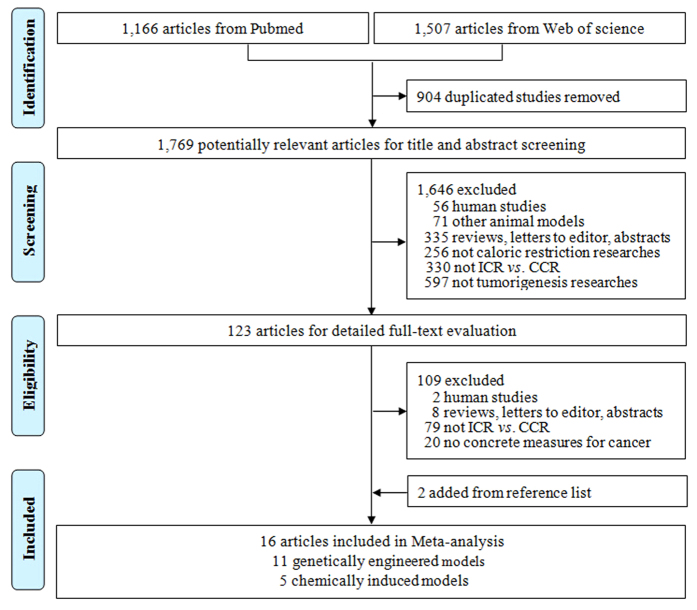
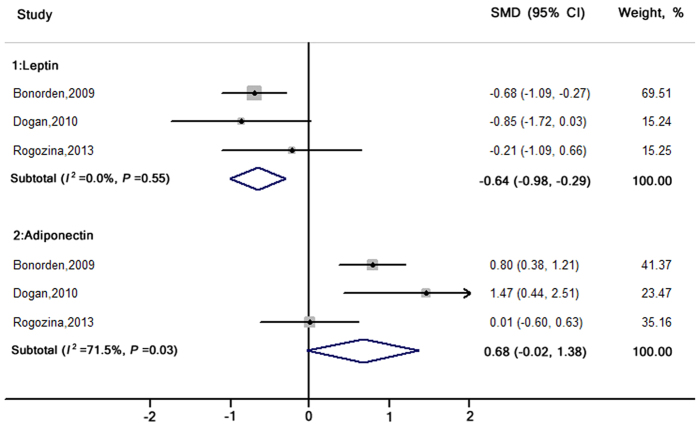
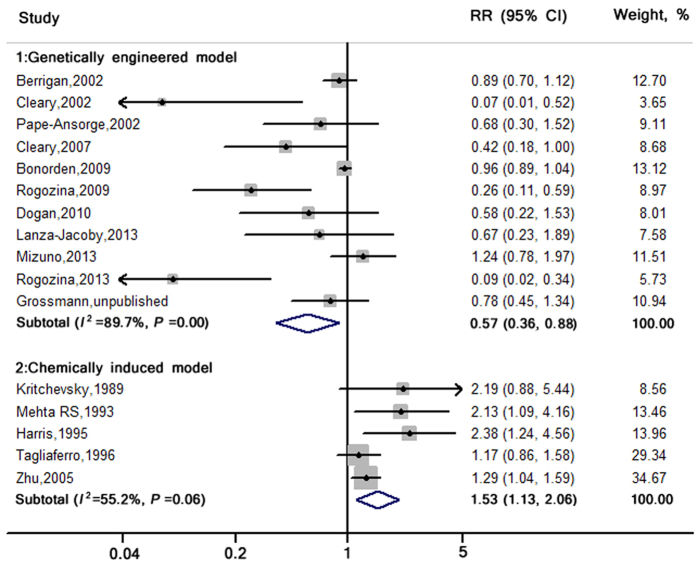
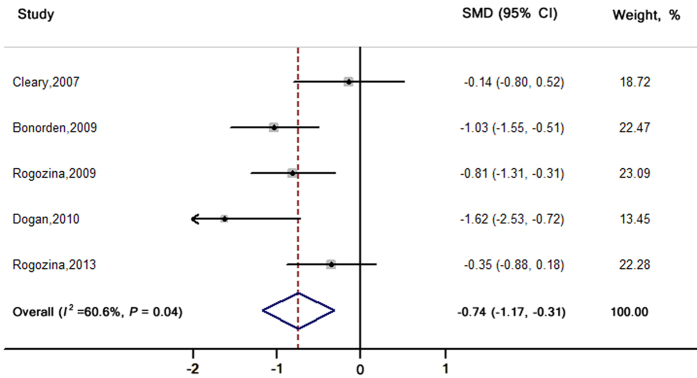
Both chronic calorie restriction (CCR) and intermittent calorie restriction (ICR) have shown anticancer effects. However, the direct evidence comparing ICR to CCR with respect to cancer prevention is controversial and inconclusive. PubMed and Web of Science were searched on November 25, 2015. The relative risk (RR) [95% confidence interval (CI)] was calculated for tumor incidence, and the standardised mean difference (95% CI) was computed for levels of serum insulin-like growth factor-1 (IGF-1), leptin, and adiponectin using a random-effects meta-analysis. Sixteen studies were identified, including 11 using genetically engineered mouse models (908 animals with 38-76 weeks of follow-up) and 5 using chemically induced rat models (379 animals with 7-18 weeks of follow-up). Compared to CCR, ICR decreased tumor incidence in genetically engineered models (RR = 0.57; 95% CI: 0.37, 0.88) but increased the risk in chemically induced models (RR = 1.53, 95% CI: 1.13, 2.06). It appears that ICR decreases IGF-1 and leptin and increases adiponectin in genetically engineered models. Thus, the evidence suggests that ICR exerts greater anticancer effect in genetically engineered mouse models but weaker cancer prevention benefit in chemically induced rat models as compared to CCR. Further studies are warranted to confirm our findings and elucidate the mechanisms responsible for these effects.
长期热量限制(CCR)和间歇性热量限制(ICR)均已显示出抗癌作用。然而,关于癌症预防方面将ICR与CCR进行比较的直接证据存在争议且尚无定论。于2015年11月25日检索了PubMed和科学网。使用随机效应荟萃分析计算肿瘤发生率的相对风险(RR)[95%置信区间(CI)],并计算血清胰岛素样生长因子-1(IGF-1)、瘦素和脂联素水平的标准化平均差(95%CI)。共纳入16项研究,其中11项使用基因工程小鼠模型(908只动物,随访38 - 76周),5项使用化学诱导大鼠模型(379只动物,随访7 - 18周)。与CCR相比,ICR在基因工程模型中降低了肿瘤发生率(RR = 0.57;95%CI:0.37,0.88),但在化学诱导模型中增加了风险(RR = 1.53,95%CI:1.13,2.06)。在基因工程模型中,ICR似乎降低了IGF-1和瘦素水平并增加了脂联素水平。因此,有证据表明,与CCR相比,ICR在基因工程小鼠模型中具有更强的抗癌作用,但在化学诱导大鼠模型中的防癌益处较弱。有必要进一步开展研究以证实我们的发现并阐明造成这些效应的机制。