Department of Health Services Research and Policy, London School of Hygiene and Tropical Medicine, London, UK (MG, ESWN, RG)
Modeling and Simulation Group, Novartis Pharma AG, Basel, Switzerland (RN)
Med Decis Making. 2012 Mar-Apr;32(2):350-61. doi: 10.1177/0272989X11418372. Epub 2011 Oct 19.
Cost-effectiveness analyses (CEAs) may use data from cluster randomized trials (CRTs), where the unit of randomization is the cluster, not the individual. However, most studies use analytical methods that ignore clustering. This article compares alternative statistical methods for accommodating clustering in CEAs of CRTs.
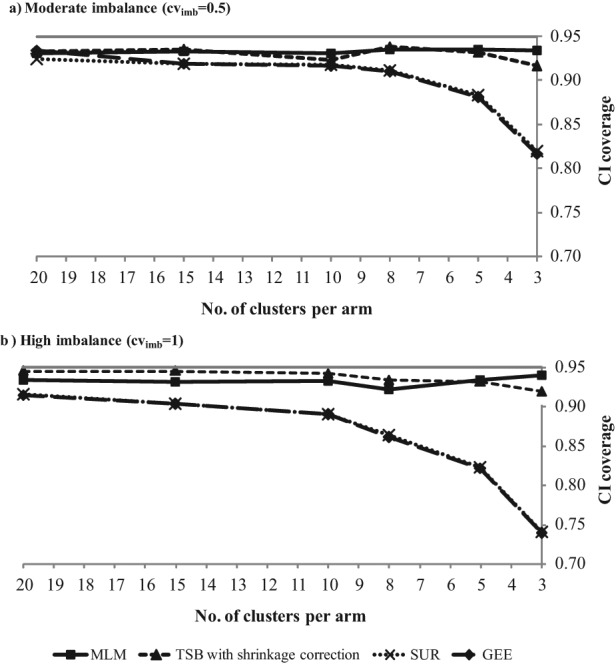
Our simulation study compared the performance of statistical methods for CEAs of CRTs with 2 treatment arms. The study considered a method that ignored clustering--seemingly unrelated regression (SUR) without a robust standard error (SE)--and 4 methods that recognized clustering--SUR and generalized estimating equations (GEEs), both with robust SE, a "2-stage" nonparametric bootstrap (TSB) with shrinkage correction, and a multilevel model (MLM). The base case assumed CRTs with moderate numbers of balanced clusters (20 per arm) and normally distributed costs. Other scenarios included CRTs with few clusters, imbalanced cluster sizes, and skewed costs. Performance was reported as bias, root mean squared error (rMSE), and confidence interval (CI) coverage for estimating incremental net benefits (INBs). We also compared the methods in a case study.
Each method reported low levels of bias. Without the robust SE, SUR gave poor CI coverage (base case: 0.89 v. nominal level: 0.95). The MLM and TSB performed well in each scenario (CI coverage, 0.92-0.95). With few clusters, the GEE and SUR (with robust SE) had coverage below 0.90. In the case study, the mean INBs were similar across all methods, but ignoring clustering underestimated statistical uncertainty and the value of further research.
MLMs and the TSB are appropriate analytical methods for CEAs of CRTs with the characteristics described. SUR and GEE are not recommended for studies with few clusters.
成本效益分析(CEA)可以使用来自整群随机试验(CRT)的数据,其中随机化的单位是群组,而不是个体。然而,大多数研究使用忽略聚类的分析方法。本文比较了 CRT 的 CEA 中用于容纳聚类的替代统计方法。
我们的模拟研究比较了具有 2 种治疗臂的 CRT 的 CEA 的统计方法的性能。该研究考虑了一种忽略聚类的方法 - 看似不相关回归(SUR)而没有稳健标准误差(SE) - 以及 4 种认识聚类的方法 - SUR 和广义估计方程(GEE),两者均具有稳健 SE、带有收缩校正的“2 阶段”非参数引导(TSB)和多层次模型(MLM)。基本情况假设 CRT 具有中等数量的平衡群组(每臂 20 个)和正态分布的成本。其他情况包括具有较少群组、不平衡群组大小和偏态成本的 CRT。性能以估计增量净效益(INB)的偏差、均方根误差(rMSE)和置信区间(CI)覆盖率报告。我们还在案例研究中比较了这些方法。
每种方法报告的偏差水平都较低。没有稳健 SE,SUR 的 CI 覆盖率较差(基本情况:0.89 与名义水平:0.95)。MLM 和 TSB 在每种情况下表现良好(CI 覆盖率,0.92-0.95)。群组较少时,GEE 和 SUR(带稳健 SE)的覆盖率低于 0.90。在案例研究中,所有方法的平均 INB 相似,但忽略聚类会低估统计不确定性和进一步研究的价值。
MLM 和 TSB 是描述特征的 CRT 的 CEA 的适当分析方法。对于群组较少的研究,不建议使用 SUR 和 GEE。