Jang Mi Hee, Choi Go Eun, Shin Bo-Moon, Lee Seon Ho, Kim Sung-Ryul, Chang Chulhun L, Kim Jeong-Man
Department of Laboratory Medicine, School of Medicine, Pusan National University, Yangsan, Korea.
Korean J Lab Med. 2011 Oct;31(4):282-4. doi: 10.3343/kjlm.2011.31.4.282. Epub 2011 Oct 3.
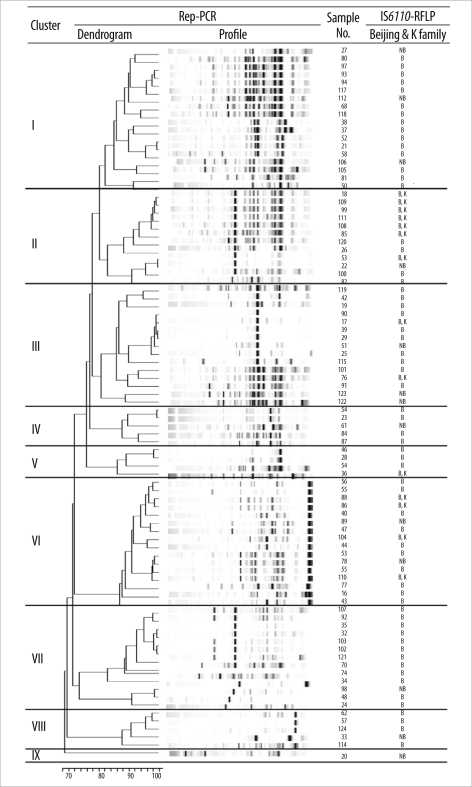
Tuberculosis remains a severe public health problem worldwide. Presently, genotyping is used for conducting epidemiologic and clinical studies on tuberculosis cases. We evaluated the efficacy of the repetitive sequence-based PCR (rep-PCR)-based DiversiLab™ system (bioMérieux, France) over the IS6110-restriction fragment length polymorphism analysis for detecting Mycobacterium tuberculosis. In all, 89 clinical M. tuberculosis isolates collected nationwide from Korea were used. The DiversiLab system allocated the 89 isolates to 8 groups with 1 unique isolate when a similarity level of 95% was applied. Seventy-six isolates of the Beijing family and 13 isolates of non-Beijing family strains were irregularly distributed regardless of rep-PCR groups. The DiversiLab system generated a rapid, sensitive, and standardized result. It can be used to conduct molecular epidemiologic studies to identify clinical M. tuberculosis isolates in Korea.
结核病仍然是全球严重的公共卫生问题。目前,基因分型用于对结核病病例进行流行病学和临床研究。我们评估了基于重复序列的聚合酶链反应(rep-PCR)的DiversiLab™系统(法国生物梅里埃公司)相较于IS6110限制性片段长度多态性分析在检测结核分枝杆菌方面的效能。总共使用了从韩国全国收集的89株临床结核分枝杆菌分离株。当应用95%的相似性水平时,DiversiLab系统将89株分离株分为8组,其中有1株独特的分离株。76株北京家族菌株和13株非北京家族菌株无论rep-PCR分组如何均呈不规则分布。DiversiLab系统产生了快速、灵敏且标准化的结果。它可用于开展分子流行病学研究以鉴定韩国的临床结核分枝杆菌分离株。