Department of Infectious Diseases and Microbiology Graduate School of Public Health, University of Pittsburgh, Pittsburgh, Pennsylvania, United States of America.
PLoS One. 2011;6(10):e25956. doi: 10.1371/journal.pone.0025956. Epub 2011 Oct 10.
To investigate the geographical origin and evolution dynamics of HIV-1 subtype C infection in India.
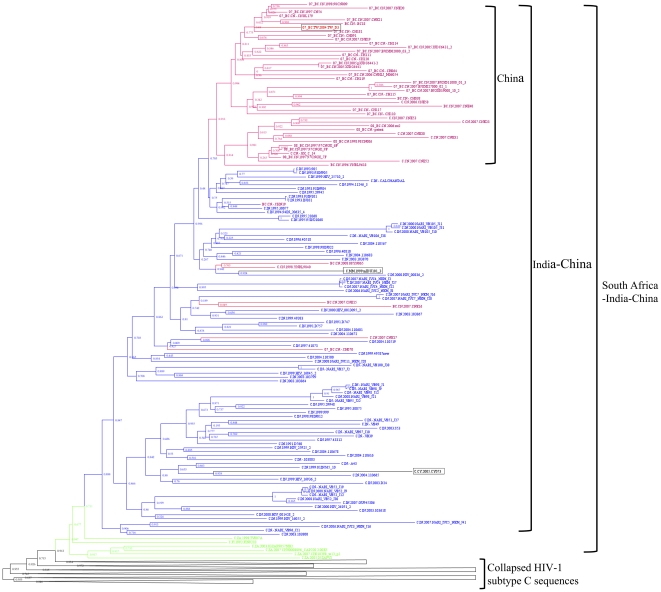
Ninety HIV-1 subtype C env gp120 subtype C sequences from India were compared with 312 env gp120 reference subtype C sequences from 27 different countries obtained from Los Alamos HIV database. All the HIV-1 subtype C env gp120 sequences from India were used for the geographical origin analysis and 61 subtype C env gp120 sequences with known sampling year (from 1991 to 2008) were employed to determine the origin of HIV infection in India.
Phylogenetic analysis of HIV-1 env sequences was used to investigate the geographical origin and tMRCA of Indian HIV-1 subtype C. Evolutionary parameters including origin date and demographic growth patterns of Indian subtype C were estimated using a Bayesian coalescent-based approach under relaxed molecular clock models.
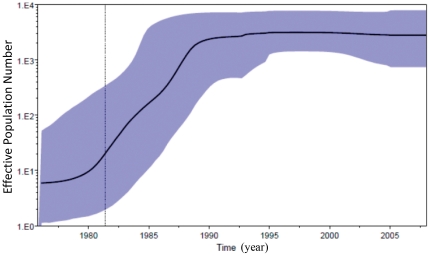
The majority of the analyzed Indian and South African HIV-1 subtype C sequences formed a single monophyletic cluster. The most recent common ancestor date was calculated to be 1975.56 (95% HPD, 1968.78-1981.52). Reconstruction of the effective population size revealed three phases of epidemic growth: an initial slow growth, followed by exponential growth, and then a plateau phase approaching present time. Stabilization of the epidemic growth phase correlated with the foundation of National AIDS Control Organization in India.
Indian subtype C originated from a single South African lineage in the middle of 1970s. The current study emphasizes not only the utility of HIV-1 sequence data for epidemiological studies but more notably highlights the effectiveness of community or government intervention strategies in controlling the trend of the epidemic.
研究印度 HIV-1 亚型 C 感染的地理起源和进化动态。
将印度的 90 个 HIV-1 亚型 C env gp120 亚型 C 序列与来自 27 个不同国家的 312 个 Los Alamos HIV 数据库中的参考 env gp120 亚型 C 序列进行比较。将所有来自印度的 HIV-1 亚型 C env gp120 序列用于地理起源分析,并且使用 61 个具有已知采样年份(1991 年至 2008 年)的亚型 C env gp120 序列来确定印度 HIV 感染的起源。
使用 HIV-1 env 序列的系统发生分析来研究印度 HIV-1 亚型 C 的地理起源和 tMRCA。使用贝叶斯合并方法,在宽松的分子钟模型下,估计了印度亚型 C 的起源日期和人口增长模式等进化参数。
分析的大多数印度和南非 HIV-1 亚型 C 序列形成了一个单一的单系群。计算出的最接近共同祖先日期为 1975.56(95%HPD,1968.78-1981.52)。有效种群规模的重建显示出三个流行增长阶段:初始缓慢增长,然后是指数增长,然后是接近当前时间的平台阶段。流行增长阶段的稳定与印度国家艾滋病控制组织的成立相关。
印度亚型 C 起源于 20 世纪 70 年代中期的单一南非谱系。本研究不仅强调了 HIV-1 序列数据在流行病学研究中的应用,而且更重要的是强调了社区或政府干预策略在控制疫情趋势方面的有效性。