Laboratory at Rheumaklinik Aachen, Hauptstrasse 21, Aachen, D-52066, Germany.
Arthritis Res Ther. 2011;13(5):R172. doi: 10.1186/ar3495. Epub 2011 Oct 21.
In the present study, we analysed in detail nuclear autoantibodies and their associations in systemic sclerosis (SSc) patients included in the German Network for Systemic Scleroderma Registry.
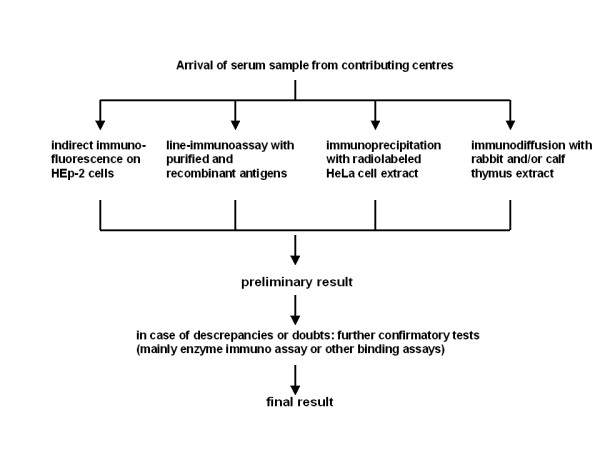
Sera of 863 patients were analysed according to a standardised protocol including immunofluorescence, immunoprecipitation, line immunoassay and immunodiffusion.
Antinuclear antibodies (ANA) were detected in 94.2% of patients. In 81.6%, at least one of the autoantibodies highly associated with SSc or with overlap syndromes with scleroderma features was detected, that is, anti-centromere (35.9%) or anti-topoisomerase I (30.1%), followed in markedly lower frequency by antibodies to PM-Scl (4.9%), U1-ribonucleoprotein (U1-RNP) (4.8%), RNA polymerases (RNAPs) (3.8%), fibrillarin (1.4%), Ku (1.2%), aminoacyl-transfer RNA synthetases (0.5%), To (0.2%) and U11-RNP (0.1%). We found that the simultaneous presence of SSc-associated autoantibodies was rare (1.6%). Furthermore, additional autoantibodies were detected in 55.4% of the patients with SSc, of which anti-Ro/anti-La, anti-mitochondrial and anti-p25/p23 antibodies were most frequent. The coexistence of SSc-associated and other autoantibodies was common (43% of patients). SSc-associated autoantibodies disclosed characteristic associations with clinical features of patients, some of which were previously not acknowledged.
This study shows that five autoantigens (that is, centromere, topoisomerase I, PM-Scl, U1-RNP and RNAP) detected more than 95% of the known SSc-associated antibody responses in ANA-positive SSc patients and characterise around 79% of all SSc patients in a central European cohort. These data confirm and extend previous data underlining the central role of the determination of ANAs in defining the diagnosis, subset allocation and prognosis of SSc patients.
在本研究中,我们详细分析了德国系统性硬皮病注册研究中纳入的系统性硬化症(SSc)患者的核自身抗体及其相关性。
根据包括免疫荧光、免疫沉淀、线免疫分析和免疫扩散在内的标准化方案分析了 863 例患者的血清。
94.2%的患者检测到抗核抗体(ANA)。在 81.6%的患者中,检测到至少一种与 SSc 或具有硬皮病特征重叠综合征高度相关的自身抗体,即抗着丝粒(35.9%)或抗拓扑异构酶 I(30.1%),其次是抗 PM-Scl(4.9%)、U1-核糖核蛋白(U1-RNP)(4.8%)、RNA 聚合酶(RNAPs)(3.8%)、核仁蛋白(1.4%)、Ku(1.2%)、氨酰基转移 RNA 合成酶(0.5%)、To(0.2%)和 U11-RNP(0.1%)。我们发现,同时存在 SSc 相关自身抗体的情况很少见(1.6%)。此外,在 55.4%的 SSc 患者中还检测到其他自身抗体,其中抗 Ro/抗 La、抗线粒体和抗 p25/p23 抗体最为常见。SSc 相关自身抗体和其他自身抗体同时存在的情况很常见(43%的患者)。SSc 相关自身抗体与患者的临床特征存在特征性关联,其中一些关联以前未被认识到。
本研究表明,在 ANA 阳性的 SSc 患者中,有五种自身抗原(即着丝粒、拓扑异构酶 I、PM-Scl、U1-RNP 和 RNAP)可检测到超过 95%的已知 SSc 相关抗体反应,它们可在中欧队列中确定约 79%的所有 SSc 患者。这些数据证实并扩展了以前的数据,强调了确定 ANA 在定义 SSc 患者的诊断、亚型分配和预后方面的核心作用。