Department of Epidemiology, The University of North Carolina at Chapel Hill, Chapel Hill, North Carolina, United States of America.
PLoS Genet. 2011 Oct;7(10):e1002322. doi: 10.1371/journal.pgen.1002322. Epub 2011 Oct 13.
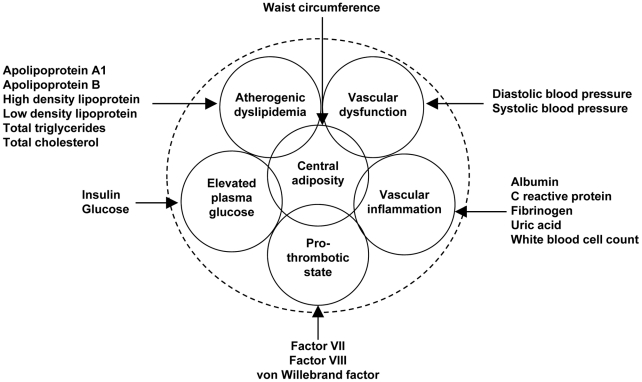
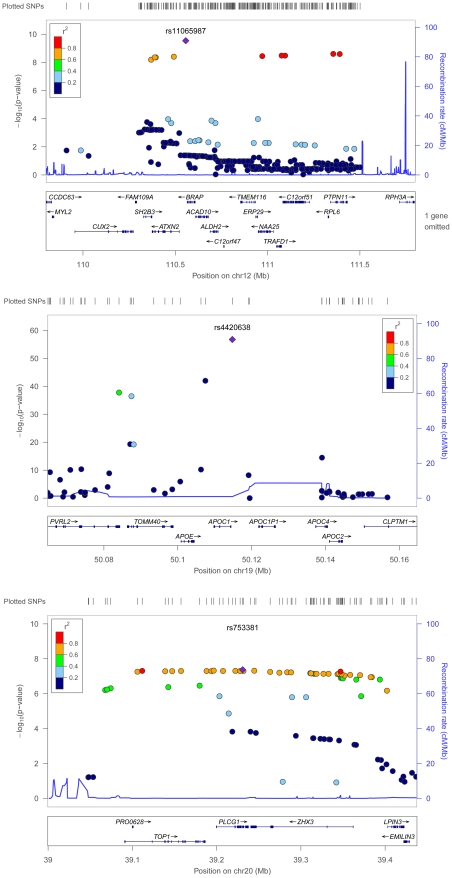
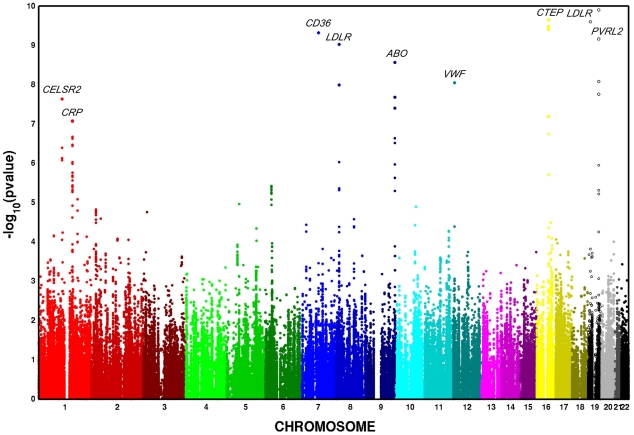
Despite evidence of the clustering of metabolic syndrome components, current approaches for identifying unifying genetic mechanisms typically evaluate clinical categories that do not provide adequate etiological information. Here, we used data from 19,486 European American and 6,287 African American Candidate Gene Association Resource Consortium participants to identify loci associated with the clustering of metabolic phenotypes. Six phenotype domains (atherogenic dyslipidemia, vascular dysfunction, vascular inflammation, pro-thrombotic state, central obesity, and elevated plasma glucose) encompassing 19 quantitative traits were examined. Principal components analysis was used to reduce the dimension of each domain such that >55% of the trait variance was represented within each domain. We then applied a statistically efficient and computational feasible multivariate approach that related eight principal components from the six domains to 250,000 imputed SNPs using an additive genetic model and including demographic covariates. In European Americans, we identified 606 genome-wide significant SNPs representing 19 loci. Many of these loci were associated with only one trait domain, were consistent with results in African Americans, and overlapped with published findings, for instance central obesity and FTO. However, our approach, which is applicable to any set of interval scale traits that is heritable and exhibits evidence of phenotypic clustering, identified three new loci in or near APOC1, BRAP, and PLCG1, which were associated with multiple phenotype domains. These pleiotropic loci may help characterize metabolic dysregulation and identify targets for intervention.
尽管代谢综合征成分存在聚类现象,但目前用于识别统一遗传机制的方法通常评估的临床类别并不能提供充分的病因信息。在这里,我们使用来自 19486 名欧洲裔美国人和 6287 名非裔美国人候选基因协会资源联盟参与者的数据,确定与代谢表型聚类相关的基因座。我们研究了六个表型域(致动脉粥样硬化性血脂异常、血管功能障碍、血管炎症、促血栓形成状态、中心性肥胖和升高的血浆葡萄糖),包括 19 个定量特征。主成分分析用于降低每个域的维度,以使每个域内代表>55%的特征方差。然后,我们应用了一种统计上有效且计算上可行的多变量方法,该方法使用加性遗传模型,将六个域中的八个主成分与 250,000 个已推断 SNP 相关联,并包括人口统计学协变量。在欧洲裔美国人中,我们确定了 606 个全基因组显著 SNP,代表 19 个基因座。这些基因座中的许多仅与一个表型域相关,与非裔美国人的结果一致,并且与已发表的发现重叠,例如中心性肥胖和 FTO。然而,我们的方法适用于任何一组具有遗传力且表现出表型聚类证据的区间尺度特征,可以在 APOC1、BRAP 和 PLCG1 中或附近识别三个新的基因座,这些基因座与多个表型域相关。这些多效性基因座可能有助于描述代谢失调并确定干预靶点。