Autoimmune Technologies, LLC, New Orleans, Louisiana, USA.
Virol J. 2011 Oct 24;8:478. doi: 10.1186/1743-422X-8-478.
Lassa fever (LF) is a devastating hemorrhagic viral disease that is endemic to West Africa and responsible for thousands of human deaths each year. Analysis of humoral immune responses (IgM and IgG) by antibody-capture ELISA (Ab-capture ELISA) and Lassa virus (LASV) viremia by antigen-capture ELISA (Ag-capture ELISA) in suspected patients admitted to the Kenema Government Hospital (KGH) Lassa Fever Ward (LFW) in Sierra Leone over the past five years is reshaping our understanding of acute LF.
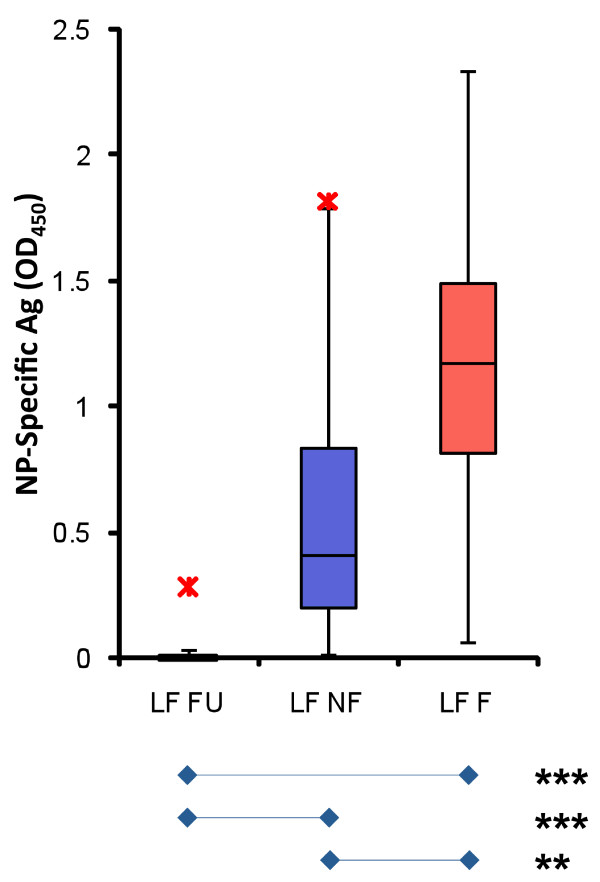
Analyses in LF survivors indicated that LASV-specific IgM persists for months to years after initial infection. Furthermore, exposure to LASV appeared to be more prevalent in historically non-endemic areas of West Africa with significant percentages of reportedly healthy donors IgM and IgG positive in LASV-specific Ab-capture ELISA. We found that LF patients who were Ag positive were more likely to die than suspected cases who were only IgM positive. Analysis of metabolic and immunological parameters in Ag positive LF patients revealed a strong correlation between survival and low levels of IL-6, -8, -10, CD40L, BUN, ALP, ALT, and AST. Despite presenting to the hospital with fever and in some instances other symptoms consistent with LF, the profiles of Ag negative IgM positive individuals were similar to those of normal donors and nonfatal (NF) LF cases, suggesting that IgM status cannot necessarily be considered a diagnostic marker of acute LF in suspected cases living in endemic areas of West Africa.
Only LASV viremia assessed by Ag-capture immunoassay, nucleic acid detection or virus isolation should be used to diagnose acute LASV infection in West Africans. LASV-specific IgM serostatus cannot be considered a diagnostic marker of acute LF in suspected cases living in endemic areas of West Africa. By applying these criteria, we identified a dysregulated metabolic and pro-inflammatory response profile conferring a poor prognosis in acute LF. In addition to suggesting that the current diagnostic paradigm for acute LF should be reconsidered, these studies present new opportunities for therapeutic interventions based on potential prognostic markers in LF.
拉沙热(LF)是一种具有破坏性的出血性病毒性疾病,流行于西非,每年导致数千人死亡。对过去五年中在塞拉利昂凯内马政府医院(KGH)拉沙热病房(LFW)收治的疑似患者进行抗体捕获 ELISA(Ab-capture ELISA)分析和通过抗原捕获 ELISA(Ag-capture ELISA)分析体液免疫反应(IgM 和 IgG)和拉沙病毒(LASV)病毒血症,正在改变我们对急性 LF 的理解。
对 LF 幸存者的分析表明,LASV 特异性 IgM 在初次感染后持续数月至数年。此外,在西非历史上无流行地区,LASV 的暴露似乎更为普遍,据报道有相当比例的健康供体在 LASV 特异性 Ab-capture ELISA 中 IgM 和 IgG 阳性。我们发现,Ag 阳性的 LF 患者比仅 IgM 阳性的疑似病例更有可能死亡。对 Ag 阳性 LF 患者的代谢和免疫参数进行分析发现,IL-6、-8、-10、CD40L、BUN、ALP、ALT 和 AST 水平较低与存活呈强相关。尽管这些患者以发热和其他一些与 LF 相符的症状就诊,但 Ag 阴性 IgM 阳性个体的特征与正常供体和非致死性(NF)LF 病例相似,这表明 IgM 状态不一定可作为西非流行地区疑似病例急性 LF 的诊断标志物。
仅应使用 Ag-capture 免疫测定、核酸检测或病毒分离法评估 LASV 病毒血症,以诊断西非的急性 LASV 感染。LASV 特异性 IgM 血清学状态不能作为西非流行地区疑似病例急性 LF 的诊断标志物。通过应用这些标准,我们确定了一种失调的代谢和促炎反应谱,在急性 LF 中预后不良。这些研究不仅表明应重新考虑急性 LF 的当前诊断范式,还为基于 LF 中的潜在预后标志物的治疗干预提供了新的机会。