Nuffield Department of Medicine, University of Oxford, Oxford, United Kingdom.
Department of Obstetrics and Gynaecology, Irrua Specialist Teaching Hospital, Irrua, Nigeria.
PLoS Negl Trop Dis. 2023 May 22;17(5):e0011354. doi: 10.1371/journal.pntd.0011354. eCollection 2023 May.
There is limited epidemiological evidence on Lassa fever in pregnant women with acute gaps on prevalence, infection incidence, and risk factors. Such evidence would facilitate the design of therapeutic and vaccine trials and the design of control programs. Our study sought to address some of these gaps by estimating the seroprevalence and seroconversion risk of Lassa fever in pregnant women.
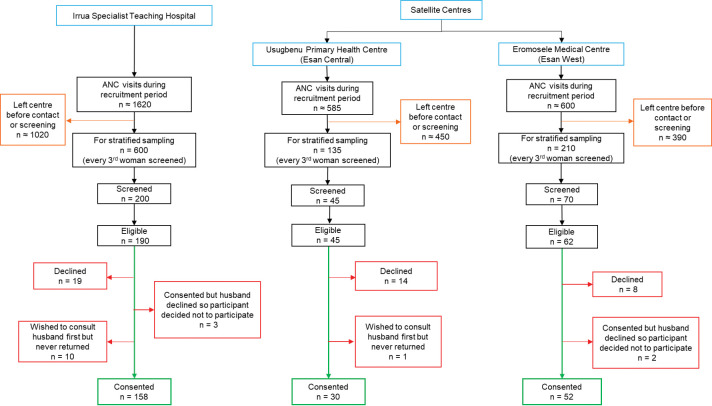
METHODOLOGY/PRINCIPAL FINDINGS: We conducted a prospective hospital-based cohort between February and December 2019 in Edo State, Southern Nigeria, enrolling pregnant women at antenatal clinic and following them up at delivery. Samples were evaluated for IgG antibodies against Lassa virus. The study demonstrates a seroprevalence of Lassa IgG antibodies of 49.6% and a seroconversion risk of 20.8%. Seropositivity was strongly correlated with rodent exposure around homes with an attributable risk proportion of 35%. Seroreversion was also seen with a seroreversion risk of 13.4%.
CONCLUSIONS/SIGNIFICANCE: Our study suggests that 50% of pregnant women were at risk of Lassa infection and that 35.0% of infections might be preventable by avoiding rodent exposure and conditions which facilitate infestation and the risk of human-rodent contact. While the evidence on rodent exposure is subjective and further studies are needed to provide a better understanding of the avenues of human-rodent interaction; public health measures to decrease the risk of rodent infestation and the risk of spill over events may be beneficial. With an estimated seroconversion risk of 20.8%, our study suggests an appreciable risk of contracting Lassa fever during pregnancy and while most of these seroconversions may not be new infections, given the high risk of adverse outcomes in pregnancy, it supports the need for preventative and therapeutic options against Lassa fever in pregnancy. The occurrence of seroreversion in our study suggests that the prevalence obtained in this, and other cohorts may be an underestimate of the actual proportion of women of childbearing age who present at pregnancy with prior LASV exposure. Additionally, the occurrence of both seroconversion and seroreversion in this cohort suggests that these parameters would need to be considered for the development of Lassa vaccine efficacy, effectiveness, and utility models.
关于拉沙热孕妇的流行病学证据有限,在流行率、感染发生率和危险因素方面存在明显差距。这些证据将有助于治疗和疫苗试验的设计以及控制方案的设计。我们的研究旨在通过估计拉沙热孕妇的血清阳性率和血清转化率风险来解决其中的一些差距。
方法/主要发现:我们在 2019 年 2 月至 12 月期间在尼日利亚南部江户州进行了一项基于医院的前瞻性队列研究,在产前诊所招募孕妇,并在分娩时对其进行随访。样本评估了针对拉沙病毒的 IgG 抗体。研究表明,拉沙 IgG 抗体的血清阳性率为 49.6%,血清转化率风险为 20.8%。血清阳性与家庭周围的啮齿动物暴露密切相关,归因风险比例为 35%。血清转换也存在,血清转换风险为 13.4%。
结论/意义:我们的研究表明,50%的孕妇有感染拉沙热的风险,通过避免啮齿动物暴露和有利于其滋生和人与啮齿动物接触的条件,35.0%的感染可能是可以预防的。虽然啮齿动物暴露的证据是主观的,需要进一步的研究来更好地了解人与啮齿动物相互作用的途径;减少啮齿动物滋生和溢出事件风险的公共卫生措施可能是有益的。鉴于血清转化率风险为 20.8%,我们的研究表明,孕妇在怀孕期间感染拉沙热的风险相当大,尽管大多数血清转化可能不是新感染,但鉴于妊娠不良结局的高风险,这支持了在怀孕期间针对拉沙热采取预防和治疗措施的必要性。我们的研究中出现血清转换表明,本研究和其他队列中获得的流行率可能低估了实际有拉沙病毒既往暴露而在妊娠时就诊的育龄妇女的比例。此外,该队列中既出现血清转化又出现血清转换表明,在开发拉沙疫苗的疗效、效果和实用性模型时,需要考虑这些参数。