Sen Aditi, Paine Suman Kalyan, Chowdhury Imran Hussain, Mukherjee Amrita, Choudhuri Subhadip, Saha Avijit, Mandal Lakshmi Kanta, Bhattacharya Basudev
Department of Biochemistry, Dr. B C Roy Post Graduate Institute of Basic Medical Education and Research (IPGME&R), Kolkata, India.
Mol Vis. 2011;17:2552-63. Epub 2011 Oct 1.
To evaluate the role of interleukin-6 (IL-6) in the inflammatory and proliferative stages of Eales' disease (ED) and to determine the influence of IL-6-174G/C polymorphism in the IL-6 and IL-6-regulated protein expression, as well as the development of ED.
One hundred and twenty-one patients diagnosed with ED, 223 matched healthy controls, and 16 control patients with macular holes were recruited from the eastern Indian population. Serum and vitreous levels of IL-6 and vascular endothelial growth factors (VEGF) were measured by enzyme-linked immunosorbent assay. Serum levels of high-sensitivity C-reactive protein (hsCRP) were measured by enzyme immunoassay. Subjects were genotyped for the IL-6-174G/C polymorphism (rs1800795) by a custom TaqMan single-nucleotide polymorphism (SNP) Genotyping Assays system.
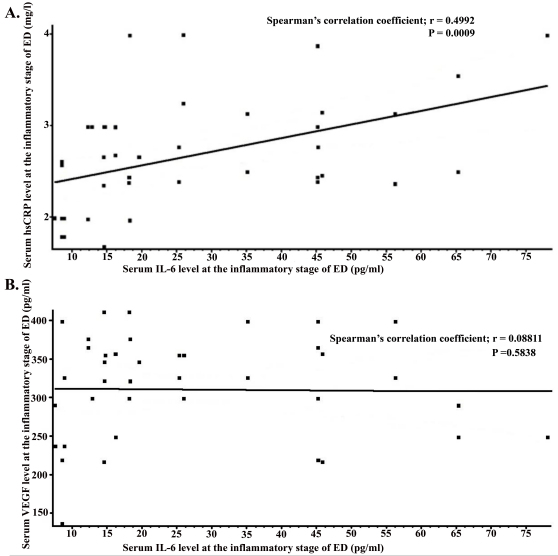
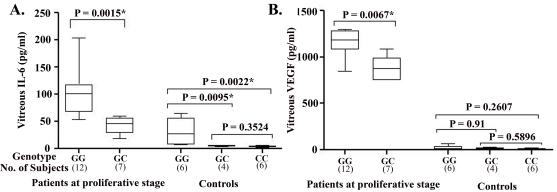
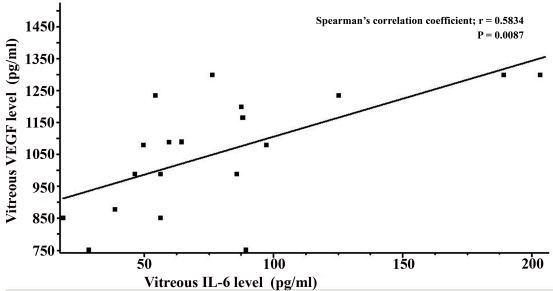
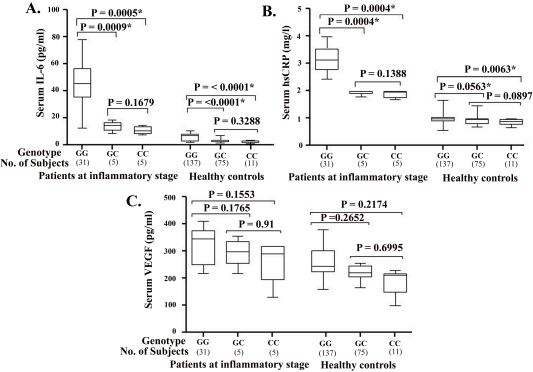
Serum IL-6 (p<0.0001), hsCRP (p<0.0001), and VEGF (p=0.0031) levels were significantly higher in the inflammatory stage of ED than in healthy controls. Serum IL-6 also significantly correlated with hsCRP (Spearman's correlation coefficient; r=0.4992, p=0.0009), but not with VEGF in this stage in ED patients. At the proliferative stage of ED, significantly higher levels of vitreous IL-6 (p=<0.0001) and VEGF (p=<0.0001) were found compared with the vitreous of patients with macular holes. A significant correlation was observed between vitreous IL-6 and VEGF in ED patients (Spearman's correlation coefficient; r=0.5834, p=0.0087). A statistically significant association was found between the -174GG genotype (p=0.006) and occurrence of ED. Mean serum and vitreous concentrations of IL-6 were also higher in the subjects with the GG genotype than in those with the GC or CC genotype in this population.
IL-6 expression, regulated by the allelic distribution of -174 loci and the enhanced level of IL-6, modulates CRP and VEGF concentration depending respectively on the acute inflammatory stimulation at the initial stage and angiogenic stimulation at the advanced stage of ED.
评估白细胞介素-6(IL-6)在伊尔斯病(ED)炎症和增殖阶段中的作用,并确定IL-6基因-174G/C多态性对IL-6及其调控蛋白表达以及ED发病的影响。
从印度东部人群中招募了121例确诊为ED的患者、223例匹配的健康对照者以及16例黄斑裂孔对照患者。采用酶联免疫吸附测定法检测血清和玻璃体中IL-6及血管内皮生长因子(VEGF)的水平。采用酶免疫测定法检测血清高敏C反应蛋白(hsCRP)水平。通过定制的TaqMan单核苷酸多态性(SNP)基因分型检测系统对受试者进行IL-6基因-174G/C多态性(rs1800795)基因分型。
ED炎症期患者血清IL-6(p<0.0001)、hsCRP(p<0.0001)和VEGF(p=0.0031)水平显著高于健康对照者。在ED患者的这一阶段,血清IL-6也与hsCRP显著相关(Spearman相关系数;r=0.4992,p=0.0009),但与VEGF无相关性。在ED增殖期,与黄斑裂孔患者的玻璃体相比,发现玻璃体中IL-6(p<0.0001)和VEGF(p<0.0001)水平显著更高。ED患者玻璃体中IL-6与VEGF之间存在显著相关性(Spearman相关系数;r=0.5834,p=0.0087)。发现-174GG基因型与ED发病之间存在统计学显著关联(p=0.006)。在该人群中,GG基因型受试者的血清和玻璃体IL-6平均浓度也高于GC或CC基因型受试者。
由-174位点的等位基因分布调控的IL-6表达以及IL-6水平的升高,分别根据ED初期的急性炎症刺激和晚期的血管生成刺激来调节CRP和VEGF浓度。