Department of Diagnostic Radiology, International University of Health and Welfare, Mita Hospital, 1-4-3, Mita Minato-ku, Tokyo, 108-8329, Japan.
Aesthetic Plast Surg. 2012 Apr;36(2):290-4. doi: 10.1007/s00266-011-9829-2. Epub 2011 Oct 25.
Baggy eyelids, formed by intraorbital fat herniation in the lower eyelids, are a sign of aging observed in the midface. This study aimed to identify the cause of baggy eyelids by evaluating the relationship between orbicularis oculi muscle thickness, orbital fat prolapse length, and age using multidetector row computed tomography (MDCT).
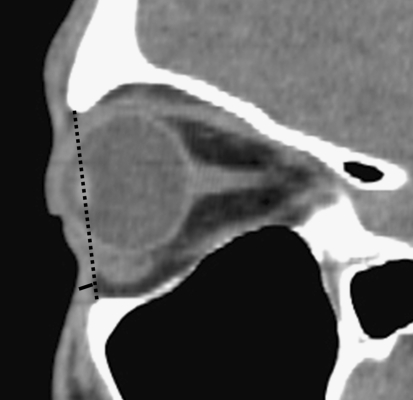
The 34 patients in the study ranged in age from 20 to 79 years. The patients were divided into three age groups: 20-29 years, 30-54 years, and 55-79 years. Orbicularis oculi muscle thickness and orbital fat prolapse length were measured using reconstructed computed tomography (CT) images.
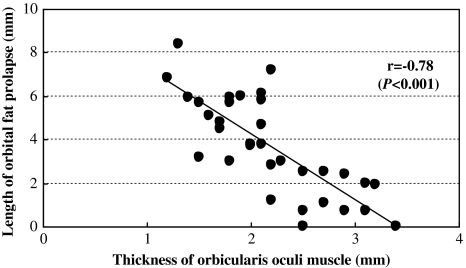
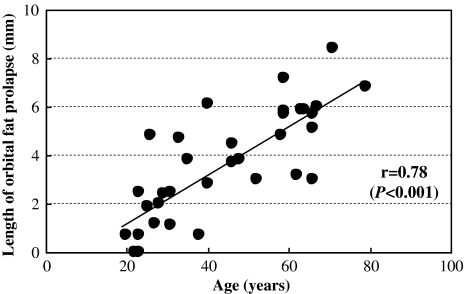
The orbicularis oculi muscle was found to be significantly thinner in the oldest group. Likewise, orbital fat prolapse was found to be significantly more prominent in the oldest group. A strong and significant negative correlation was found between orbicularis oculi muscle thickness and orbital fat prolapse length (r = -0.78; P < 0.001) and between orbicularis oculi muscle thickness and age (r = -0.77; P < 0.001). A strong and significant positive correlation was found between orbital fat prolapse length and age (r = 0.78; P < 0.001).
The use of MDCT provides insight into the detailed changes associated with aging that take place within the lower eyelids. This study objectively demonstrated that the major factors associated with baggy eyelids include orbicularis oculi muscle thickness, orbital fat prolapse length, and age. Decreased orbicularis oculi muscle thickness leads to the orbital fat prolapse.
眼袋是中面部衰老的表现之一,其特征为下眼睑的眶隔脂肪疝出。本研究旨在通过多层螺旋 CT(MDCT)评估眼轮匝肌厚度、眶隔脂肪疝出长度与年龄的关系,以明确眼袋形成的原因。
本研究共纳入 34 例患者,年龄 20-79 岁。将患者分为 3 个年龄组:20-29 岁组、30-54 岁组和 55-79 岁组。通过重建 CT 图像测量眼轮匝肌厚度和眶隔脂肪疝出长度。
结果显示,年龄最大组的眼轮匝肌最薄,眶隔脂肪疝出最长。眼轮匝肌厚度与眶隔脂肪疝出长度(r=-0.78;P<0.001)及与年龄(r=-0.77;P<0.001)呈强负相关;眶隔脂肪疝出长度与年龄(r=0.78;P<0.001)呈强正相关。
MDCT 可提供有关下眼睑内与衰老相关的详细变化的信息。本研究客观地表明,导致眼袋形成的主要因素包括眼轮匝肌厚度、眶隔脂肪疝出长度和年龄。眼轮匝肌厚度的减少导致眶隔脂肪疝出。