Department of Bioengineering, University of California San Diego, La Jolla, California, United States of America.
PLoS One. 2011;6(10):e26172. doi: 10.1371/journal.pone.0026172. Epub 2011 Oct 18.
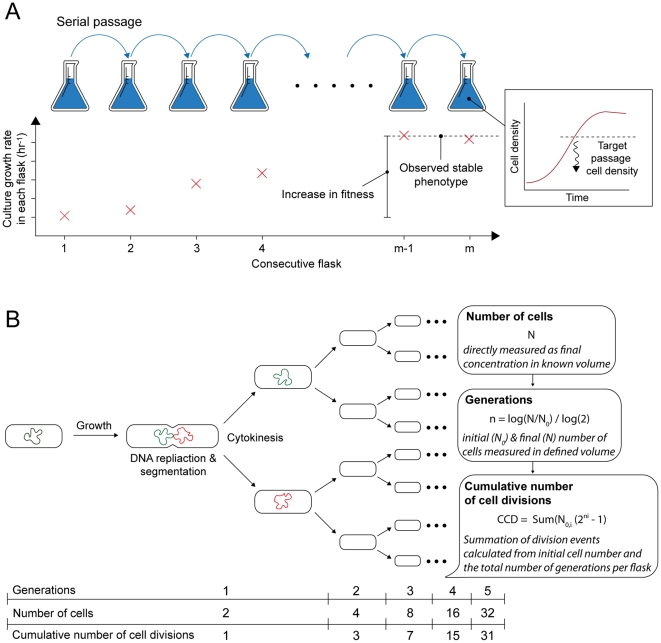
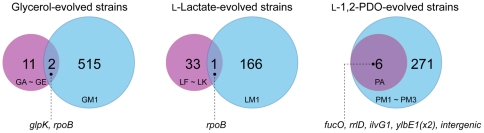
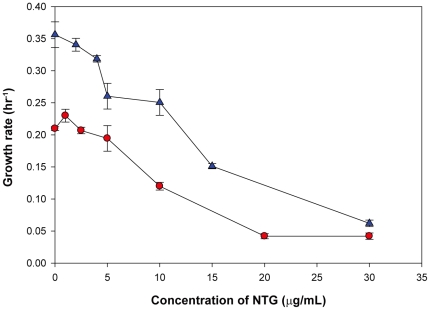
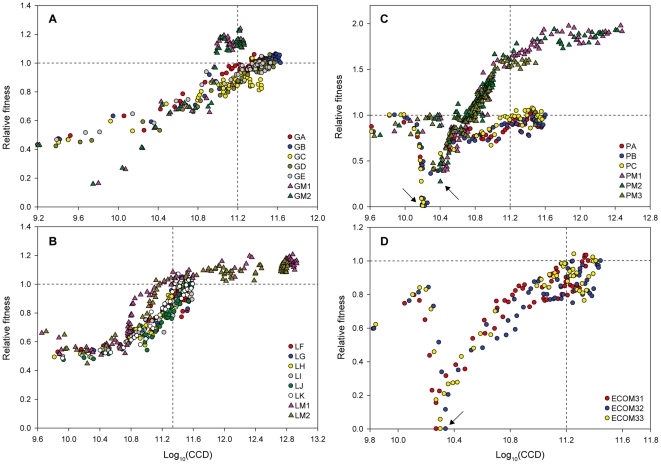
Adaptive laboratory evolution (ALE) under controlled conditions has become a valuable approach for the study of the genetic and biochemical basis for microbial adaptation under a given selection pressure. Conventionally, the timescale in ALE experiments has been set in terms of number of generations. As mutations are believed to occur primarily during cell division in growing cultures, the cumulative number of cell divisions (CCD) would be an alternative way to set the timescale for ALE. Here we show that in short-term ALE (up to 40-50 days), Escherichia coli, under growth rate selection pressure, was found to undergo approximately 10(11.2) total cumulative cell divisions in the population to produce a new stable growth phenotype that results from 2 to 8 mutations. Continuous exposure to a low level of the mutagen N-methyl-N'-nitro-N-nitrosoguanidine was found to accelerate this timescale and led to a superior growth rate phenotype with a much larger number of mutations as determined with whole-genome sequencing. These results would be useful for the fundamental kinetics of the ALE process in designing ALE experiments and provide a basis for its quantitative description.
适应性实验室进化(ALE)在受控条件下已成为研究微生物在特定选择压力下遗传和生化基础的一种有价值的方法。传统上,ALE 实验的时间尺度是以世代数来设定的。由于突变被认为主要发生在生长培养物的细胞分裂过程中,因此累积细胞分裂数(CCD)将是设定 ALE 时间尺度的另一种方法。在这里,我们表明,在短期 ALE(长达 40-50 天)中,大肠杆菌在生长率选择压力下,被发现经历了大约 10^11.2 次总累积细胞分裂,以产生新的稳定生长表型,这是由 2 到 8 个突变引起的。连续暴露于低水平诱变剂 N-甲基-N'-硝基-N-亚硝基胍被发现可以加速这一时间尺度,并导致具有更多突变的更高生长率表型,这可以通过全基因组测序来确定。这些结果对于设计 ALE 实验的 ALE 过程的基本动力学有用,并为其定量描述提供了基础。