Children's Cancer Research Institute, St. Anna Kinderkrebsforschung, Vienna, Austria.
PLoS One. 2011;6(10):e26348. doi: 10.1371/journal.pone.0026348. Epub 2011 Oct 20.
ETV6/RUNX1 (E/R) (also known as TEL/AML1) is the most frequent gene fusion in childhood acute lymphoblastic leukemia (ALL) and also most likely the crucial factor for disease initiation; its role in leukemia propagation and maintenance, however, remains largely elusive. To address this issue we performed a shRNA-mediated knock-down (KD) of the E/R fusion gene and investigated the ensuing consequences on genome-wide gene expression patterns and deducible regulatory functions in two E/R-positive leukemic cell lines.
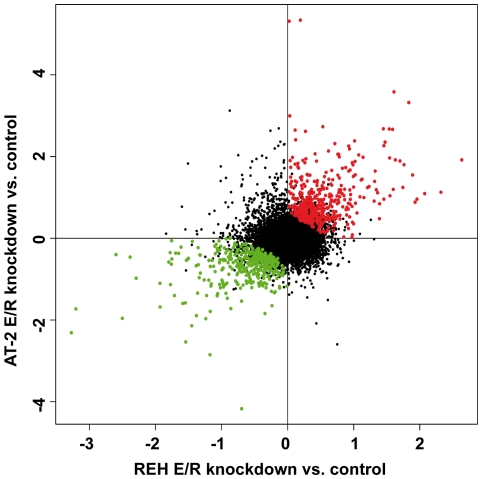
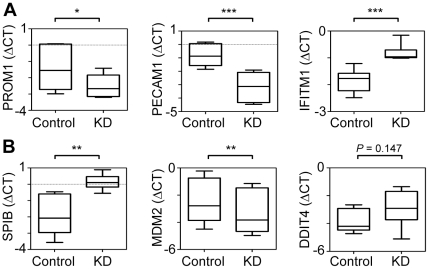
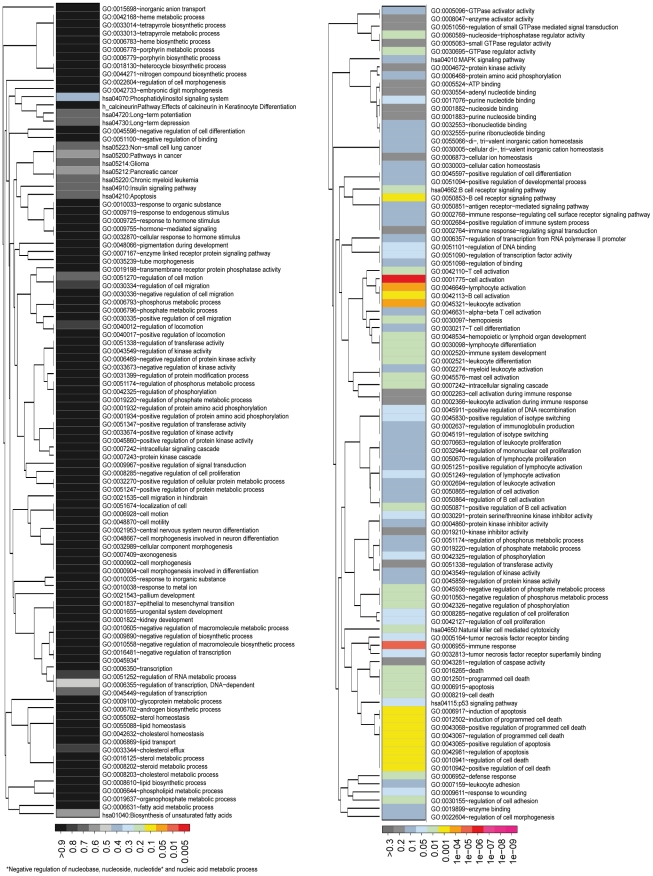
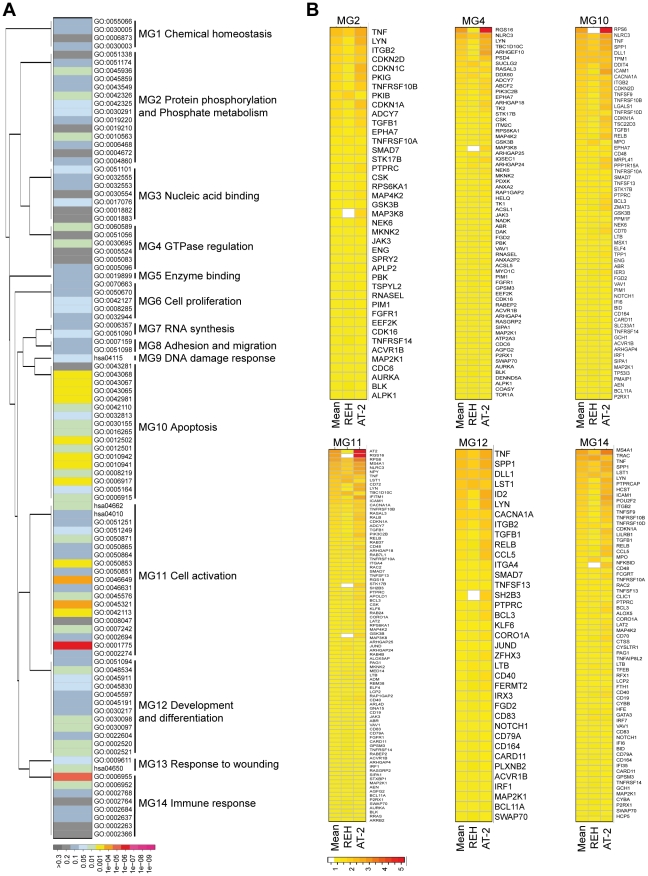
Microarray analyses identified 777 genes whose expression was substantially altered. Although approximately equal proportions were either up- (KD-UP) or down-regulated (KD-DOWN), the effects on biological processes and pathways differed considerably. The E/R KD-UP set was significantly enriched for genes included in the "cell activation", "immune response", "apoptosis", "signal transduction" and "development and differentiation" categories, whereas in the E/R KD-DOWN set only the "PI3K/AKT/mTOR signaling" and "hematopoietic stem cells" categories became evident. Comparable expression signatures obtained from primary E/R-positive ALL samples underline the relevance of these pathways and molecular functions. We also validated six differentially expressed genes representing the categories "stem cell properties", "B-cell differentiation", "immune response", "cell adhesion" and "DNA damage" with RT-qPCR.
Our analyses provide the first preliminary evidence that the continuous expression of the E/R fusion gene interferes with key regulatory functions that shape the biology of this leukemia subtype. E/R may thus indeed constitute the essential driving force for the propagation and maintenance of the leukemic process irrespective of potential consequences of associated secondary changes. Finally, these findings may also provide a valuable source of potentially attractive therapeutic targets.
ETV6/RUNX1(E/R)(也称为 TEL/AML1)是儿童急性淋巴细胞白血病(ALL)中最常见的基因融合,也是疾病起始的关键因素;然而,其在白血病传播和维持中的作用在很大程度上仍不清楚。为了解决这个问题,我们进行了 shRNA 介导的 knock-down(KD)E/R 融合基因,并在两种 E/R 阳性白血病细胞系中研究了随后对全基因组基因表达模式和可推导的调控功能的影响。
微阵列分析鉴定出 777 个表达明显改变的基因。尽管大约相等的比例被上调(KD-UP)或下调(KD-DOWN),但对生物学过程和途径的影响却大不相同。E/R KD-UP 组显著富集了包含在“细胞激活”、“免疫反应”、“细胞凋亡”、“信号转导”和“发育和分化”类别的基因,而在 E/R KD-DOWN 组中只有“PI3K/AKT/mTOR 信号”和“造血干细胞”类别变得明显。从原发性 E/R 阳性 ALL 样本中获得的可比表达谱强调了这些途径和分子功能的相关性。我们还使用 RT-qPCR 验证了代表“干细胞特性”、“B 细胞分化”、“免疫反应”、“细胞黏附”和“DNA 损伤”类别的六个差异表达基因。
我们的分析首次提供了初步证据,表明连续表达 E/R 融合基因会干扰塑造这种白血病亚型生物学的关键调控功能。因此,E/R 可能确实构成了白血病过程传播和维持的基本驱动力,而不论相关继发性变化的潜在后果如何。最后,这些发现也可能为有吸引力的治疗靶点提供有价值的来源。