Department of Biotechnology, Assam University, India.
BMC Complement Altern Med. 2011 Oct 28;11:102. doi: 10.1186/1472-6882-11-102.
The current practice of ingesting phytochemicals for supporting the immune system or fighting infections is based on centuries-old tradition. Macrophages are involved at all the stages of an immune response. The present study focuses on the immunostimulant properties of Tinospora cordifolia extract that are exerted on circulating macrophages isolated from CCl(4) (0.5 ml/kg body weight) intoxicated male albino mice.
Apart from damaging the liver system, carbon tetrachloride also inhibits macrophage functions thus, creating an immunocompromised state, as is evident from the present study. Such cell functions include cell morphology, adhesion property, phagocytosis, enzyme release (myeloperoxidase or MPO), nitric oxide (NO) release, intracellular survival of ingested bacteria and DNA fragmentation in peritoneal macrophages isolated from these immunocompromised mice. T. cordifolia extract was tested for acute toxicity at the given dose (150 mg/kg body weight) by lactate dehydrogenase (LDH) assay.
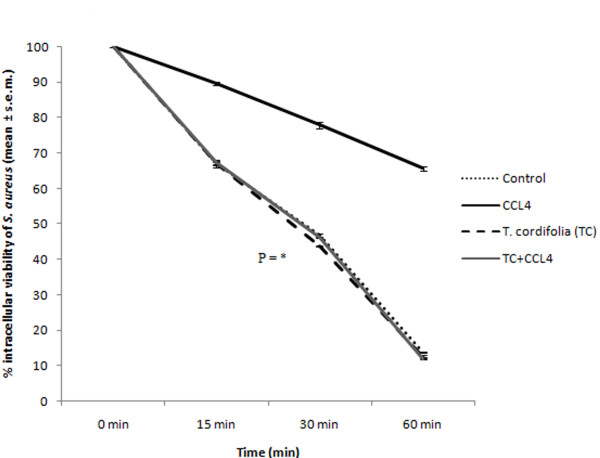
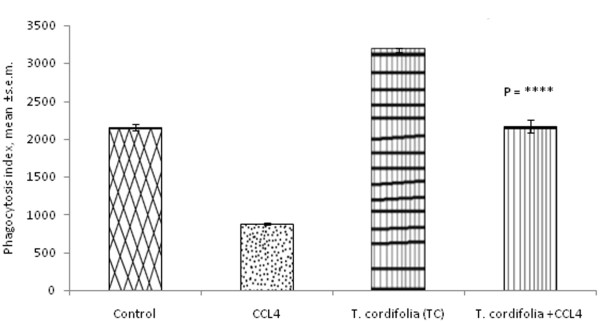
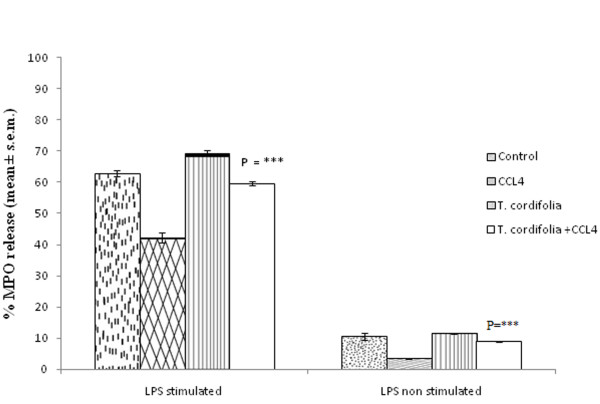
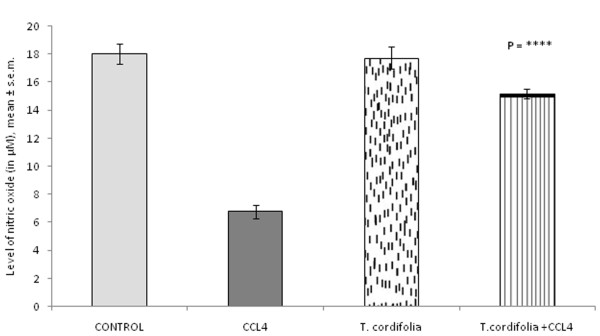
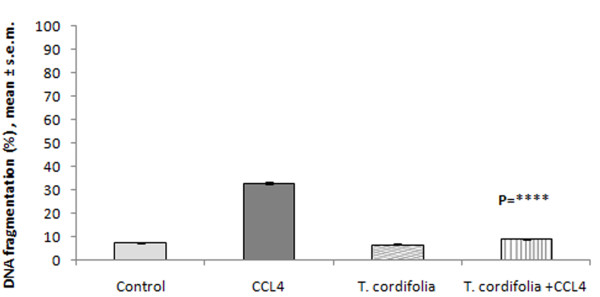
The number of morphologically altered macrophages was increased in mice exposed to CCl(4). Administration of CCl(4) (i.p.) also reduced the phagocytosis, cell adhesion, MPO release, NO release properties of circulating macrophages of mice. The DNA fragmentation of peritoneal macrophages was observed to be higher in CCl(4) intoxicated mice. The bacterial killing capacity of peritoneal macrophages was also adversely affected by CCl(4). However oral administration of aqueous fraction of Tinospora cordifolia stem parts at a dose of 40 mg/kg body weight (in vivo) in CCl(4) exposed mice ameliorated the effect of CCl(4), as the percentage of morphologically altered macrophages, phagocytosis activity, cell adhesion, MPO release, NO release, DNA fragmentation and intracellular killing capacity of CCl(4) intoxicated peritoneal macrophages came closer to those of the control group. No acute toxicity was identified in oral administration of the aqueous extract of Tinospora cordifolia at a dose of 150 mg/kg body weight.
From our findings it can be suggested that, polar fractions of Tinospora cordifolia stem parts contain major bioactive compounds, which directly act on peritoneal macrophages and have been found to boost the non-specific host defenses of the immune system. However, the molecular mechanism of this activity of Tinospora cordifolia on immune functions needs to be elucidated.
目前,人们摄入植物化学物质来支持免疫系统或抵抗感染的做法基于几个世纪以来的传统。巨噬细胞参与免疫反应的所有阶段。本研究专注于穿心莲提取物的免疫刺激特性,这些特性作用于从 CCl 4(0.5ml/kg 体重)中毒的雄性白化小鼠分离的循环巨噬细胞。
除了破坏肝脏系统外,四氯化碳还抑制巨噬细胞的功能,从而导致免疫功能低下,正如本研究所示。这种细胞功能包括细胞形态、粘附特性、吞噬作用、酶释放(髓过氧化物酶或 MPO)、一氧化氮(NO)释放、摄入细菌在这些免疫功能低下的小鼠分离的腹腔巨噬细胞中的存活和 DNA 片段化。穿心莲提取物在给定剂量(150mg/kg 体重)下通过乳酸脱氢酶(LDH)测定进行急性毒性测试。
暴露于 CCl 4 的小鼠中形态改变的巨噬细胞数量增加。腹腔内给予 CCl 4 也降低了小鼠循环巨噬细胞的吞噬作用、细胞粘附、MPO 释放、NO 释放特性。CCl 4 中毒小鼠的腹腔巨噬细胞 DNA 片段化更高。CCl 4 还影响腹腔巨噬细胞的细菌杀伤能力。然而,在 CCl 4 暴露的小鼠中,以 40mg/kg 体重的剂量(体内)口服给予穿心莲茎部分的水提物可改善 CCl 4 的作用,因为形态改变的巨噬细胞、吞噬作用活性、细胞粘附、MPO 释放、NO 释放、CCl 4 中毒的腹腔巨噬细胞的 DNA 片段化和细胞内杀伤能力的百分比更接近对照组。在 150mg/kg 体重的剂量下口服给予穿心莲水提取物未发现急性毒性。
从我们的发现可以看出,穿心莲茎部分的极性馏分含有主要的生物活性化合物,这些化合物直接作用于腹腔巨噬细胞,并被发现增强了免疫系统的非特异性宿主防御。然而,穿心莲对免疫功能的这种活性的分子机制仍需阐明。