Department of Gastroenterologic Surgery, Stavanger University Hospital, N-4068 Stavanger, Norway.
Scand J Trauma Resusc Emerg Med. 2011 Oct 30;19:66. doi: 10.1186/1757-7241-19-66.
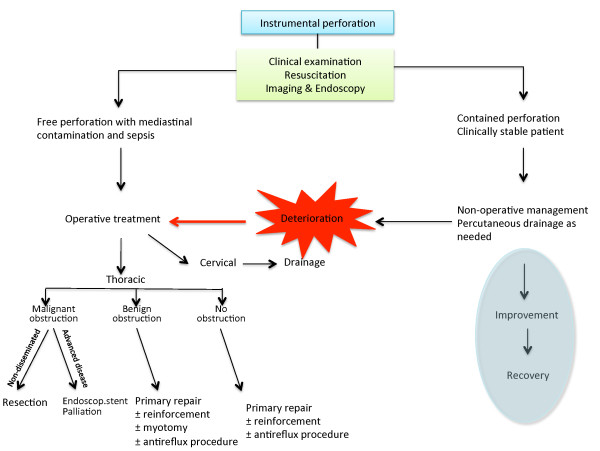
Esophageal perforation is a rare and potentially life-threatening condition. Early clinical suspicion and imaging is important for case management to achieve a good outcome. However, recent studies continue to report high morbidity and mortality greater than 20% from esophageal perforation. At least half of the perforations are iatrogenic, mostly related to endoscopic instrumentation used in the upper gastrointestinal tract, while about a third are spontaneous perforations. Surgical treatment remains an important option for many patients, but a non-operative approach, with or without use of an endoscopic stent or placement of internal or external drains, should be considered when the clinical situation allows for a less invasive approach. The rarity of this emergency makes it difficult for a physician to obtain extensive individual clinical experience; it is also challenging to obtain firm scientific evidence that informs patient management and clinical decision-making. Improved attention to non-specific symptoms and signs and early diagnosis based on imaging may translate into better outcomes for this group of patients, many of whom are elderly with significant comorbidity.
食管穿孔是一种罕见且可能危及生命的疾病。早期的临床怀疑和影像学检查对于病例管理至关重要,以实现良好的结果。然而,最近的研究继续报告食管穿孔的发病率和死亡率很高,超过 20%。至少有一半的穿孔是医源性的,主要与上消化道使用的内镜仪器有关,而大约三分之一是自发性穿孔。手术治疗仍然是许多患者的重要选择,但当临床情况允许采用较少侵入性方法时,应考虑非手术治疗方法,包括内镜支架的使用或内部或外部引流的放置。这种紧急情况的罕见性使得医生难以获得广泛的个人临床经验;也难以获得确凿的科学证据,为患者管理和临床决策提供信息。提高对非特异性症状和体征的关注,并根据影像学进行早期诊断,可能会为这群患者带来更好的结果,其中许多患者是患有严重合并症的老年人。