Institute of Genetic Medicine, Newcastle University, Newcastle upon Tyne, UK.
Lancet. 2011 Dec 17;378(9809):2081-7. doi: 10.1016/S0140-6736(11)61049-0. Epub 2011 Oct 27.
Observational studies report reduced colorectal cancer in regular aspirin consumers. Randomised controlled trials have shown reduced risk of adenomas but none have employed prevention of colorectal cancer as a primary endpoint. The CAPP2 trial aimed to investigate the antineoplastic effects of aspirin and a resistant starch in carriers of Lynch syndrome, the major form of hereditary colorectal cancer; we now report long-term follow-up of participants randomly assigned to aspirin or placebo.
In the CAPP2 randomised trial, carriers of Lynch syndrome were randomly assigned in a two-by-two factorial design to 600 mg aspirin or aspirin placebo or 30 g resistant starch or starch placebo, for up to 4 years. Randomisation was in blocks of 16 with provision for optional single-agent randomisation and extended postintervention double-blind follow-up; participants and investigators were masked to treatment allocation. The primary endpoint was development of colorectal cancer. Analysis was by intention to treat and per protocol. This trial is registered, ISRCTN59521990.
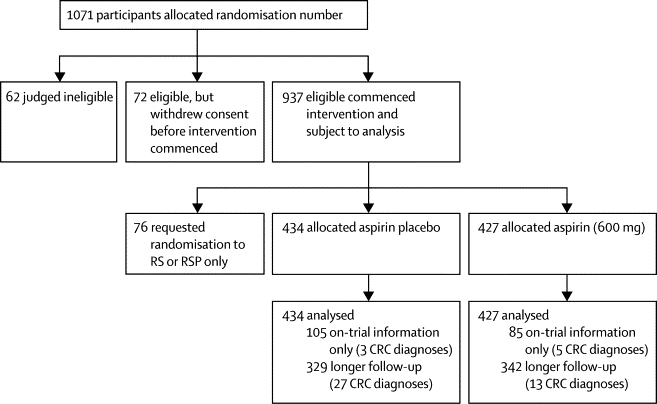
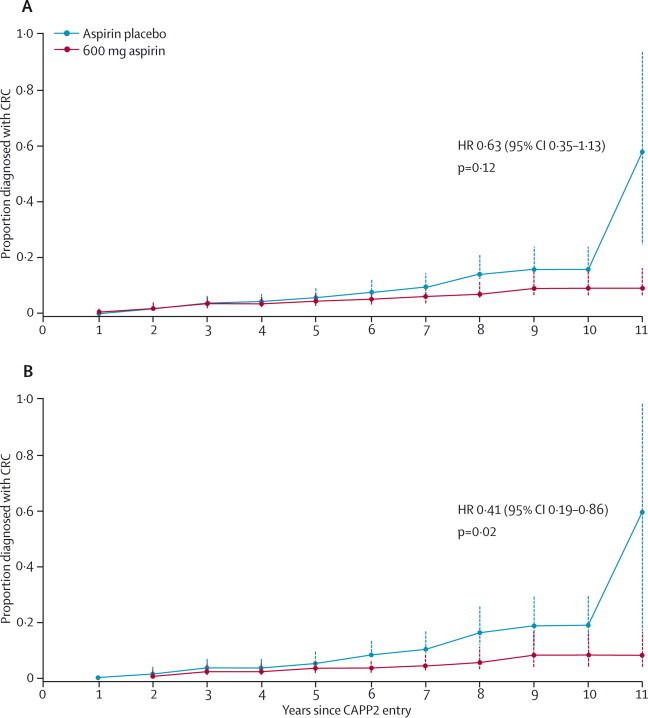
861 participants were randomly assigned to aspirin or aspirin placebo. At a mean follow-up of 55·7 months, 48 participants had developed 53 primary colorectal cancers (18 of 427 randomly assigned to aspirin, 30 of 434 to aspirin placebo). Intention-to-treat analysis of time to first colorectal cancer showed a hazard ratio (HR) of 0·63 (95% CI 0·35-1·13, p=0·12). Poisson regression taking account of multiple primary events gave an incidence rate ratio (IRR) of 0·56 (95% CI 0·32-0·99, p=0·05). For participants completing 2 years of intervention (258 aspirin, 250 aspirin placebo), per-protocol analysis yielded an HR of 0·41 (0·19-0·86, p=0·02) and an IRR of 0·37 (0·18-0·78, p=0·008). No data for adverse events were available postintervention; during the intervention, adverse events did not differ between aspirin and placebo groups.
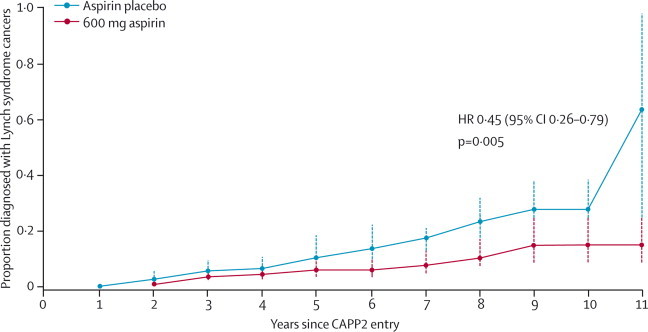
600 mg aspirin per day for a mean of 25 months substantially reduced cancer incidence after 55·7 months in carriers of hereditary colorectal cancer. Further studies are needed to establish the optimum dose and duration of aspirin treatment.
European Union; Cancer Research UK; Bayer Corporation; National Starch and Chemical Co; UK Medical Research Council; Newcastle Hospitals trustees; Cancer Council of Victoria Australia; THRIPP South Africa; The Finnish Cancer Foundation; SIAK Switzerland; Bayer Pharma.
观察性研究报告显示,经常服用阿司匹林的人患结直肠癌的风险降低。随机对照试验已经表明,阿司匹林可以降低腺瘤的风险,但没有一项试验将预防结直肠癌作为主要终点。CAPP2 试验旨在研究阿司匹林和抗性淀粉对林奇综合征携带者的抗肿瘤作用,林奇综合征是遗传性结直肠癌的主要形式;我们现在报告参与者随机分配接受阿司匹林或安慰剂的长期随访结果。
在 CAPP2 随机试验中,林奇综合征携带者以 2×2 的析因设计随机分为每天 600 毫克阿司匹林或阿司匹林安慰剂或 30 克抗性淀粉或淀粉安慰剂组,最长持续 4 年。随机分组以 16 分为一组进行,提供了单药随机分组的选择,并进行了延长的干预后双盲随访;参与者和研究者对治疗分配均不知情。主要终点是结直肠癌的发生。分析采用意向治疗和方案。该试验已注册,ISRCTN59521990。
861 名参与者被随机分配接受阿司匹林或阿司匹林安慰剂。平均随访 55.7 个月时,48 名参与者发生了 53 例原发性结直肠癌(阿司匹林组 18 例,阿司匹林安慰剂组 30 例)。首次结直肠癌的意向治疗时间分析显示,风险比(HR)为 0.63(95%CI 0.35-1.13,p=0.12)。考虑到多次原发事件的泊松回归得出的发病率比(IRR)为 0.56(95%CI 0.32-0.99,p=0.05)。对于完成 2 年干预的参与者(阿司匹林组 258 人,阿司匹林安慰剂组 250 人),方案分析得出的 HR 为 0.41(0.19-0.86,p=0.02),IRR 为 0.37(0.18-0.78,p=0.008)。干预后没有关于不良事件的数据;在干预期间,阿司匹林组和安慰剂组的不良事件没有差异。
每天服用 600 毫克阿司匹林,平均持续 25 个月,可显著降低遗传性结直肠癌患者 55.7 个月后的癌症发病率。需要进一步的研究来确定阿司匹林治疗的最佳剂量和持续时间。
欧盟;英国癌症研究中心;拜耳公司;国家淀粉和化学公司;英国医学研究理事会;纽卡斯尔医院受托人;澳大利亚维多利亚癌症协会;南非 THRIPP;芬兰癌症基金会;瑞士 SIAK;拜耳制药公司。