Institute of Animal Nutrition and Nutrition Physiology, Justus-Liebig-Universität Gießen, Heinrich-Buff-Ring 26-32, 35392 Gießen, Germany.
Nutr Metab (Lond). 2011 Oct 31;8:76. doi: 10.1186/1743-7075-8-76.
Carnitine has attracted scientific interest due to several health-related effects, like protection against neurodegeneration, mitochondrial decay, and oxidative stress as well as improvement of glucose tolerance and insulin sensitivity. The mechanisms underlying most of the health-related effects of carnitine are largely unknown.
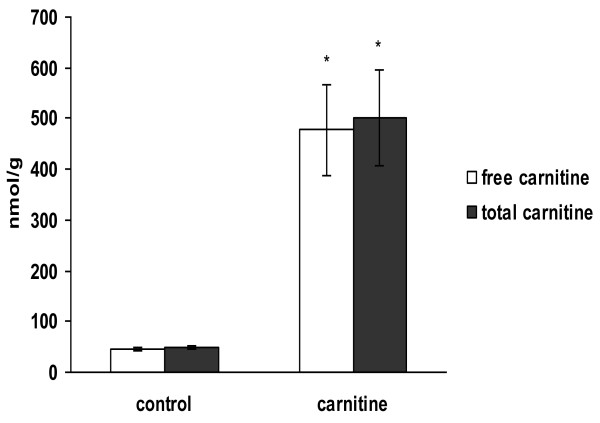
To gain insight into mechanisms through which carnitine exerts its beneficial metabolic effects, we fed piglets either a control or a carnitine supplemented diet, and analysed the transcriptome in the liver.
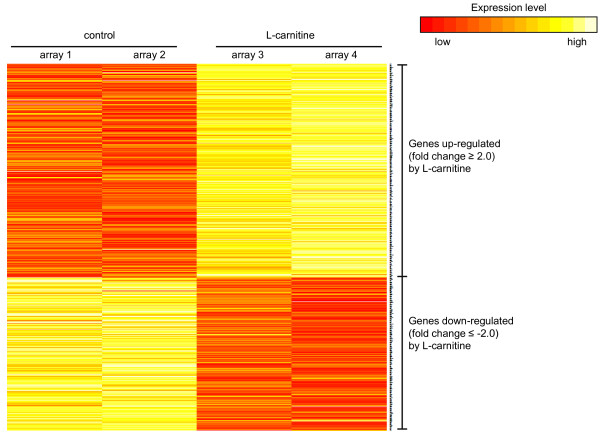
Transcript profiling revealed 563 genes to be differentially expressed in liver by carnitine supplementation. Clustering analysis of the identified genes revealed that most of the top-ranked annotation term clusters were dealing with metabolic processes. Representative genes of these clusters which were significantly up-regulated by carnitine were involved in cellular fatty acid uptake, fatty acid activation, fatty acid β-oxidation, glucose uptake, and glycolysis. In contrast, genes involved in gluconeogenesis were down-regulated by carnitine. Moreover, clustering analysis identified genes involved in the insulin signaling cascade to be significantly associated with carnitine supplementation. Furthermore, clustering analysis revealed that biological processes dealing with posttranscriptional RNA processing were significantly associated with carnitine supplementation.
The data suggest that carnitine supplementation has beneficial effects on lipid and glucose homeostasis by inducing genes involved in fatty acid catabolism and glycolysis and repressing genes involved in gluconeogenesis.
肉碱因其对神经退行性变、线粒体衰退和氧化应激的保护作用,以及对葡萄糖耐量和胰岛素敏感性的改善作用等与健康相关的多种效应而引起了科学界的兴趣。肉碱发挥其有益代谢作用的大部分机制尚不清楚。
为了深入了解肉碱发挥其有益代谢作用的机制,我们用添加或不添加肉碱的饲料喂养仔猪,并分析肝脏中的转录组。
转录谱分析显示,肉碱补充使肝脏中 563 个基因的表达发生差异。鉴定出的基因的聚类分析表明,排名最高的注释术语聚类中的大多数都与代谢过程有关。这些聚类中受肉碱显著上调的代表性基因参与细胞脂肪酸摄取、脂肪酸激活、脂肪酸β氧化、葡萄糖摄取和糖酵解。相反,肉碱使参与糖异生的基因下调。此外,聚类分析确定与胰岛素信号级联相关的基因与肉碱补充显著相关。此外,聚类分析还表明,涉及转录后 RNA 加工的生物学过程与肉碱补充显著相关。
这些数据表明,肉碱通过诱导参与脂肪酸分解和糖酵解的基因,并抑制参与糖异生的基因,对脂质和葡萄糖稳态产生有益影响。