School of Veterinary Medicine and Science, University of Nottingham, Loughborough, UK.
Int J Obes (Lond). 2012 Jan;36(1):1-11. doi: 10.1038/ijo.2011.186. Epub 2011 Nov 1.
While many studies have demonstrated positive associations between childhood obesity and adult metabolic risk, important questions remain as to the nature of the relationship. In particular, it is unclear whether the associations reflect the tracking of body mass index (BMI) from childhood to adulthood or an independent level of risk. This systematic review aimed to investigate the relationship between childhood obesity and a range of metabolic risk factors during adult life.
To perform an unbiased systematic review to investigate the association between childhood BMI and risk of developing components of metabolic disease in adulthood, and whether the associations observed are independent of adult BMI.
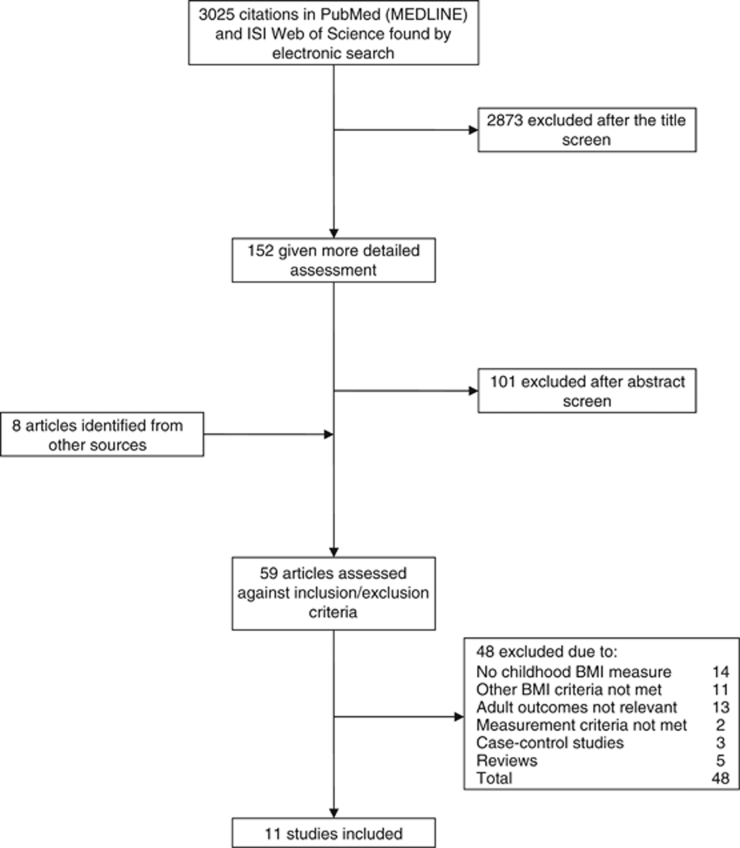
Electronic databases were searched from inception until July 2010 for studies investigating the association between childhood BMI and adult metabolic risk. Two investigators independently reviewed studies for eligibility according to the inclusion/exclusion criteria, extracted the data and assessed study quality using the Newcastle-Ottawa Scale.
The search process identified 11 articles that fulfilled the inclusion and exclusion criteria. Although several identified weak positive associations between childhood BMI and adult total cholesterol, low-density lipo protein-cholesterol, triglyceride and insulin concentrations, these associations were ameliorated or inversed when adjusted for adult BMI or body fatness. Of the four papers that considered metabolic syndrome as an end point, none showed evidence of an independent association with childhood obesity.
Little evidence was found to support the view that childhood obesity is an independent risk factor for adult blood lipid status, insulin levels, metabolic syndrome or type 2 diabetes. The majority of studies failed to adjust for adult BMI and therefore the associations observed may reflect the tracking of BMI across the lifespan. Interestingly, where adult BMI was adjusted for, the data showed a weak negative association between childhood BMI and metabolic variables, with those at the lower end of the BMI range in childhood, but obese during adulthood at particular risk.
虽然许多研究表明儿童肥胖与成人代谢风险之间存在正相关关系,但对于这种关系的性质仍存在一些重要问题。特别是,尚不清楚这些关联是否反映了从儿童期到成年期的体重指数(BMI)的追踪,还是独立的风险水平。本系统评价旨在调查儿童肥胖与成年后一系列代谢危险因素之间的关系。
进行无偏见的系统评价,以调查儿童 BMI 与成年后发生代谢疾病成分的风险之间的关联,以及观察到的关联是否独立于成人 BMI。
从创建到 2010 年 7 月,电子数据库搜索了研究儿童 BMI 与成人代谢风险之间关联的研究。两名调查员根据纳入/排除标准独立审查研究的资格,使用纽卡斯尔-渥太华量表提取数据并评估研究质量。
搜索过程确定了 11 篇符合纳入和排除标准的文章。尽管有几项研究发现儿童 BMI 与成人总胆固醇、低密度脂蛋白胆固醇、甘油三酯和胰岛素浓度之间存在微弱的正相关,但当调整为成人 BMI 或体脂时,这些关联得到改善或反转。在考虑代谢综合征作为终点的四篇论文中,没有一篇有证据表明与儿童肥胖有独立关联。
几乎没有证据支持儿童肥胖是成人血脂状况、胰岛素水平、代谢综合征或 2 型糖尿病的独立危险因素的观点。大多数研究未能调整成人 BMI,因此观察到的关联可能反映了一生中 BMI 的追踪。有趣的是,当调整成人 BMI 时,数据显示儿童 BMI 与代谢变量之间存在微弱的负相关,儿童期 BMI 处于较低范围的人,而成年期肥胖的人则处于特别危险的状态。