Laboratório de Imunopatologia, Instituto Butantan, São Paulo, Brazil.
BMC Genet. 2011 Nov 1;12:94. doi: 10.1186/1471-2156-12-94.
Snake venom metalloproteinases (SVMPs) are widely distributed in snake venoms and are versatile toxins, targeting many important elements involved in hemostasis, such as basement membrane proteins, clotting proteins, platelets, endothelial and inflammatory cells. The functional diversity of SVMPs is in part due to the structural organization of different combinations of catalytic, disintegrin, disintegrin-like and cysteine-rich domains, which categorizes SVMPs in 3 classes of precursor molecules (PI, PII and PIII) further divided in 11 subclasses, 6 of them belonging to PII group. This heterogeneity is currently correlated to genetic accelerated evolution and post-translational modifications.
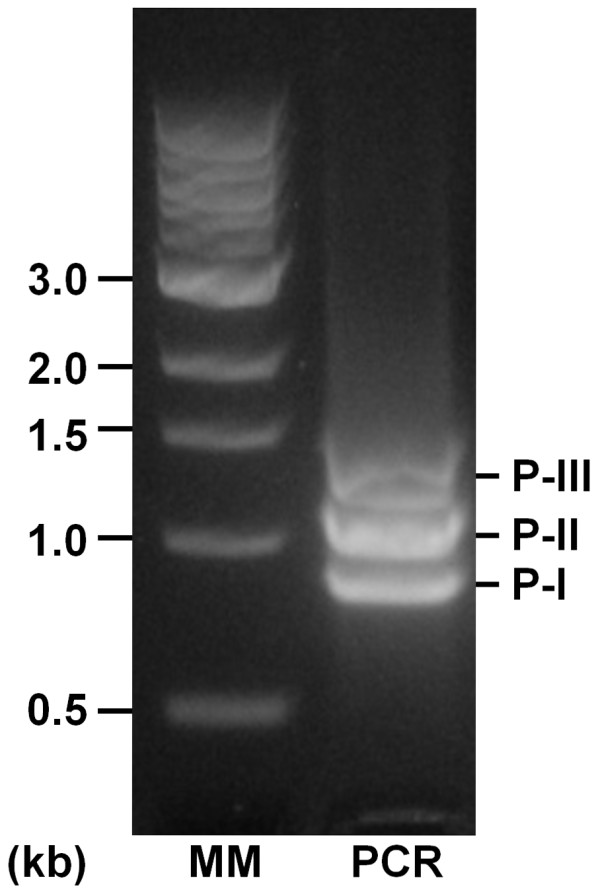
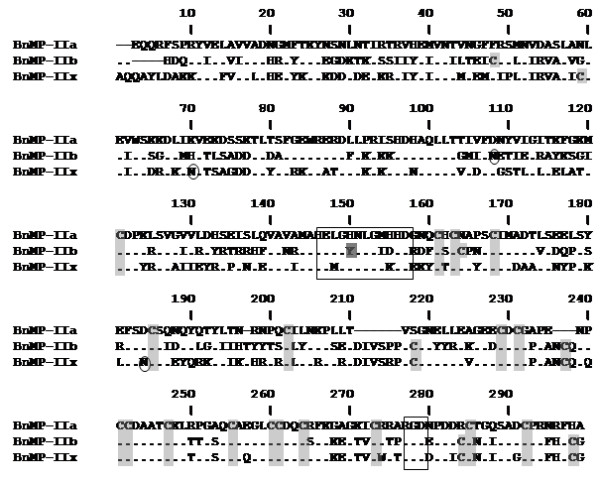
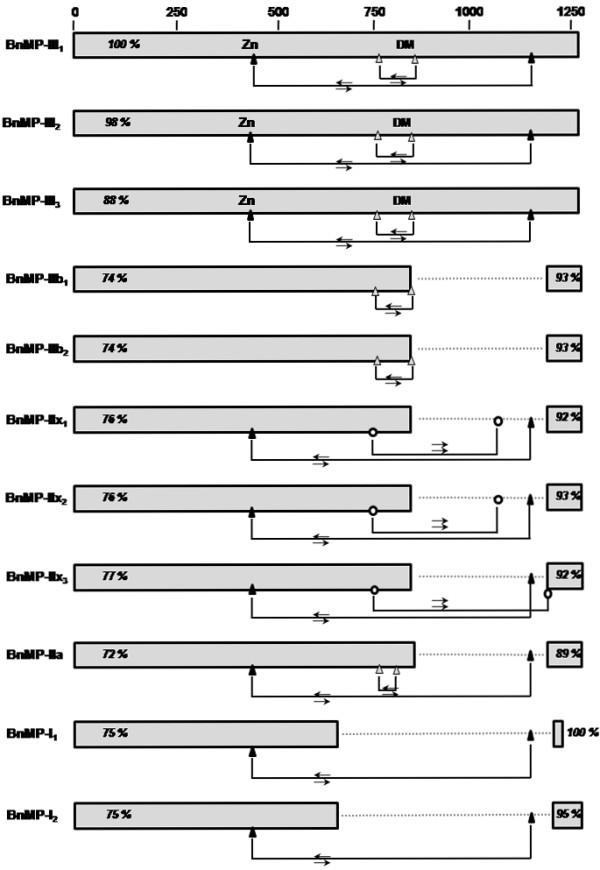
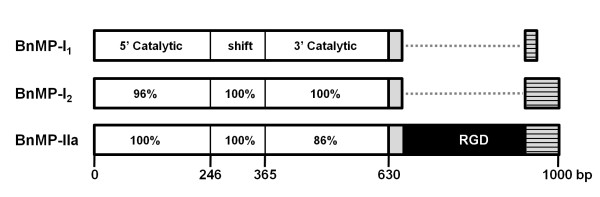
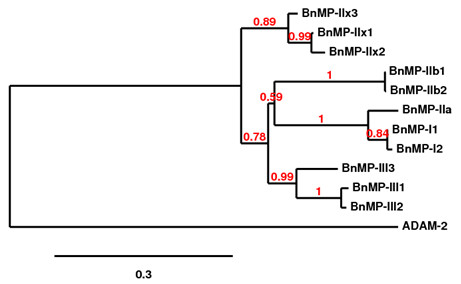
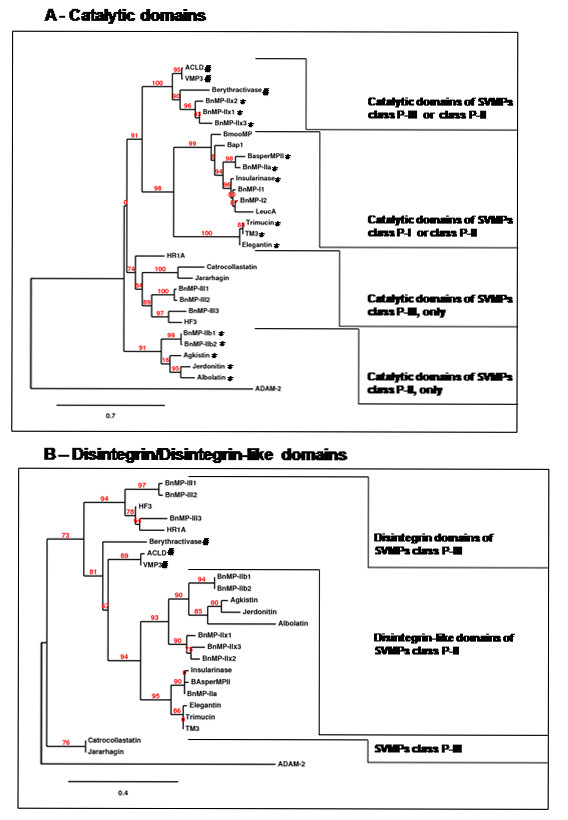
Thirty-one SVMP cDNAs were full length cloned from a single specimen of Bothrops neuwiedi snake, sequenced and grouped in eleven distinct sequences and further analyzed by cladistic analysis. Class P-I and class P-III sequences presented the expected tree topology for fibrinolytic and hemorrhagic SVMPs, respectively. In opposition, three distinct segregations were observed for class P-II sequences. P-IIb showed the typical segregation of class P-II SVMPs. However, P-IIa grouped with class P-I cDNAs presenting a 100% identity in the 365 bp at their 5' ends, suggesting post-transcription events for interclass recombination. In addition, catalytic domain of P-IIx sequences segregated with non-hemorrhagic class P-III SVMPs while their disintegrin domain grouped with other class P-II disintegrin domains suggesting independent evolution of catalytic and disintegrin domains. Complementary regions within cDNA sequences were noted and may participate in recombination either at DNA or RNA levels. Proteins predicted by these cDNAs show the main features of the correspondent classes of SVMP, but P-IIb and P-IIx included two additional cysteines cysteines at the C-termini of the disintegrin domains in positions not yet described.
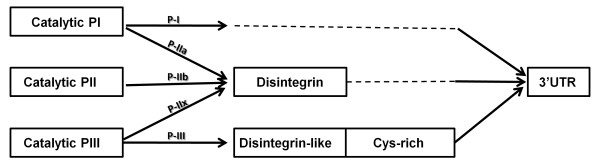
In B. neuwiedi venom gland, class P-II SVMPs were represented by three different types of transcripts that may have arisen by interclass recombination with P-I and P-III sequences after the divergence of the different classes of SVMPs. Our observations indicate that exon shuffling or post-transcriptional mechanisms may be driving these recombinations generating new functional possibilities for this complex group of snake toxins.
蛇毒金属蛋白酶(SVMPs)广泛分布于蛇毒中,是多功能毒素,靶向多种涉及止血的重要元素,如基底膜蛋白、凝血蛋白、血小板、内皮细胞和炎症细胞。SVMPs 的功能多样性部分归因于不同组合的催化、解整合素、解整合素样和富含半胱氨酸结构域的结构组织,这将 SVMPs 分为 3 类前体分子(PI、PII 和 PIII),进一步细分为 11 个亚类,其中 6 个属于 PII 组。这种异质性目前与遗传加速进化和翻译后修饰有关。
从一条新比氏布蛇的单个标本中克隆了 31 个全长 SVMP cDNA,对其进行测序并分为 11 个不同的序列,然后通过系统发育分析进一步分析。PI 类和 PIII 类序列分别呈现出纤维蛋白溶解和出血性 SVMPs 的预期树拓扑结构。相反,PII 类序列观察到三个不同的分离。PIIb 显示出典型的 PII 类 SVMP 分离。然而,PIIa 与 P-I 类 cDNA 聚在一起,在其 5' 端的 365bp 处具有 100%的同一性,提示转录后发生了类间重组。此外,P-IIx 序列的催化结构域与非出血性 PIII 类 SVMP 分离,而其解整合素结构域与其他 P-II 类解整合素结构域聚在一起,提示催化和解整合素结构域的独立进化。在 cDNA 序列内注意到互补区域,并且可以在 DNA 或 RNA 水平上参与重组。由这些 cDNA 预测的蛋白质显示出相应 SVMP 类别的主要特征,但 PIIb 和 PIIx 在解整合素结构域的 C 末端包含两个额外的半胱氨酸,位于尚未描述的位置。
在新比氏布蛇的毒腺中,PII 类 SVMPs 由三种不同类型的转录本组成,这些转录本可能是在不同 SVMP 类分化后,与 P-I 和 P-III 序列发生类间重组而产生的。我们的观察表明,外显子改组或转录后机制可能是驱动这些重组的原因,为这组复杂的蛇毒素产生新的功能可能性。