Department of Otolaryngology - Head and Neck Surgery, University of California San Francisco San Francisco, CA, USA.
Front Hum Neurosci. 2011 Oct 25;5:82. doi: 10.3389/fnhum.2011.00082. eCollection 2011.
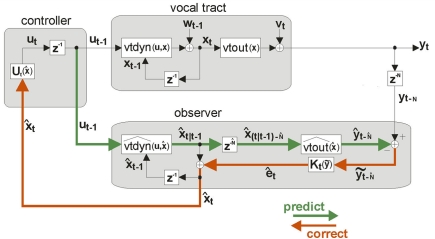
Spoken language exists because of a remarkable neural process. Inside a speaker's brain, an intended message gives rise to neural signals activating the muscles of the vocal tract. The process is remarkable because these muscles are activated in just the right way that the vocal tract produces sounds a listener understands as the intended message. What is the best approach to understanding the neural substrate of this crucial motor control process? One of the key recent modeling developments in neuroscience has been the use of state feedback control (SFC) theory to explain the role of the CNS in motor control. SFC postulates that the CNS controls motor output by (1) estimating the current dynamic state of the thing (e.g., arm) being controlled, and (2) generating controls based on this estimated state. SFC has successfully predicted a great range of non-speech motor phenomena, but as yet has not received attention in the speech motor control community. Here, we review some of the key characteristics of speech motor control and what they say about the role of the CNS in the process. We then discuss prior efforts to model the role of CNS in speech motor control, and argue that these models have inherent limitations - limitations that are overcome by an SFC model of speech motor control which we describe. We conclude by discussing a plausible neural substrate of our model.
口语的存在是由于一个显著的神经过程。在说话者的大脑中,一个意图的信息引发神经信号,激活声道的肌肉。这个过程之所以显著,是因为这些肌肉以正确的方式被激活,声道产生的声音被听众理解为意图的信息。理解这个关键运动控制过程的神经基质的最佳方法是什么?神经科学中最近的一个关键建模进展是使用状态反馈控制(SFC)理论来解释中枢神经系统在运动控制中的作用。SFC 假设,中枢神经系统通过(1)估计正在控制的物体(例如手臂)的当前动态状态,以及(2)基于此估计状态生成控制来控制电机输出。SFC 已经成功地预测了大量的非言语运动现象,但在言语运动控制领域尚未得到关注。在这里,我们回顾了言语运动控制的一些关键特征,以及它们对中枢神经系统在该过程中的作用的看法。然后,我们讨论了先前对中枢神经系统在言语运动控制中的作用进行建模的努力,并认为这些模型存在固有局限性-通过我们描述的言语运动控制的 SFC 模型可以克服这些局限性。最后,我们讨论了我们模型的一个合理的神经基质。